

Scientists have characterised liquid carbon for the first time, using a record-breaking laser that could hold the key to researching understudied materials

  • Creating liquid carbon summary slide index image

    Download this

    Use this story and the accompanying summary slide for a real-world context when studying bonding and the structures of carbon with your 14–16 learners.

    Download the story as MS Word or PDF and the summary slide as MS PowerPoint or PDF.

Researchers have successfully characterised liquid carbon in the lab using an ultra-powerful laser. The data obtained offers rare insight into one of the most abundant elements in the universe, which remains the least understood of the stable elements in its liquid form.

Unknown properties

Liquid carbon only forms under extreme temperatures and pressures, making it notoriously difficult to study. ‘The liquid phase requires pressures of at least several hundred atmospheres to form,’ says Dominik Kraus, a physicist from the University of Rostock in Germany, who led the study. 

Carbon also has the highest melting temperature of all materials under these conditions, meaning there is no known material that can contain it during lab analysis. 

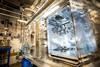
A technician in a white cleansuit makes adjustments inside a large piece of metal scientific equipment

Source: © Jan Hosan/European XFEL

The experiments used the High Energy Density instrument at the European XFEL facility near Hamburg, Germany

Without the ability to make liquid carbon in the lab, scientists are unable to study it, and its properties remain largely unknown. Liquid carbon forms transiently during the synthesis of some novel carbon materials, such as carbon nanotubes and nanodiamonds, and during nuclear fusion. Understanding carbon’s behaviour in liquid form will help scientists better understand these processes.

Scientists also believe that liquid carbon exists deep within the interiors of icy giant planets, such as Uranus and Neptune. ‘Studying liquid carbon [will help] model how carbon behaves deep within these planets,’ says Dominik. ‘It may undergo unusual changes that could affect a planet’s heat flow, magnetic field and overall structure.’

Going to extremes

Creating liquid carbon on Earth is no easy task. To achieve this, Dominik’s team used a record-breaking solid-state laser that a team at the Centre for Advanced Laser Technology and Applications (CALTA) in the UK developed. The researchers used the laser to create pressures exceeding one million atmospheres and temperatures of around 7000 K. This turned solid carbon into liquid form for a few nanoseconds – long enough to take a snapshots of the material using x-ray.

This is by far ‘the most detailed and informative data yet obtained for the liquid state of carbon,’ comments physical chemist Richard Saykally from the University of California, Berkeley, in the US, who was not part of the project team. The x-ray diffraction data closely aligns with predictions, he adds.

In solid diamond, each carbon atom is bonded to four others in a stable, fixed structure. When melted, researchers expected these bonds to break completely. But Dominik and his team found that the atoms in liquid carbon tended to stay near four neighbours. ‘It somewhat preserves remnants from the solid diamond structure,’ says Dominik.

The team now plans to expand its laser-based techniques to observe other understudied materials under extreme pressure and temperature.

This article is adapted from Victoria Corless’ in Chemistry World

Nina Notman

Reference

D Kraus et al, Nature, 2025, doi.org/10.1038/s41586-025-09035-6


Download this

Summary slide with questions and the article for context when teaching 14–16 lessons on bonding and the structure of carbon: rsc.li/45gjiZN