



Does new evidence supplant Volta’s battery as the first?
-
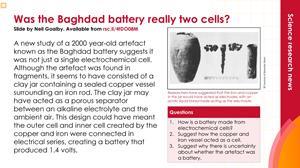
Download this
Use this story and the accompanying summary slide for a real-world context when studying metals and electrolytes with your 14–16 learners.
Download the story as MS Word or PDF and the summary slide as MS PowerPoint or PDF.
Most science historians believe the first working battery was built in 1800 by Italian scientist Alessandro Volta. Some archaeologists, however, believe this milestone was reached roughly 2000 years earlier by people living in a region of the Middle East now known as Iraq.
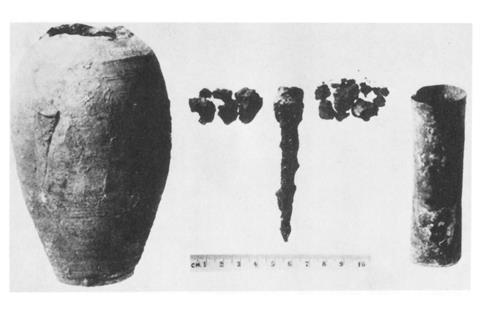
This theory is based on a clay jar that was discovered in 1936 during excavations a few miles from Baghdad. The jar, known as the Baghdad battery, is thought to date from between the 1st and 3rd centuries and was found in several fragments. It was on display in the National Museum of Iraq until it was lost during the US-led invasion of Iraq in 2003.
The jar seems to have consisted of a copper cylinder with a vertical iron rod inside. Archaeologists have proposed various theories about what it was used for, such as a storage vessel for sacred scrolls or medicinal herbs, or as an early form of electrochemical cell. Suggested uses for such a battery include electroplating gold or silver onto jewellery made of cheaper metals, for electrotherapy, or for religious rituals.
Recharging the theory
How did the battery work?
A battery requires two electrodes and an electrolyte. When in operation, electrons flow between these electrodes generating a voltage. It has been suggested that the iron and copper in the Baghdad battery were the electrodes and the electrolyte was an acidic liquid such as vinegar, lemon juice or wine (all of which were readily available at the time). There is corrosion on the iron rod which adds weight to the battery theory.
In previous attempts to recreate the Baghdad battery, extremely low currents were generated, casting doubt on the battery theory. Now, US-based independent researcher Alexander Bazes has tweaked the design to produce 1.4 V, a much higher voltage than previous reconstruction attempts have achieved.
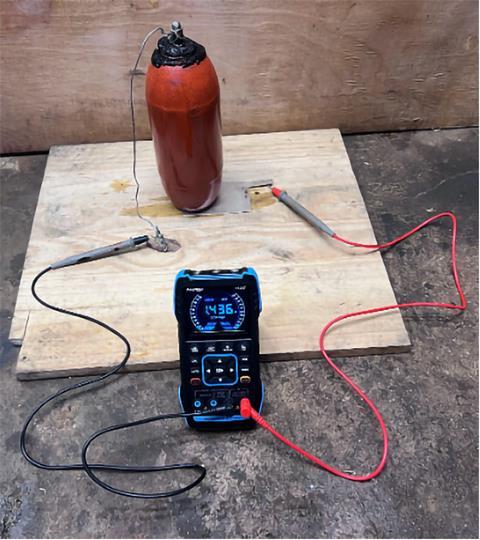
Alexander’s design has an inner section that matches previous reconstruction designs and an additional outer section that resembles the design of modern metal-air batteries. This outer section, he says in his journal paper published by Sino-Platonic Papers, significantly boosts the battery’s overall power.
We may never know for certain the purpose of the Baghdad battery, but this new reconstruction provides food for thought for the proponents of the battery theory.
More resources to galvanise your learners
- Help your 14–16 students master electrolysis with these teaching strategies.
- Investigate electrochemistry in the classroom using this microscale approach.
- Probe and improve your post-16 learners’ understanding of electrochemical cells with our misconception buster resource.
This article is adapted from Tom Metcalfe’s in Chemistry World.
Nina Notman
Reference
A Bazes, Sino-Platonic Papers, 2026, 377
Download this
Summary slide with questions and the article for context when teaching 14–16 lessons on metals and electrolytes: rsc.li/XX
Downloads
Baghdad battery student sheet
Handout | PDF, Size 0.17 mbBagdhad battery summary slide
Handout | PDF, Size 0.59 mbBaghdad battery student sheet
Editable handout | Word, Size 0.54 mbBaghdad battery summary slide
Editable handout | PowerPoint, Size 0.48 mb








No comments yet