


Genetically modified (GM) foods continue to generate media attention and concern among the public. This has presented a challenge to analytical chemists to provide valid data on whether or not foods have been genetically modified so that consumers can make informed choices.

Plants have been cultivated by Man for thousands of years. Crops would be selected for improved yields, growth or specific food characteristics, and as a result Man produced new varieties of plants faster than would have occurred in the natural environment. Genetic modification of crops represents Man's most recent attempt to breed new characteristics into crops. These include pest and disease resistance, increased herbicide tolerance, improved yield and quality, and drought/frost resistance.1 The term 'genetically modified' (GM) refers to the direct manipulation of an organism's DNA (deoxyribonucleic acid) by using modern biotechnology rather than by natural methods. Genetically modified food thus refers to any food product that contains materials derived from an organism that has been genetically modified. For food derived from GM crops, benefits can include increased shelf-life and improved nutritional content. Here we reflect on the concerns the public has with GM foods and what scientists and Government are doing to address these.
Consumer concerns
There are several perceived risks associated with GM food.
Environmental impact and biodiversity
Some people are concerned that inserted DNA from an engineered crop variety could escape and transfer into another plant, effectively generating 'super weeds'. A loss of biodiversity would potentially occur where the 'super weed' out competes other species or varieties of plants, subsequently affecting other organisms in the local ecosystem.
Potential methods to contain or stop the spread of genetically modified DNA in native 'wild' populations are being investigated. For example, genetic use restriction technology (GURT) involves rendering seeds from a particular plant sterile until sprayed with a chemical stimulus. Basically genetic modification of the transgenic plants' DNA ensures that the plant produces lethal proteins late in its development, which renders the seed sterile unless the chemical stimulus is applied.
While GURT has the potential to prevent gene flow of GM DNA into other plants, it has been criticised for exploiting poorer farmers whose livelihoods depend upon storage of viable seeds between crop sowings. If GURT is used farmers are forced to spend money to buy the chemical spray to ensure their seeds become fertile and can be planted during the next season.2 A further concern is that genetically modified crops which produce toxins may also affect beneficial insects either directly, or indirectly as they feed on the pest that has ingested the toxin.3 However, at present there is little evidence to support any negative impact GM crops might have on beneficial insect predators.
While some scientists express concern that GM crops could remove other crops from the environment because they have a selective advantage, others argue that biodiversity could be increased through the production of new varieties of crops or by reducing the need for destructive herbicides and pesticides. Biodiversity might, for example, be increased by producing crops capable of colonising in poor soils, or by re-introducing specific disease-resistance traits from extinct plant relatives housed in the world's gene banks (repositories used to store DNA sequence information).
Allergens, toxins and nutrient content
A further consumer concern is that GM food may result in the formation of new toxins and allergens. However, according to a report published by the Royal Society in 2002 on genetically modified plants for food products, there is no evidence that GM foods account for more allergic responses than conventionally-derived crops.4 Further, the report finds, there may be unpredictable changes regarding the nutritional status of GM food, but these changes can also occur through conventional breeding techniques and therefore do not constitute an additional health risk for GM foods.
Herbicides
A large proportion of current GM crops has been engineered to be more resistant to herbicides.1 This could affect the chemical spraying regimes applied to crops and may result in an increased use of herbicides. However, studies in the US have found that herbicide spraying has been reduced by up to 40 per cent in some areas following the introduction of GM crops because the latter require reduced amounts of herbicide to stay healthy.5 Additionally, in some rural parts of South Africa the introduction of GM cotton has given rise to a 90 per cent reduction in the costs of pesticides.6
Human health
There is some concern that GM food may have an unpredictable effect upon human health. Questions that need to be addressed here include: would people's own DNA become modified after ingesting GM food?; could novel proteins in the GM food cause harm to people?; what is the likelihood of transfer of, for example,
antibiotic resistance from a GM crop to humans? All these questions require a full risk assessment on a case by case basis of the specific DNA fragments in question and the proteins that they produce. However, what can be said is that the human digestive system breaks down most of the DNA ingested from consumed foods. Low molecular weight DNA may be taken into cells in the gastrointestinal tract, but again this is rapidly degraded in the cells.7 However, the risk of DNA entering the blood stream through viruses cannot be ignored. Researchers in the US and in France discovered that in a trial involving a retrovirus as a vector for the treatment for a genetic disease some patients developed the associated T-cell leukaemias. This suggests that DNA can enter the blood stream through viruses which are used as vehicles for the transport of genetically modified DNA.8
According to the Royal Society report,4 since the normal human diet is based largely on ingestion of DNA from food sources containing significant amounts of DNA from contaminating microbes and viruses, it is unlikely that the ingestion of GM foods will add significant risk to human health. Moreover, while it is unlikely that engineered DNA is transferred from GM food to bacterial gut-flora that reside in the human digestive tract,9 some scientists acknowledge that the positive identification of such gene transfer may be dependent upon the sampling and monitoring techniques used.10
To allow people to make their own decision on GM foods a systematic labelling scheme is being enforced. Current EU legislation stipulates that all products (including seed, bulk commodities, food items and animal feed) that contain GM material must be labelled as such when sold. To account for adventitious or accidental contamination, a minimum threshold of 0.9 per cent has been set for EU approved GM varieties, providing that every effort is made to exclude GM material from the product, and products that are below this limit do not need to be labelled. For non-EU approved plant varieties (those that are grown outside Europe, for instance) the limit is set at 0 per cent unless the variety has been given a favourable scientific review by the EU in which case it is 0.5 per cent. The credibility of this labelling scheme is, however, dependent upon the reliability, efficiency and confidence we have in detecting genetic modification at the molecular level.
Detecting GM foods
To detect whether or not a food is a GM product, analytical methods focus on the protein or metabolites produced by the DNA modification, or the modified DNA itself.
Protein detection
Protein-based methods commonly use antibodies coupled to an enzyme to catalyse colour production to indicate a positive. However, these methods are limited to less processed food products because proteins degrade and denature on processing, making them less easily detected by antibodies. In addition, there is a lack of appropriate antibodies for the range of target proteins available and some of these proteins are not produced to the same degree in all of the tissues in a particular crop, especially those tissues that are used in a food product. However, protein-based methods are still useful for screening raw ingredients for the presence of GM material.
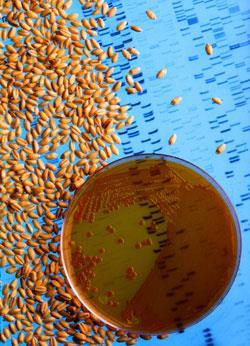
DNA detection
This method has the advantage over protein-based methods because DNA is more resistant to degradation during food processing. The method is therefore widely used to analyse raw, cooked and processed samples. Copies of the target DNA sequence will be present throughout the plant tissues used for food production and there is some choice over which parts of the DNA are targeted. The introduced DNA fragments can be targeted because these identify the difference between the GM crop and the unmodified variety. In any genetically modified plant there will be several of these that may be used, the choice of which determines the specificity of the test result. These may range from using DNA fragments that control the GM gene (low specificity tests), to event-specific methods that target the junction sequence between the new DNA elements and the site of insertion into the plant genome (high specificity tests).11
Method
The first step involves extracting pure DNA from the food product, in sufficient amounts to allow subsequent analysis.12 At present, it is not possible to detect the individual target DNA molecules in a GM source, so researchers make use of the polymerase chain reaction (PCR) to amplify the target sequence to a concentration at which it can be detected. This involves synthesising short DNA fragments (primers) that bind to complementary sequences at either end of the target region in the extracted DNA sample. An enzyme, Taq polymerase, then rapidly synthesises the intervening DNA sequence between the two primers to create a new DNA strand. This process is repeated 20-40 times, giving an exponential doubling of the amount of new DNA with each cycle, to obtain millions of copies of the specific target sequence by the end of the reaction.
The products of the PCR process are detected at the end of the reaction by using gel electrophoresis or real-time PCR. The latter method involves measuring the amount of PCR product formed using fluorescent dyes that bind to new DNA molecules. Thus, there is a net accumulation of fluorescent signal over a set number of cyclical reactions. This accumulation is proportional to the amount of PCR product formed, and thus to the original amount of target analyte.13
The detection of two gene targets is typically used for quantitative GM evaluation. One measures the amount of GM target present while another, the total amount of starting material present from both GM and non-GM material by detecting a species-specific gene (the 'reference gene') that has not been genetically modified. The latter will therefore be present in both modified and unmodified crops of the same species. The ratio of the signal produced by the GM gene assay to that of the reference assay is calculated to give the amount of GM material present in relation to the total amount of material present from the crop species (both GM and non-GM). Legislation in the EU is based upon ingredients and therefore requires that the amount of GM material is determined as a proportion of the total ingredient, rather than as a proportion of the total food product.

And finally...
Some people in the UK choose not to buy GM produce because there is still confusion regarding the development and use of GM foods in the UK, while others feel that they are not in a position to assess objectively the information relating to GM food.14 One potential way of addressing these aspects is to improve communication between all stakeholders involved in GM food so that all parties know the facts and issues. This is being addressed within the UK by the Food Standards Agency15 which acts as a source of independent information relating to GM food.
The monitoring associated with the development of GM crops has gathered importance in recent years. EU directives enforce regulation regarding laboratory research work on GM plants and the labelling and traceability of resulting foodstuffs that may contain GM ingredients. Within the UK, the Food Safety Act states that food must be fit for consumption and free from contamination, and strict regulations govern the labelling and traceability associated with GM ingredients in food products. Ultimately, communication and elaboration of these guidelines may increase confidence in the public's perception of GM crops. The acceptance or rejection of GM Food in the UK may lie with the reliability of the regulatory process, which itself is linked to the confidence associated with the molecular techniques used to determine the amount of GM ingredient in a food product.
Dr Malcolm Burns is the biostatistician in the Bio-Molecular Innovation Group, and Dr Neil Harris is Bioanalysis New Business team leader at LGC Limited, Queens Road, Teddington, Middlesex TW11 OLY.
Related Links
Genetically Modified crops
The Royal Society
The independent scientific academy of the UK dedicated to promoting excellence in science
Royal Society Policy statements and reports
Genetically modified plants for food use and human health - an update
foodfuture
Facts and figures about genetically modified (GM) crops and foods
Food Standards Agency
Set up to protect the public's health and consumer interests in relation to food
References
1. C. James, Global status of commercialised transgenic crops. ISAAA briefs no 21: Preview. ISAA: Ithaca, NY, 2000.
2. Nuffield Council on Bioethics report
3. S. Downes, Outlooks on pest-management, 2004, 15, 284.
4. Royal Society report
5. R. T. Bessin and D. F. Hildebrand, Agricultural biotechnology and the environment. College of agriculture, University of Kentucky: Cooperative Extension service, 2000.
6. foodfuture
7. R. Einspanier et al, Eur. Food Res. Technol., 2001, 212, 2.
8. J. Kaiser, Science, 2003, 299, 991.
9. M. Stanhope et al, Nature (London), 2001, 411, 940.
10. K. Nielsen and J. Townsend, Nature Biotechnol., 2004, 22, 1110.
11. A. Holst-Jensen et al, Anal. Bioanal. Chem., 2003, 375, 985.
12. C. F. Terry, N. Harris and H. C. Parkes, J. AOAC Internat., 2002, 85, 768.
13. D. Grove, J. Biomol. Tech., 1999, 10, 11.
14. Nuffield Council on Bioethics report
15. Food Standards Agency






No comments yet