

Investigating activation energies
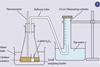
A challenge for post-16 students to investigate the activation energies of the enzyme-catalysed and the inorganic-catalysed decomposition of hydrogen peroxide
In our discussions with secondary school teachers in Hong Kong we are told that students, aged 16-17, generally find it difficult to plan their own experiments to determine activation energies for reactions. To address this problem we have devised a laboratory-based investigation which challenges students to compare the activation energies for the catalase-catalysed and iodide-catalysed decomposition of hydrogen peroxide. This investigation should also help them to understand the different effects of biological and inorganic catalysts on activation energy. To make the investigation more authentic, simulating the work of a biochemist for example, students extract catalase from a natural source, in this case lettuce leaves. Our trials demonstrated that lettuce produces a suitable concentration of catalase for this kind of investigation.
Make your lessons pop
Choose an account option to continue exploring our full range of articles and teaching resources