


As digital assessment becomes more likely, explore the benefits and challenges for students and teachers
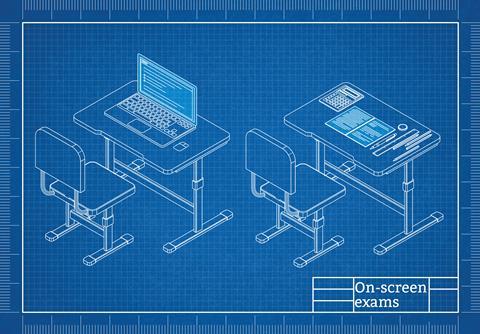
Ask any chemistry teacher what they think about on-screen assessment (OSA), and you’ll likely get a reaction somewhere between cautious optimism and mild panic. So, is the shift to digital exams a genuine opportunity, or are there other drivers at play?
Why the push for a digital overhaul?
The pressure to go digital is real. AQA’s chief executive has argued that not introducing on-screen exams would be ‘a disservice to young people’, given the digital world most will work in. Ofqual and the DfE’s three-year joint research project identified genuine potential, and Ofqual’s proposed approach is measured: no personal devices, a cap on high-entry subjects and rigorous accreditation requirements. Pen and paper stay for now.
There is something genuinely exciting in the possibilities. On-screen assessment could open the door to faster marking, instant results and a smaller mountain of paper crates. Accessibility could help level the playing field for students with additional needs. Helen Scally, head of chemistry at Turnbull High School, feels hopeful that going digital will ‘work well with PISA assessments, particularly when using simulations to assess inquiry’.
Cambridge International Education launched digital examinations in June 2026, marking the start of a planned implementation across its full IGCSE, AS and A-level curriculums.
Why the change?
The pressure to go digital is real. AQA’s chief executive has argued that not introducing on-screen exams would be ‘a disservice to young people’, given the digital world most will work in. Ofqual and the DfE’s three-year joint research project identified genuine potential, and Ofqual’s proposed approach is measured: no personal devices, a cap on high-entry subjects and rigorous accreditation requirements (bit.ly/4vrJ0EM). Pen and paper stay for now.
There is something genuinely exciting in the possibilities. On-screen assessment could open the door to faster marking, instant results and a smaller mountain of paper crates. Accessibility could level the field for students with additional needs. Helen Scally, head of chemistry at Turnbull High School, feels hopeful that going digital will ‘work well with PISA assessments, particularly when using simulations to assess inquiry’.
Cambridge International Education launched digital examinations in June 2026, marking the start of a planned implementation across its full IGCSE, AS and A-level curriculums.
Does the medium change the message?
Daisy Christodoulou, director of education at No More Marking, gets to the heart of it: ‘Moving test content from paper to screen isn’t a neutral change. It changes the way students interact with content and will also affect classroom practice. Everyone tends to skim and scan more on screen, so we need to consider if that is what we want to encourage in our education system.’
Her concern is well founded. Government research shows persistent mode effects – the ways different questioning methods create differences in results – mean students respond differently to identical questions depending on how they are presented.
What about the environment?
It’s also worth considering the environmental case. Ofqual’s own carbon footprint research found that the largest contributors to a paper exam’s footprint are not the paper itself but travel. However, with device manufacture carrying a carbon cost of 100 to 200 kg of CO2 per unit, scaling up for national on-screen assessment is far from carbon neutral.
The environment
It’s also worth considering the environmental case. Ofqual’s own carbon footprint research found that the largest contributors to a paper exam’s footprint are not the paper itself but travel (bit.ly/44OhJ4a). However, with device manufacture carrying a carbon cost of 100 to 200 kg of CO2 per unit, scaling up for national on-screen assessment is far from carbon neutral.
The subject-specific problem
Here, not only do the concerns multiply but chemistry teachers independently raise similar issues.
Making mistakes is fundamental to learning, explains head of science Joel Kenyon. ‘Science is learnt through trial and error. Students work through chemical equations, chemical bonding structures and atomic formulae without immediately being at the right answer. Instead, they write, check their errors, notice patterns and conclude the correct answer. Using a computer assumes students know without trial and error. That’s not how science works.’
On-screen exams could also affect working memory and cognitive load – an issue on which there was striking consensus. Colin McGill, associate professor of teacher education, warns that ‘the government’s research shows some students perform more poorly when taking an assessment on screen – especially in heavily worded contexts such as English exams’. He goes on to state that this is ‘before we even think about the added difficulties of communicating chemistry concepts on a screen, e.g. equations, subscripts and superscripts, curly arrows and structures’.
Saunia Hussain, science teacher and chemistry curriculum coordinator, echoes this notion: ‘Introducing a digital format in final exams could add unnecessary cognitive load. There is a real risk of assessing digital navigation skills as much as, or more than, their chemistry understanding.’
The added cognitive load of digital formats, according to principal examiner Matthew Parks, ‘may reduce students’ ability to clearly communicate what they know under exam pressure, particularly when processing and structuring numerical thinking’. Assessing chemistry also introduces new challenges, with head of chemistry Matthew Gundry believing that any tools used for drawing organic structures would ‘give too much away and would therefore not be able to be used as effective assessments’.
William Fenton, head of chemistry, notes that ‘students slow down when having to deal with the software’. Though, as head of chemistry Neil Goalby acknowledges, while a tablet and stylus could in theory address some of these problems, he also notes that ‘many current exam questions could not be asked, and we would lose the ability to test certain important skills’. He instead suggests that ‘a hybrid approach is best’.
The core concerns
Chemistry teachers independently raise similar issues with the potential rollout.
Daisy Christodoulou, director of education at No More Marking, gets to the heart of it: ‘Moving test content from paper to screen isn’t a neutral change. It changes the way students interact with content and will also affect classroom practice.’
On-screen exams could also affect working memory and cognitive load – an issue on which there was striking consensus (rsc.li/4fnuysl). Colin McGill, associate professor of teacher education, warns that ‘the government’s research shows some students perform more poorly when taking an assessment on screen – especially in heavily worded contexts such as English exams’. He goes on to state that this is ’before we even think about the added difficulties of communicating chemistry concepts on a screen, e.g. equations, subscripts and superscripts, curly arrows and structures’.
Assessing chemistry introduces new challenges, with head of chemistry Matthew Gundry believing that any tools used for drawing organic structures would ‘give too much away and would therefore not be able to be used as effective assessments’.
Neil Goalby, head of chemistry, envisages a middle ground, suggesting that ‘a hybrid approach is best’.
Matthew Parks, principal examiner, believes that the added cognitive load of digital formats, ‘particularly when processing and structuring numerical thinking, may reduce students’ ability to clearly communicate what they know under exam pressure’.
Saunia Hussain, science teacher and chemistry curriculum coordinator, agrees: ‘There is a real risk of assessing digital navigation skills as much as, or more than, their chemistry understanding.’
The Swedish walkback
Sweden went further than almost any other country with classroom digitalisation and is now pulling back. It is investing more than £200 million to return printed textbooks to classrooms after OECD PISA data confirmed that access alone does not improve learning and had small negative effects in maths among students from less academic backgrounds.
Tech availability issues
A stark practical reality compounds these pedagogical concerns. The DfE’s Technology in schools survey (2025) found that, while 95% of secondary schools reported having laptops available, 77% said they were available to fewer than half of students at any one time. Ofqual has also acknowledged the very real risks of cybersecurity threats, technical failures and new forms of malpractice with increased technology usage.
However, for school teacher fellow Nick Barker, it’s the equity dimension that cuts particularly deep. ‘This technology is likely to increase social disparity. The least advantaged children thrive on positive human connections with adults who know them, believe in them and want to encourage them. There is no IT interface that can provide that.’
For SEND students, the picture is equally mixed. Ofqual’s own research acknowledges digital exams could benefit some learners with SEND through built-in accessibility tools. Yet research from CALL Scotland (2025) found that students with dyslexic traits who had developed effective assistive technology skills on their school devices could not transfer those skills to exam settings.
Availability issues
A stark practical reality compounds these pedagogical concerns. The DfE’s Technology in schools survey (2025) found that, while 95% of secondary schools reported having laptops available, 77% said they were available to fewer than half of students at any one time (bit.ly/4f3FbiC). Ofqual has also acknowledged the very real risks of cybersecurity threats, technical failures and new forms of malpractice with increased technology usage.
However, for school teacher fellow Nick Barker, it’s the equity dimension that cuts particularly deep. ‘This technology is likely to increase social disparity. The least advantaged children thrive on positive human connections with adults who know them, believe in them and want to encourage them (rsc.li/4aILMOm). There is no IT interface that can provide that.’
For SEND students, the picture is equally mixed. Ofqual’s own research acknowledges digital exams could benefit some learners with SEND through built-in accessibility tools. Yet research from CALL Scotland (2025) found that students with dyslexic traits who had developed effective assistive technology skills on their school devices could not transfer those skills to exam settings (bit.ly/44QNZ6O).
More resources
- Read the RSC’s policy position on Addressing the digital skills gap in UK chemistry education.
- Identify the advantages and disadvantages of tablets in teaching for more information on how digitisation impacts learning and assessment.
- Discover strategies for being an inclusive science teacher with research-informed tips.
- Incorporate different techniques to improve assessment accessibility for multilingual learners.
So where does that leave us?
The picture is not uniformly bleak. Students who struggle with handwriting, those with physical disabilities and some learners with SEND could benefit significantly. Faster results and reduced marking burdens are not trivial, either. Students will benefit equitably only if the transition is handled with care: ensuring exam devices match those students use day to day, investing in infrastructure before rollout, gathering robust evidence on disadvantaged students first – as the EEF has urged – and listening to teachers and examiners in the room.
If the assessment cannot yet capture the visual language of the subject, it is not ready to replace the exam it claims to replicate. Examiners are often practitioners who bring what they learn back into their classrooms. If automated marking quietly replaces them, something valuable disappears from the profession without anyone quite deciding to remove it. As Daisy Christodoulou observes, there may be no solutions here, only trade-offs. The goal, as Swedish researchers now put it, should be recalibration rather than reversal. The UK would do well to hold that thought.
The picture is not uniform. Learners who struggle with handwriting, those with physical disabilities, and some with SEND could benefit significantly from digital tools. Faster results and reduced marking burdens are not trivial gains, either. But benefits will only be realised equitably if the transition is handled with care: ensuring exam devices match those learners use day to day, investing in infrastructure before rollout and gathering robust evidence on the impact for disadvantaged pupils first. Above all, listen to those at the chalk face. If OSA cannot yet capture the visual language of chemistry, it is not ready to replace the written exam it claims to replicate.
Are you already navigating on-screen assessment in your school, or dreading its arrival? We would love to hear your stories. Email education@rsc.org with the subject line EiC Tech talk.
More resources
- Read the RSC’s policy position on addressing the digital skills gap in UK chemistry education: rsc.li/4btuaGi.
- Identify the advantages and disadvantages of tablets in teaching for more information on how digitisation impacts learning and assessment: rsc.li/3R3p8tk.
- Discover strategies for being an inclusive science teacher with research-informed tips: rsc.li/4p5Q9sN.
- Incorporate different techniques to improve assessment accessibility for multilingual learners: rsc.li/4gXp5cX.
Wendy Winnard

Topics
Tech talk
From overhead projectors to AI, our new series explores educational technology and how teachers are using it to their advantage
- 1
 Currently
reading
Currently
reading
Accessibility advantage or digital disadvantage?
- 3
- 4
- 5
- 6







No comments yet