


From contrails to cabin food, challenge the myths and explore the chemistry behind everyday aeroplane mysteries
We’ve all seen the lines left behind by aeroplanes when they fly overhead. Some people believe hoaxes and conspiracies claiming they are evidence of chemicals being dropped in our atmosphere. The truth, however, is far more interesting: it’s all to do with the chemistry of water.
How contrails form
Vapour trails and tall tales
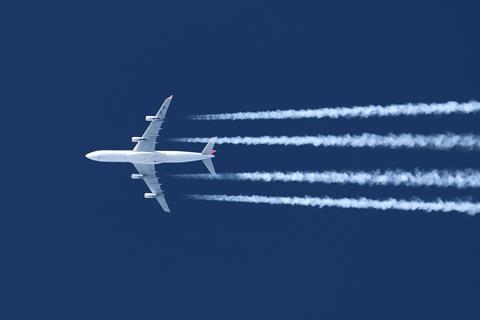
The white streaks left behind by aeroplanes are known as contrails – short for condensation trails. Just like cars, aeroplane engines produce exhaust gases, mostly composed of carbon dioxide and water, with a few other waste particles such as soot (carbon) and sulfur. At a plane’s cruising altitude (7620–13,000 m), the air temperature is very cold (at least -35°C). This temperature difference means that the hot water emerging from the engine condenses around some of the solid waste particles, creating visible water droplets in the air. This is the same reason a car’s exhaust fumes can be seen on chilly, wintry days, just on a much larger, jet-sized scale. The result is a clear, visible line that we can see on the ground more than six miles below.
So, if it’s to do with cold, why is it that we usually see contrails on clear, sunny days rather than in the winter? In dry air, such as in wintery conditions, contrails quickly vanish because the ice crystals undergo sublimation – turning from a solid straight into a gas – and the water vapour disperses. But if the air is humid, these crystals remain, meaning that the contrails can last for much longer. Air currents and wind can make these contrails spread, sometimes growing to several miles wide and creating unusual cloud formations that can drift far away from where they were created. In fact, studies have shown that the number of thin, wispy cirrus clouds over the United States increased by 3 per cent between 1971 and 1995, probably due to air traffic.
It’s a total myth that anyone has ever been sucked down a plane toilet
So, if it’s to do with cold, why is it that we usually see contrails on clear, sunny days rather than in the winter? In dry air, such as in wintery conditions, contrails quickly vanish because the ice crystals undergo sublimation – turning from a solid straight into a gas – and the water vapour disperses. But if the air is humid, these crystals remain, meaning that the contrails can last for much longer. Air currents and wind can make these contrails spread, sometimes growing to several miles wide and creating unusual cloud formations that can drift far away from where they were created. In fact, studies have shown that the number of cirrus (thin, wispy) clouds over the United States increased by 3 per cent between 1971 and 1995, probably due to air traffic (bit.ly/43aHTxn).
How suction toilets use pressure
The loo with a view
The contrails left by aeroplanes are just the start of their fascinating chemistry – and some other notorious myths. For example, you might have heard that if you do a poo in an aeroplane, it flies out of the bottom as blue ice: waste combined with blue disinfectant that freezes as it falls out of the plane. While this happened a few times in older planes, it was never deliberate (airlines aren’t allowed to throw out poo mid-air).
Today, planes take a different approach. When someone uses the toilet on a plane, the waste is sucked into a sealed holding tank using a vacuum system. On the ground this is powered electronically, but once a plane is at high altitude, the system uses the difference between the cabin’s pressure and the outside air to create suction – which is why an aeroplane’s toilet gets noisier the higher it flies. And, once again, it’s a total myth that anyone has ever been sucked down a plane toilet; that could only happen with a perfect seal, meaning the person would need a very oddly shaped bottom.
How altitude affects taste
Taste at high altitude
The way the changes in pressure alter chemistry in planes don’t end there. For example, if you were to eat aeroplane food on the ground, you’d probably think it tastes disgusting: it would be far too salty. This is because it’s designed for high altitude eating.
Most of the way we taste food is actually through smell. The combination of a plane’s cabin pressure, which is lower than sea level, and 12 per cent humidity, which is drier than a desert, dries out the mucus membranes in our noses, making it harder for us to detect sweet and salt flavours. The hum of an aeroplane’s engines has also been shown to reduce our sensitivity to sweetness and saltiness. As a result, airlines have chefs ramp up the sweetness and saltiness in the food on offer, or design menus that rely on other types of flavour.
So there you have it. Next time you see a vapour trail, tuck into a delicious meal on a long-haul flight, or make use of an aeroplane toilet, remember that it’s all about chemistry, not conspiracy.
@royalsocietyofchemistry Ever wondered if plane toilets really "dump" everything at 30,000 feet? 🚽🧻 Let's bust that myth and reveal what actually happens in the cabin loo! Ross also explains why aeroplane food tastes so.....odd 🍽️✈️ #learnontiktok #chemistry #sciencetok ♬ Summer Vibes - GRLN
Kit Chapman
Explane how air pressure makes suction toilets work and food taste funny: bit.ly/4grGV7A







1 Reader's comment