



From ammonia to pheromones, there’s more chemistry in cat wee than you might think
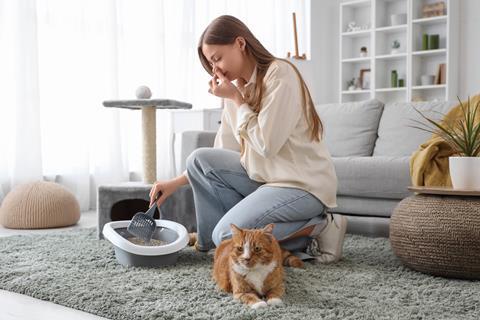
Even if you’re a cat lover, there’s almost certainly one thing you don’t adore about your feline chum – that their urine absolutely stinks. Is it something you’re feeding them or is it not your fault?
How cats evolved
The evolution of the moggy
Cat urine stinks because of how cats evolved. Although most domestic cats are content to lay in front of the fire, inside any cardboard box they find or on the lap of someone who was just about to get up,they all descend from the African wildcat, Felis silvestris lybica, a species adapted to desert environments.
Around 10,000 years ago, these clever kitties became domesticated but kept many of the traits they evolved to survive in the desert. These include hunting nocturnally, not drinking as much as other animals and being comfortable in hot temperatures.
Highly concentrated
Highly concentrated urine
This ancestry means a cat’s kidneys are incredibly efficient and produce urine that is far more concentrated than a human’s. Urine contains urea, CO(NH2)2. Inside the body, urea helps remove ammonia, NH3, a waste product produced when proteins are broken down. Once outside the body, this urea is broken down again by bacteria into ammonia, a pungent gas that causes the distinctive wee smell. (Ammonia is actually incredibly useful. It’s used as in fertilisers and, as a base, it used to be prized as a bleaching agent to make robes white.)
Cats also release hormones in their urine, which is why they often have less whiffy wee once they’ve been spayed or neutered
This high concentration means that cat pee also causes a second smell if it isn’t cleaned up quickly. Cat urine contains felinine, an amino acid that breaks down into 3-Mercapto-3-methylbutan-1-ol (MMB) and the pheromones that a cat uses to mark their territory. While pheromones are obviously useful for the cat, MMB has a distinctive odour that’s often described as similar to cooked leeks. MMB is found in some foods, such as white wines and coffee; but because it is so concentrated in cat urine, this roasty smell can become unpleasant. And it’s not just the concentration that can cause an odour – cats also release hormones in their urine, which is why they often have less whiffy wee once they’ve been spayed or neutered.
So, if cat pee reeks because it’s highly concentrated, what’s the best way to use chemistry to get rid of the smell? While the best way to neutralise odours is an enzyme-based cleaner, you can also go after the ammonia itself. As ammonia is a base, you can neutralise it by mixing one-part white vinegar and one-part water, creating a slightly acidic cleaner that will quickly get rid of the smell.
Lovely litter
Train your cat to use a litter box
What you really want to do is convince your feline friend to use a litter tray. Cat litter is a mix of sand and clay. These materials are absorbent: sand crystals (silicon dioxide) are highly porous, so soak up the urine, while clay clumps, trapping the moisture inside.
Cat litter also uses another trick. It contains additives such as activated charcoal or sodium bicarbonate. These are adsorbent, forming chemical bonds with the odour-causing molecules, such as ammonia, trapping them on the surface. This means there’s no ammonia gas for your nostrils to detect, and therefore no stinky smells.
Cat litter is so good at its job, it’s used in some surprising ways. Hospital pharmacies around the world often have a supply of cat litter on hand in case they need to quickly soak up spills of a potentially dangerous medicine or destroy controlled drugs such as morphine. As they can’t just throw away these very addictive medicines, as someone might steal them, pharmacists will often mix the drugs into cat litter before transporting them for incineration.
Kit Chapman
Know what doesn’t stink? This TikTok:










No comments yet