



Discover the chemistry that helped the Ancient Egyptians talk to the gods, lets curators spot forgeries and that may have killed Napoleon
The idea of painting things goes back to prehistory: drawing on walls is one of the most enduring legacies of early humans in the Stone Age. These early artists used a range of different pigments to create their drawings, for example by using rocks such as hematite for red and calcite for white. Cave painters would mix these pigments with animal fat, then smear them on the wall.
Blue hues
The deadly ingredients of early paints
The first synthetic paint colour was blue and was made in Ancient Egypt in around 3250BC. The Ancient Egyptians believed that they could talk directly to their gods through statues, but struggled to find a cheap alternative for lapis lazuli, a rare blue stone that represented the gods’ hair.
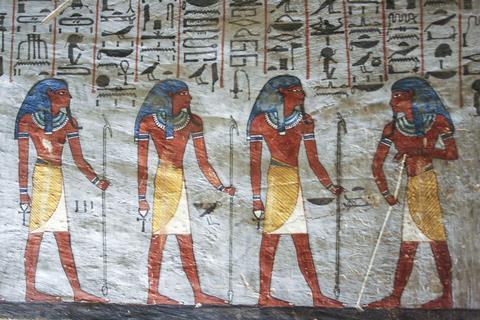
Fortunately, the Egyptians knew that copper creates a blue colour when it oxidises on exposure to air to form a verdigris. They then mixed this verdigris with glass, made from the desert sand. Sand consists of a huge, interlinked crystal network of silicon dioxide; the Egyptians would create glass in thin layers, with the blue copper trapped in the silicon dioxide web, then grind it up into powder. The result was calcium copper silicate, Egyptian blue, a bright blue pigment that can still be seen in the tombs of the pharaohs buried in the Valley of the Kings near Luxor.
Egyptian blue was only the first of thousands of paints that emerged, many of which contained deadly ingredients. In the Islamic Golden Age, painters used mercury sulfide to create reds, whereas in the 19th century, one of the most popular colours, Scheele’s green, contained arsenic and gave off deadly fumes if it got wet. Indeed, there’s some evidence that Napoleon’s green walls may have contributed to his demise (bit.ly/4dVmQWn).
Egyptian blue was only the first of thousands of paints that emerged, many of which contained deadly ingredients. In the Islamic Golden Age, painters used mercury sulfide to create reds, while in the 19th century, one of the most popular colours, Scheele’s green, contained arsenic and gave off deadly fumes if it got wet. Indeed, there’s some evidence that Napoleon’s green walls may have contributed to his demise.
Safer paints, more vibrant colours
Safer shades
Today, we use safer, less toxic alternatives. Reds are usually made from calcium sulfide, blues from copper phthalocyanine and greens from chromium oxide. These modern versions create more vibrant, long-lasting colours – and can even be used to detect forgeries.
One of the most famous pigments in the early 19th century, used by artists such as J M W Turner, was Indian yellow. Indian yellow was made from the urine of cows given a specific diet and is rich in euxanthic acid. Today, Indian yellow is no longer produced, so art forgers use tartrazine, the nearest equivalent. Although tartrazine might fool your eye, it can’t fool a chemical detector. Indian yellow glows strongly under ultraviolet light, whereas tartrazine only glows faintly, which means curators can quickly check to see if a painting in a gallery is the original.
Painting by polymers
Paint’s polymer problem
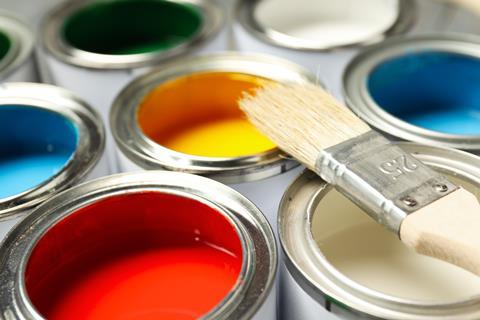
Modern paint isn’t just about the colours. There are a host of different types of paint depending on what you need it for. Water-based paints work by evaporation, which deposits the pigment onto the object that you are painting, while oil-based paints oxidise in air, meaning they harden to create a thick, tough coating.
Acrylic paints are different again. As the water from acrylic paint evaporates, the pigments become trapped in the latex (long-chain polymers) in the mixture that remains on the object’s surface. This is incredibly useful, as the polymers make the paint durable and water resistant.
The problem is that unused paint in tins is a huge waste of plastic. The Royal Society of Chemistry estimates that every year, there’s enough leftover polymers in liquids such as paint to fill Wembley Stadium 32 times. This is why it’s important to recycle your unwanted paint rather than let it go to landfill, so that it can be used and cut down on this invisible source of plastics waste.
Watch this TikTok – better than watching paint dry:
@royalsocietyofchemistry Humans have been making paint since the stone age 🪨🎨 From ancient Egyptian blue made with copper and glass to paints so toxic they may have killed emperors 💀, to solving crimes with glowing pigments under UV ligh, even a famous colour made from poo 💩 and a modern problem the size of 32 Wembley stadiums 😱 Ross shows us 5 paint facts all while making his own natural paints! #learnontiktok #chemistry #painting ♬ 纸飞机 ART ATTACK - Opensound
The problem is that unused paint in tins is a huge waste of plastic. The Royal Society of Chemistry estimates that every year, there’s enough leftover polymers in liquids such as paint to fill Wembley Stadium 32 times (bit.ly/4cxYKQ7). This is why it’s important to recycle your unwanted paint rather than let it go to landfill, so that it can be used to cut down on this invisible source of plastics waste.
Kit Chapman
Watch this TikTok – better than watching paint dry: bit.ly/4vq3m2p










1 Reader's comment