

Scientists are preparing to say goodbye to Herschel, the largest ever space telescope
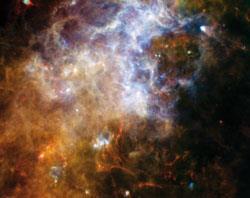
One and a half million kilometres away from planet Earth, a bustling space observatory is slowly dying. It's running out of liquid helium. Without it, instruments will start to overheat and fail, the observatory will be unable to function and it will be left, floating impotently in space. When will the lights blink out? We're not exactly sure; Herschel probably has a few more months, but as the carrier of the largest, most powerful telescope ever flown in space, and with a mission no less fundamental than revealing how our galaxy came into being, Herschel's legacy will last far beyond the day the final data package is despatched to Earth.
Blast off
Herschel was launched on a sunny afternoon in May 2009 from Europe's spaceport in Kourou, in French Guiana. Alongside Herschel on the launcher was Planck, a spacecraft designed to analyse radiation left over from the big bang. Between them, the two observatories represented the most complex satellites ever built in Europe, involving over 100 contractors and more than a dozen different countries.
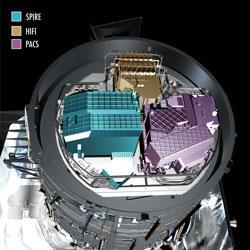
Herschel is an enormous infrared (IR) telescope - the largest ever flown in space. Thanks to three powerful instruments on board, it is also spectacularly sensitive, generating tantalising glimpses of the early universe in a way that simply hasn't been possible before.
Most of the universe is incredibly cold and doesn't give off any visible light, but it does shine at longer IR and sub-millimetre wavelengths. While visible light can be observed by ground-based telescopes, the Earth's atmosphere causes problems at longer wavelengths. It generates, for example, huge amounts of IR radiation itself, which gets in the way of attempts to look beyond the atmosphere into the IR radiation in space. It's even worse in the far IR and sub-millimetre region, because the water vapour in the atmosphere blocks any of this radiation from space reaching Earth's surface.
The only way to get a clear picture of what is going on at these wavelengths beyond our planet is to get away from the interference of the Earth's atmosphere and travel into space.
Planck and Herschel separated from their launcher 30 minutes after take-off and then travelled separately for two months before reaching a gravitational sweet spot known as the second Lagrangian point, or L2. Almost a million miles away behind the dark side of the Earth, at this spot the pull of the Earth and the sun balance out to create an area of gravitational stability, around which Herschel and Planck orbit.
A world of gas and dust
Stars that are visible with the human eye or 'conventional' telescopes emit light at wavelengths in the visible range (400-700 nm), and they're also generally rather hot. Our sun, for example, is a yellow dwarf star and has a surface temperature of around 5800 kelvin (about 5500°C).
The wavelengths that Herschel is interested in are up to 1000 times longer than that of visible light, and the material emitting at these wavelengths is also considerably colder - not far above absolute zero (0 kelvin or -273.15°C). At these wavelengths, Herschel will be able to see gas and dust - but this material is far more than interstellar dirt.
Huge clouds of gas and dust often obscure objects astronomers would like to be able to see. 'If you ever look up and see the Milky Way in the night sky, you might notice dark patches in it,' explains Chris North of Cardiff University's school of physics and astronomy. 'Those are dust lanes, and they block out light from the stars behind.' But when you view the same region in the IR, you get a very different picture: 'We see that dust glowing with its own light, and suddenly by comparing the different wavelengths, we can tell how warm or cold the dust is, how much dust there is, and we can trace the temperature and the mass of the dust in various environments in our galaxy and other galaxies.'
It is when the spectrometers on board Herschel train their eyes on the gas and dust that things get really interesting. Between them, the three instruments cover wavelengths stretching from 55 to 671 microns - no other space-based telescope has ever been designed to detect the full range of frequencies in that section of the spectrum.
PACS (Photodetector Array Camera and Spectrometer) covers wavelengths from 55 to 210 microns. It is complemented by SPIRE (Spectral and Photometric Imaging Receiver) operating at longer wavelengths of 194 to 671 microns, and finally there is Hifi (Heterodyne Instrument for the Far Infrared).
Hifi is a very high resolution spectrometer - the highest ever in the range of wavelengths it covers: 157 to 212 microns and 240 to 625 microns. Hifi can produce spectra of thousands of wavelengths simultaneously, and can identify individual molecular species, studying their movement, temperature and other physical properties.
Mirror, mirror
Building an observatory like Herschel is no mean feat. The project was 20 years in the planning, and thousands of people were involved including technicians, engineers and research scientists from all over the world. Altogether the spacecraft, its scientific payload, the launch, mission and science operations came with a price tag of £890.5 million.
Herschel is effectively a tall tube, 7.4 m tall and 4 m wide. At launch it weighed in at 3400 kg, a large part of which was the 2000 kg of liquid helium on board to cool the instruments down to their operating temperature just a fraction above absolute zero.
The most dominant feature of the satellite is its enormous mirror. At 3.5 m in diameter it is one and a half times the size of Hubble's and the largest mirror ever to be flown in space. Four times larger than that of any previous IR telescope, it helps Herschel collect almost 20 times as much radiation.
The mirror is Herschel's light collector. Light from objects in space hits the mirror and is directed towards a smaller secondary mirror, where it's then focused towards Herschel's powerful instruments to be detected and analysed.
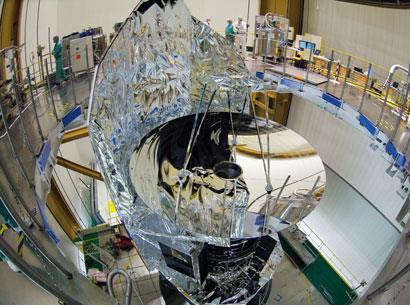
The size of the mirror is the secret to Herschel's sensitivity: the larger the mirror is, the more light it can capture, the fainter the objects it can detect and the greater the detail it can define.
As with such a crucial piece of equipment, a great deal of care and attention went into its design. It is made almost entirely of silicon carbide, with 12 segments brazed together and then machined with diamond tools into its parabolic shape and polished to its final thickness of 3 mm.
The mirror had to be precisely shaped and perfectly smooth to ensure there would be no distortions in the images. Any bump on the mirror's surface had to be less than one thousandth of a millimetre high. A new polishing facility was built by the company contracted to do the work, specifically to accommodate Herschel's requirements. The 250 kg mirror also had to be strong enough to withstand the launch into space, during which the satellite experienced vibrations, noise and force several times that of the Earth's gravity - all of which had to be tested in the lab before the telescope made its journey into space.
Because of its high resolution and ability to probe sub-millimetre radiation, Hifi has been playing a key role in conducting a chemical census of the cosmos. Sub-millimetre radiation is emitted by the rotational movement of molecules, which generate specific spectra according to their composition. This information provides crucial insights into the physical and chemical conditions of the environment being studied, and also gives us a peek at the ingredients the cosmos uses to make a star.
'We care about the dust and gas because that's what stars form from, and it's what they create when they die,' says North. 'The amount of gas and dust there is, and the concentration of it, affects how stars form and how massive they are.' And because Herschel can analyse radiation not only from our own galaxy but also distant galaxies whose light has taken billions of years to reach us, it's able to look backwards and trace star formation throughout cosmic time.
The molecules that Herschel can identify tell us a lot about what's happening to the gas in the interstellar medium. 'By looking at those molecules and the way they're emitting light at specific wavelengths, we can look at exactly how warm the gas is and how it is behaving, whether it's being shocked and excited by other processes, for example,' explains North. The presence of different molecules in nebulae (or star-forming regions) changes the way the material around a forming star behaves, and the nature of the star that emerges. And because star-forming regions can go on to form planetary systems, the molecular make-up of the dust and gas can ultimately influence that development too.
Water, water everywhere
Herschel's Hifi instrument was designed with water in mind, specifically, tracing it in its various forms across space. Water's presence is revealed by tell-tale emission lines, chemical fingerprints, in the spectra being emitted at far IR and sub-millimetre wavelengths.
'We knew there was going to be a lot of water out there, but it was amazing to see the number of lines, the number of transitions,' says Serena Viti, a professor of astrophysics at University College London. 'The nice thing about the water molecule is that it can emit in a different range of densities and temperatures, and so by observing many transitions you can really probe the physical conditions of the star forming regions that you're observing.' It takes an instrument with Hifi's sensitivity to obtain sufficiently precise spectra that can tell us so much about the environment the water was found in.
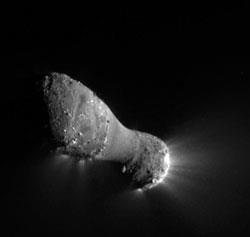
But Herschel has also revealed secrets of the water here on Earth, thanks to its observations of the comet Hartley 2 in 2010. Comets are essentially dirty snowballs, masses of rock and ice carrying material from the cloud that formed the planets 4500 million years ago. They're effectively travelling fossils, and can be unique tools to probe the early solar system.
It had long been suggested that the Earth's water could have been delivered by comets, but the composition of water on board a number of previously studied comets didn't match that of Earth.
In 2010 Hartley 2 passed 19 million kilometres from Earth, the closest since its discovery in 1986 and the closest it will get for the next century. On 20 October, it travelled past Herschel at a distance of 16.4 million kilometres, giving the telescope a chance to take a close look.
In semi-heavy water the place of one of the molecule's hydrogen atoms is taken by one of hydrogen's isotopes, deuterium. The ratio of hydrogen to deuterium acts as a sort of fingerprint, telling you where the water came from. In previous analyses of cometary water, that ratio didn't match that of Earth's water, throwing the water delivery theory into question.
That was until comet Hartley 2. Analysis of the deuterium:hydrogen ratio in its water showed a composition similar to that of Earth's oceans. 'Comet Hartley 2 formed out in the Kuiper belt near Pluto, so formed in a different place in the solar system [to the other comets that had been analysed],' explains Cardiff's North. 'So it could be that comets like Hartley 2 could have been the ones that came to Earth and delivered the water.'
Shocking stellar formation
Serena Viti has worked with Herschel for 10 years, and is especially interested in the 'shocks' that occur around newborn stars. 'During the formation of a star you get these large, high velocity jets of hot gas that come out of the star and impact upon the surrounding cloud,' she explains. 'The type of chemistry that you see is very interesting because you have very hot material impacting on quite cold material, so these interactions are really interesting from a molecular point of view.'
The kinds of interactions that Viti has been modelling are exactly what would have been happening during the formation of our sun a few million years ago. She studied an outflow known as L1157 near a low mass star - a protostar, or star in the making: 'We like targeting newborn protostars because that's where all the action happens,' she says.
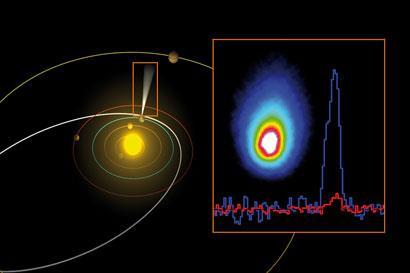
The Herschel scientists were expecting to get some interesting data, but even Viti was amazed by some of the results. 'We were very surprised at times to see the chemical richness in the spectra of these objects,' she says.
The spectra themselves only provide a snapshot of what is going on - you can't tell what happened before or what will happen next in the star you're observing. 'But because you observe so many transitions of so many different species, that can then be fed back into models that can tell you how the shock originated, what happened in the past, in order for you to see what you're seeing at the moment,' explains Viti. That, says Viti, is where the real strength of an instrument like Hifi lies: in its ability to let you see the richness in so many species and so many transitions. Around L1157 they saw not only water, relatively common across the cosmos, but also ammonia, formaldehyde, methanol and several other species.
Herschel's legacy
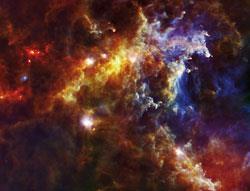
The liquid helium that cools Herschel's instruments to their operating temperature a fraction above absolute zero will run out early next year. Once that happens, the observations will stop, and no similar capability will be available for the foreseeable future.
But the satellite has already generated terabytes of data, and hundreds of scientific papers have so far been published based on the telescope and its observations. The maps of the sky that Herschel is producing will keep astronomers busy for decades; even if a particular region has been analysed by one team, they'll likely have only been looking for a specific type of phenomenon. But there will be hundreds of other objects in that region that could be analysed - 'it's just a case of looking for them,' says North, 'and there simply aren't enough people working on Herschel to do all that.'
Researchers are still finding things in the catalogue produced by IRAS, the Infrared Astronomical Satellite launched in the 1980s, so Herschel's legacy will likely long outlast its active life of less than four years. And until the day that Herschel's lights finally blink out, its instruments will continue probing the material of space and helping astronomers reveal the secrets of the stars.
Anna Lewcock is a freelance science writer based near London, UK
Related Links
Herschel Educational Resources
Class activities and downloadable resources
Herschel and Planck in the classroom
Teaching materials, including downloadable pdfs



No comments yet