


How can advances in materials science make one of the world’s most energy-intensive chemical processes more sustainable?
-
Download this
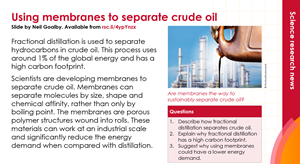
Use this story and the accompanying summary slide for a real-world context when studying fractional distillation with your 14–16 learners.
Download the story as MS Word or PDF and the summary slide as MS PowerPoint or PDF.
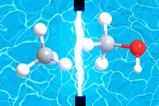
Scientists are developing membranes that can efficiently separate the hydrocarbons in crude oil. These materials could help reduce energy demand and carbon dioxide emissions compared with conventional separation methods.
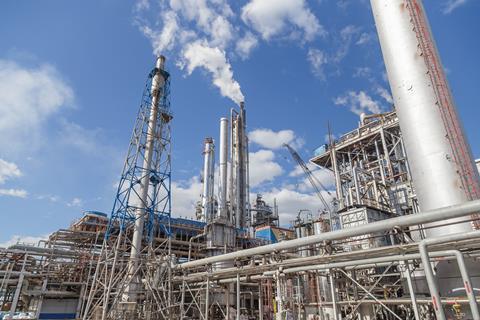
Crude oil is a fossil fuel that contains a mixture of valuable hydrocarbons including diesel and petrol. Refineries currently use fractional distillation to separate these hydrocarbons, a process that accounts for around 1% of the world’s global energy use. This separation method also emits more than 160 million tonnes of carbon dioxide annually.
Estimates suggest that using membranes to separate the hydrocarbons in crude oil could reduce the energy required for the separation by up to 90% and slash carbon emissions.
Using membranes to separate the hydrocarbons in crude oil could reduce the energy required for the separation by up to 90%
Fractional distillation separates hydrocarbons based on their boiling points. Membranes, meanwhile, can be fine-tuned to separate molecules by their size, shape and chemical reactivity. Many labs around the world are currently seeking suitable materials for these membranes.
Three recent breakthroughs
In June 2026, three groups announced three different types of materials that had shown promising results when used to separate crude oil in their labs.
Researchers at Exactmer, a company spun out of Imperial College London, revealed an ultrathin polymer membrane with permanent pores each smaller than a nanometre in size. Meanwhile, another group in Saudi Arabia, at King Abdullah University of Science and Technology, shared a membrane made of covalent organic frameworks, a novel type of material that has exceptionally high numbers of permanent pores. While a third team, from the Korea Advanced Institute of Science and Technology, repurposed an existing membrane – polyacrylonitrile – who’s current uses include water treatment and kidney dialysis.
‘Membrane-based hydrocarbon fractionation is [now] moving from a promising idea toward a more practical technology,’ says Sheng Guo, a researcher at Nanjing University in China who wasn’t involved with any of these projects.
More fractional distillation resources
- Find everything you need to teach fractional distillation.
- Develop your students’ distillation knowledge and practical skills.
- Read more separation science research news.
- Take a look at Stuart’s job profile and how he works to make research and development happen faster as a project leader in oil and gas experimentation.
This article is adapted from Mason Wakley’s in Chemistry World.
Nina Notman
References
1 A Oxley et al, Science, 2026, 392, 1268 (doi.org/10.1126/science.aed1111)
2 L Cao et al, Science, 2026, 392, 1262 (doi.org/10.1126/science.aea0869)
3 J Choi et al, Nature, 2026, (doi.org/10.1038/s41586-026-10677-3)
Download this
Summary slide with questions and the article for context when teaching 14–16 lessons on fractional distillation: rsc.li/XXX
Downloads
Membranes to separate crude oil student sheet
Word, Size 0.9 mbMembranes to separate crude oil student sheet
PDF, Size 0.2 mbMembranes to separate crude oil summary slide v02
Presentation | PowerPoint, Size 1.13 mbMembranes to separate crude oil summary slide v02
Presentation | PDF, Size 0.24 mb


No comments yet