



A second type of liquid water with fewer hydrogen bonds could explain why ice floats
-
Download this
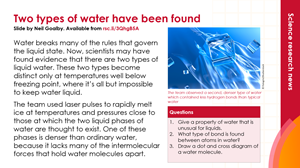
Use this story and the accompanying summary slide for a real-world context when studying hydrogen bonding and molecular structure with your 14–16 learners.
Download the story as MS Word or PDF and the summary slide as MS PowerPoint or PDF.
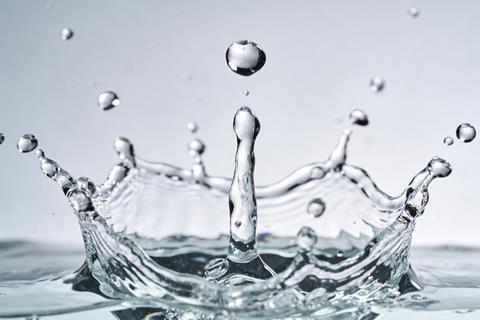
Water is weird. It breaks many of the usual rules that liquids are expected to follow. In 1992 a team of researchers suggested why that is. They proposed that there are two types of liquid water, which only become distinct at temperatures well below freezing point. Researchers have sought evidence for this bold conjecture ever since – and now an international team claims to have found it.
Water is weird. It breaks many of the usual rules that liquids are expected to follow. In 1992 a team of researchers suggested why that is (bit.ly/3RLcoaM). They proposed that there are two types of liquid water, which only become distinct at temperatures well below freezing point. Researchers have sought evidence for this bold conjecture ever since – and now an international team claims to have found it.
The team led by Anders Nilsson of Stockholm University used ultrafast laser pulses to rapidly melt ice and then studied the resulting supercooled liquid water.
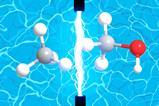
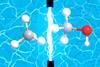
In ordinary water, H2O molecules form intermolecular hydrogen bonds between the lone pairs on their oxygen atoms and the positively charged hydrogen atoms of nearby water molecules. Each water molecule forms four hydrogen bonds resulting in an extensive network of molecules all being held at arm’s length from each other.
This model of hydrogen bonding remains the key explanation used in the curriculum to describe why water behaves unusually, including why ice floats. The team’s findings may add further detail rather than replace that explanation.
Fewer hydrogen bonds
The scientists observed a second liquid phase for water containing fewer hydrogen bonds than we would expect to see in liquid water. The lack of bonds holding the molecules apart means that this second phase is more dense than ordinary water.
It is thought that liquid water typically exists as mixtures of these two states. The presence of this second form of liquid water may explain some of its more unusual properties, such as why it is most dense at 4°C above freezing.
As a rule, liquids shrink when cooled, causing their density to increase. Ice should therefore sink in liquid water. But as we know, it floats. The findings of these new experiments suggest that liquid water’s higher density comes from its second, denser liquid phase.
This article is adapted from Philip Ball’s in Chemistry World
Nina Notman
Reference
S You et al, Science, 2026, 391, 1387 (doi.org/10.1126/science.aec0018)
Download this
Summary slide with questions and the article for context when teaching 14–16 lessons on hydrogen bonding and molecular structure: rsc.li/XXX
Downloads
Weird water student sheet
PDF, Size 0.16 mbWeird water student sheet
Word, Size 0.51 mbWeird water summary slide
Handout | PDF, Size 0.26 mbWeird water summary slide
Handout | PowerPoint, Size 1.28 mb



No comments yet