
The use and abuse of cocaine are tales of power and exploitation, and destroyed lives. Elucidating the structure of this complex molecule provides a more credible side to its story.
-
Coca leaves and Bordeaux wine make for a popular 19th century 'tonic'
- Structural formula of cocaine takes chemists some 30 years to confirm

The stimulant effects of coca leaves were known to the ancient Incas, long before the Spanish conquistadors arrived in South America in the early 1500s. However, the coca leaves proved convenient for the conquistadors - not only did intoxicated slaves work harder in the gold mines, but their appetites were suppressed, making them cheaper to feed. Spaniards returning from South America told of the virtues of coca leaves, though such properties rarely survived the long voyage back to Europe.
Even so, coca leaves were gaining a reputation as an 'elixir of life' and an editorial in the Gentleman's magazine of 1814 pushed for more research into the properties of the leaves in the hope that they might be 'used as a substitute for food so that people could live a month, now and then, without eating'.1 And while the Church initially banned the use of the leaves, presumably because of their connotations with earlier religious rites, recognising their economic importance, they were soon legalised and taxed, and at one stage were the major source of income for the Church.2
Despite the early interest, however, it was to be some decades before the active ingredient of the coca plant would be identified.
Early chemistry
In 1853, Heinrich Wackenroder, a German pharmaceutical chemist was the first to produce a crude extract of the active ingredient of coca leaves. Using a mixture of 84 per cent ethanol and 16 per cent water, he obtained a green solution that produced a yellow-white precipitate with isinglass* solution and a dirty green coloration with iron(III) chloride. Two years later another pharmacist, Friedrich Gaedecke, evaporated an aqueous extract of the leaves and then dried the residue to obtain white crystals, albeit contaminated by an oily residue. He christened them erythroxyline, after their botanical source, the shrub Erythroxyla coca. In 1860 Albert Niemann reported the first quantitative investigation of the extract, which he called cocaine. (*Isinglass - a purified form of gelatin obtained from the air bladders of certain fish.)
Using Wackenroder's alcohol mixture, slightly acidified with dilute sulfuric acid and at temperature of 40°C, Niemann obtained 0.25 per cent cocaine (respectable considering we now know the content in the leaves to be ca 0.7-1.8 per cent). He determined the relative molecular mass (RMM) of his product by making a gold chloride adduct which he decomposed to leave metallic gold. His values (280 and 288) again compare well with today's value of 303.
Combustion analysis combined with his RMM value, led him to the molecular formula C32 H20 NO8 for cocaine, which corresponds to C16 H20 NO4 when recalculated using today's relative atomic mass values.2+ Niemann noted: 'Its solutions have an alkaline reaction, a bitter taste, promote the flow of saliva and leave a peculiar numbness, followed by a sense of cold when applied to the tongue', though he does not seem to have appreciated the importance of the latter observation. (+ At the time chemists were uncertain as to which atomic mass scale to use. Niemann was presumably using one that included C = 6 and O = 8.)
Sadly Niemann died the following year and it was left to his former student, Wilhelm Lossen, to continue his work. Lossen repeated Niemann's analyses and concluded that the molecular formula was C17 H21 NO4, now known to be the correct result. The full structural formula of the complicated cocaine molecule, however, would have to wait over 30 years.
Commercial potential
Meanwhile, the commercial potential of cocaine was already being exploited. Angelo Mariana, who was to become the world's first cocaine millionaire, was a Corsican from a long line of doctors and chemists. He moved to Paris in 1863 at a time when there was debate about the health-giving properties of coca and cocaine. After studying travellers' reports and the emerging literature, he became a habitual user. He found that the most bitter leaves were the most potent but the least palatable, and that steeping the leaves in Bordeaux wine led to the most agreeable way of preparing a 'tonic'.1 In fact, ethanol-extracted cocaine from the leaves formed cocaethylene (benzoyl ecgonine ethyl ester), a more potent form of the drug.
With advertising, Vin Mariani became enormously successful, attracting celebrity endorsements from many notables of the day - including, allegedly, Queen Victoria, the Prince of Wales, the Shah of Persia, the writers H. G. Wells, Jules Verne, Ibsen, and Zola; the singer Sarah Bernhardt; the scientist Thomas Edison and even two Popes (Pius X and Leo XIII). Robert Louis Stephenson is said to have written The strange case of Dr Jekyll and Mr Hyde during a six-day cocaine binge.
Vin Mariani also claimed support from some 8000 doctors, including the young Sigmund Freud, then a Viennese neurologist. He advocated the tonic as a 'cure' for morphine addiction and to 'increase vitality' in a paper published in 1884. When he mentioned to colleague, Carl Koller, that cocaine caused numbness of the lips, eyes and mouth, Koller went on to develop its use as a local anaesthetic for eye operations.3 It was only some three years later that Freud acknowledged drug's addictive properties.4
With its role in anaesthesia, and widespread commercial and public interest, many chemists turned their attention to solving its structure.
Structural insights
Some three years before Lossen had published his molecular formula, he had noted that if cocaine was hydrolysed by dilute hydrochloric acid it gave benzoic acid and another white crystalline material that analysed as C9 H15 NO3. He named this ecgonine, from the Greek ekgonos, meaning son of or descendant.
C17 H21 NO4 + 2H2 O → C7 H6 O2 + C9 H15 NO3 + a small fragment containing a single carbon atom
Completing the equation leads us to conclude that the fragment is methanol, a fact that had to wait until 1885 for confirmation. If cocaine is heated with water in a sealed tube at 90-95°C, CH3 OH comes off, leaving the benzoic acid precursor still connected to the cocaine residue:
C17 H21 NO4 → C16 H19 NO4
By this time chemical theory had advanced sufficiently for the 19th century chemists to conclude that ecgonine contained an hydroxyl group which could be esterified with benzoic acid and a -COOH group that could be esterified with methanol. The product from such a double esterification was cocaine. Just three years later, in 1888, Alfred Einhorn showed that cocaine would form a quaternary ammonium salt on treatment with CH3 I, a characteristic of tertiary amines. Thus the nitrogen in the molecule is covalently linked to three carbon atoms, not hydrogen atoms.
The hydroxyl group in ecgonine behaved like a secondary alcohol, producing a ketone (ecgoninone, 1898) on oxidation. On gentle heating, this molecule lost its acid grouping to form the recognised product tropinone. This was an oxidation product of tropine, a tertiary base derived from the alkaloids atropine and hyoscyamine, both of which have medicinal/physiological properties. Work on these two compounds was going on in parallel with the work on cocaine, often by the same research groups. This meant that identification of the structure of any of either tropine, tropinone or ecgoninone would enable 'back-tracking' to deduce the structure of cocaine.
Tropine provides some clues
Most researchers, in fact, focused on tropine, which had first been isolated in 1864 by Lossen. Tropine, C8 H15 NO, also contains a secondary -OH group and a tertiary nitrogen atom. Its OH group could be replaced by iodine by treating with HI solution, and zinc/dilute hydrochloric acid reduction gave the parent tertiary base, tropane.
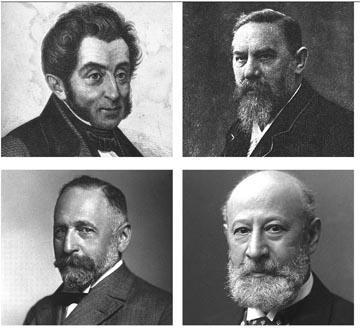
That tropine might contain at least one ring structure was down to Adolf Baeyer. In 1866 he had shown that some alicyclic compounds could be dehydrogenated by heating them with zinc dust to give the corresponding aromatic ring species and thus help clarify their structure. When this was done with tropane in 1887, 2-ethyl pyridine (1) was obtained - the first substance of known structure derived from the 'core' of the molecule in the cocaine/atropine sequence.
This indicated that part of the tropine molecule (and thus part of the cocaine molecule) contained a reduced (or partially reduced) pyridine ring bonded to two connected carbon atoms. In the same year Albert Ladenburg suggested structure (2) for tropine. And, in 1889, this provoked Einhorn to propose a related structure for ecgonine, see (3).
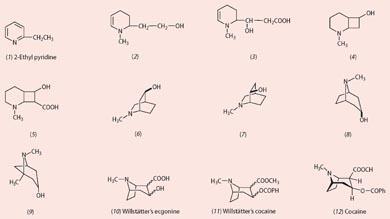
However, Carl Liebermann challenged these two structures because he could oxidise both ecgonine and tropine to tropinic acid. Although this product was still of uncertain structure, it maintained both the ring system and the N-CH3 grouping but, crucially, contained two -COOH groups. Oxidation of Einhorn's and Ladenburg's molecules would yield corresponding products that only contained one such exocyclic carboxylic acid group. So, in 1891, Liebermann came up with his own versions of tropine (4) and ecgonine (5). Following on Liebermann's heels, Georg Merling suggested two less strained versions of tropine, see (6) and (7). (These and the subsequent structures are written as 'semi three dimensional' structures, though at the time the chemists drew their molecules as planar structures.)
Some seven years later, in 1898, Richard Willstätter observed that tropinone formed a dibenzal derivative on treatment with benzaldehyde. This indicated the presence of a -CH2 -CO-CH2 - grouping within the molecule, with each CH2 having the ability to condense with an aldehyde. He adapted Merling's ideas to incorporate this grouping (with the carbonyl reduced to CHOH) and proposed several structures for tropine, including (8) and (9).
By means of a somewhat lengthy sequence of reactions Willstätter was able to convert tropine into a cycloheptenone. This ruled out structure (9) since the maximum carbocyclic ring that this could yield would only contain six carbon atoms. In fact, structure (8) was the correct formula for tropine and he went on, in 1898, to deduce the structures of ecgonine (10) and cocaine (11).5
Two tasks remained - confirmation of the structure in two and three dimensions. To confirm the proposed structure Willstätter had to synthesise the substance from simple starting materials of known structure. If the synthesised target matched the natural product, then the formula could be guaranteed. In 1922/3 Willstätter prepared synthetic cocaine according to his formula, starting from succinic dialdehyde.6 Moreover, he was able to resolve the racemic ecgonine intermediate in the sequence to come up, finally, with (-)-cocaine, Nature's stereoisomer. To complete the three dimensional picture, it was necessary to establish the configurations of the chiral centres within the molecule. Today, this problem would be solved by X-ray crystallography, but in the 1950s chemists would synthesise the molecule starting from a molecule of known configuration [(S)(+)-glutamic acid]. This work was done by E. Hardegger, who showed that (-)-cocaine is (-)-2R -methoxy-carbonyl-3S -benzoxyloxytropane, see structure (12).7
Social consequences
Meanwhile, cocaine continued to be widely used. Until 1916 it was sold at Harrods as part of ' A welcome present for friends at the Front'. Ernest Shackleton took tablets of 'Forced March' (Burroughs Wellcome) containing cocaine with him on his Antarctic exploration; and it was widely used in tonics, toothache cures and patent medicines. The pharmaceutical company Parke Davis, claimed that cocaine 'could make the coward brave, the silent eloquent, and render the sufferer insensitive to pain'.1
Inevitably, Vin Mariani had many imitators. In the US, John Stith Pemberton, who was an established manufacturer of patent medicines, and addicted to morphine following treatment for injuries received during the Civil War (1861-65), sold a similar wine tonic as a cure for 'nervous trouble, dyspepsia, mental and physical exhaustion, all chronic and wasting diseases, gastric irritability, constipation, sick headache, neuralgia'. Pemberton, it seems, also saw it as a potential cure for his morphine addiction.
However, looming prohibition meant the days of wine-containing tonics were numbered. During 1886 Pemberton experimented with various alcohol-free preparations, though still retaining the coca leaves.1 The accidental mixing of one of these with carbonated water by his assistant led to what they called Coca Cola, which they chose to sell as a 'fountain drink' as an alternative to root beer and ginger ale. Effective advertising was, and has remained, central to its success.8 Pemberton, however, suffered various misfortunes and died in poverty, the control of the Coca Cola Company passing to another pharmacist, Asa Candler, who was responsible for its later worldwide commercial success.
By now, however, the observations by Freud and his generation of doctors on the addictive properties of cocaine were becoming clear to many and were beginning to capture public attention. Racist statements sought to link cocaine addiction to concerns about violence allegedly (but without clear evidence) committed by African Americans. Candler was now selling his soda in bottles that were available everywhere rather than 'soda fountains' in affluent suburbs. Having acquired good sales among African Americans, he could not afford to lose their custom. In 1901 he quietly had coca leaves 'decocainised' before they were used to make Coca Cola. The Pure Food Act of 1906 led to further regulation, but it was not until 1914 that heroin became illegal in the US and cocaine not outlawed until 1922.1
Drug abuse

Gradually, the damage caused by cocaine addiction became clearer. It was first 'snorted' around 1905, and nasal damage as a result of its effects on the nose was recognised some five years later. Taken in small doses, cocaine usually causes euphoria, increased energy and mental alertness. Regular users often report restlessness, irritability and anxiety, and it can lead to paranoia. However, cocaine is highly addictive, and users often report being depressed when they are not using the drug - leading to further use. As they become addicted, they use more of the drug to generate the same level of stimulation. This can lead to a paranoid psychosis, in which the individual loses touch with reality and experiences hallucinations. The depression on withdrawal may be of suicidal intensity. Moreover cocaine reduces blood flow, leading to ulceration and gangrene in the nose when snorted, and in the bowel when taken by mouth. When injected, there are all the risks of any injected drug of abuse - infection leading to septicaemia and damage to heart valves, and infection with HIV and hepatitis B and C if needles are shared.
While the glamorous image of abuse by famous rock stars and others continues,9 it is estimated that some £3 billion is spent on cocaine each year in the UK and there is increasing pressure on children as young as 11 to use the drug.10 In the US, the cost was estimated as $35 billion in 2003.1 Those involved in organised crime supply most of the cocaine used in the UK and the US, and these figures indicate the extent of the power of these criminals within the economy. For comparison, the total expenditure by the Metropolitan Police for Greater London during 2006/7 will be just over £3 billion. This reminds us that, just as the Spanish exploited the Inca through the use of coca leaves, organised crime now has the power to exploit children, once they are hooked on this highly addictive and destructive drug.
Further Reading
An account of the cocaine story may be found in John Mann's text.11 Probably the most comprehensive account of the structural work on cocaine is given in Pelletier's text, but the chronology has to be carefully picked out across various sections.12 Finar gives a much shorter account which omits most of the key dates.13 To our knowledge, this aspect of the chemistry of cocaine is not available on the Internet.
Also of interest
Cocaine
Social history of cocaine
Loma Linda University Bioethics Library
Online Ethics Library: The Jack Provonsha lectureships - Cocaine Addiction: The Nemesis of Modern Culture - Presented at the Jack W. Provonsha Lectureship for the Alumni Postgraduate Convention on March 3, 1997
Coca Cola
Coca Cola
The Times
The Times
References
- Social history of cocaine.
- Social history of cocaine.
- Anaesthetic properties.
- Addictive properties.
- R. Willstättetter and J. J. Müller, Berichte, 1898, 31, 1202.
- R. Willstätter, O. Wolfes and O. Mäder, Annalen, 1923, 434, 11.
- E. Hardegger and H. Ott, Helv. Chim. Acta, 1955,38, 312.
- Coca Cola.
- The Times, 8 October 2005.
- The Times, 25 March 2006.
- J. Mann, Murder, magic and medicine, revised edn. Oxford: OUP, 2000.
- S. W. Pelletier (ed), The chemistry of the alkaloids. New York: Van Nostrand Reinhold, 1970.
- L. Finar, Organic chemistry, Vol 2, 5th edn. London: Longman, 1975.



No comments yet