



Take a closer look at alkalis and bases and explore their uses in daily life and beyond
When we think about something with the power to dissolve a metal or body parts, our thoughts turn to acids. But at the other end of the spectrum, bases or alkalis can be even more corrosive. So, what’s the strongest base in the world?
To begin with, we need to understand a little about bases. There are a couple of definitions for bases, but the easiest is any substance that can accept a hydrogen ion – otherwise known as a proton. If a soluble base releases hydroxide ions (OH‾) it’s called an alkali.
What’s in a base?
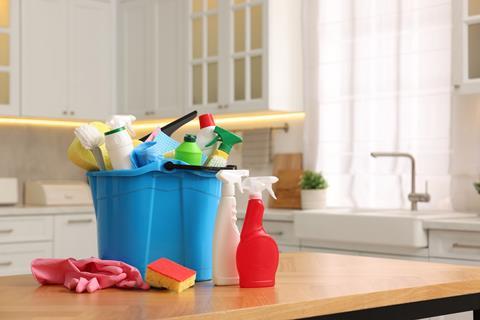
Bases taste bitter (which we don’t recommend), turn litmus paper blue, and their aqueous solutions conduct electricity. They also react with weak acids, causing them to deprotonate, or lose a hydrogen ion. Everyday examples of alkalis include soap, ammonia and bleach. At higher pH, bases are more dangerous to work with and can irritate the skin and eyes. Inhaling bases can also be harmful, which means you should only work with them in open spaces. And you should never mix two cleaning products together.
Caesium hydroxide is so alkaline it can dissolve glass
Working out what the strongest alkali would be is straightforward: we can just look at the periodic table. On the far left, group 1 and group 2 are the alkali metals and alkaline earth metals. This is because they have the fewest electrons in their outer shells, and so readily give them up to produce a hydroxide ion in water. You can see this happening if you put a small strip of lithium (from group 1) into water: it readily donates its electrons, causing it to fizz and dissolve, creating an alkali, lithium hydroxide. This is strong and very useful in electric car batteries.
The search for stronger alkalis
If we follow the trends of the periodic table, as we go down we should expect that the heavier elements in group 1 are even more reactive. Sure enough, sodium hydroxide is even stronger (enough that some serial killers have used it to dissolve bodies), and potassium hydroxide is stronger still, with some types of cremation using it. The last of the alkali metals we can test is caesium (francium is highly radioactive and only exists in tiny quantities) and, sure enough, caesium hydroxide is so alkaline it can dissolve glass.
Caesium hydroxide is probably the strongest alkali, however it’s not the most basic substance in the world. Since the 1850s, we have known about even more powerful chemicals called superbases. These compounds, usually based on group 1 elements, have unusual chemical structures that mean they have an exceptional affinity for protons. In fact, the trade name of one of them, 1,8-Bis(dimethylamino)naphthalene, is Proton Sponge.
More on acids and alkalis
- Discover what the strongest acid in the world is in another Everyday chemistry article.
- Use a decision tree on acids, bases and buffers with your post-16 learners. Download the presentation for teacher guidance and a pre-prepared example to guide students’ thinking.
- Learn more about alkaline hydrolysis and cremation in A greener future for funerals.
- Review your 14–16 learners’ understanding of key ideas, words and phrases relating to acids and bases with scaffolded worksheets.
Chemists designed these superbases, which don’t occur naturally, because they are useful as catalysts. One of the strongest superbases is tert-butyllithium, which is so basic that it can deprotonate benzene, an extremely stable carbon ring. You won’t find tert-butyllithium in a science class because it’s far too dangerous; it is so reactive it spontaneously bursts into flames on contact with air.
Unbelievably, tert-butyllithium isn’t the strongest possible base. There are other substances that are even more basic. This includes lithium monoxide’s anion (LiO‾), which scientists have only ever made in small quantities. Ortho-diethynylbenzene dianion currently holds the title of the most basic substance. In 2008 chemists first created this superbase, along with two other variants, and it is even stronger than an equivalent superacid. Other even more basic superbases may exist, and researchers may one day discover them, although you will probably never use them in your daily life.
Scrub up on super science with this TikTok:
@royalsocietyofchemistry What's the most powerful alkali in the world? 💪 We bring to you the SUPERBASE 🦸♀️ As Ross explains, a superbase isn't just a Nicki Minaj song. Bases, like soap or bleach, are found all over the place, especially in group 1 of the periodic table. The further we go down the table, the stronger (and more super) the alkali metals become. Some superbases can even dissolve glass or burst into flames right before your eyes 🧨 Follow us for more chemistry fun! 👋 #Alkaline #gcsechemistry #ScienceTok #nickiminaj #Chemistry ♬ original sound - The Royal Society of Chemistry
Kit Chapman
Scrub up on super science with this TikTok: bit.ly/4grfip3





1 Reader's comment