

Help students move beyond labelling diagrams to build a confident, accurate understanding of the particle model

Students aged 11–12 can typically correctly label particle model diagrams of the three states of matter – solid, liquid and gas. But this does not necessarily mean that they understand them.
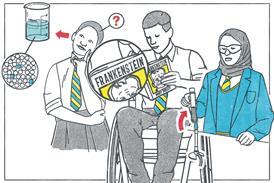
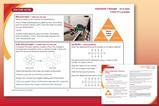
An expert chemist can move effortlessly between macroscopic observations, sub-microscopic thinking and symbolic representations. But the particle model is the first time in the chemistry curriculum when learners have to engage with all three of these levels of thinking at once. Consider using Johnstone’s Triangle as a teaching aid to check your students are understanding what you’re teaching them.
Ensure that students understand that there is nothing between the particles
Students need to be secure in their understanding of the macroscopic properties of all three states. They must then grasp the cencept of the particulate nature of matter and its symbolic representation in diagrams made up of various arrangements of circles. It’s hardly surprising that they may develop a range of misconceptions about the particle model, and indeed hold alternative mental models as Philip Johnson found in his longitudinal study.
For example, some students may think that the particles are located in the substance and others that the particles have the same properties as the bulk substance (such as thinking that copper atoms are shiny and orange). Despite this, these students can correctly draw or give the state of the three well-known particle diagrams.
Use diagnostic questions to reveal any already embedded misunderstandingsyour learners have about the particle model. To reduce further misconceptions developing and build a stronger foundation for later understanding, use these three strategies.
1. Check student understanding
Be absolutely sure that students are clear about the gas state before introducing the particle model. In everyday life people commonly refer to an empty glass or bottle, reinforcing the misconception that air is nothing. The BEST 7-11 Materials and their properties diagnostic question ‘Thinking about air’ (Key Concept 1 States of Matter) could be used to check for student confusion.
Be absolutely sure that students are clear about the gas state before introducing the particle model. In everyday life people commonly refer to an empty glass or bottle, reinforcing the misconception that air is nothing. The BEST 7-11 Materials and their properties diagnostic question ‘Thinking about air’ (Key Concept 1 States of Matter; rsc.liXXXwheelbarrow) could be used to check for student confusion.
Give a simple balance demonstration, comparing the mass of an inflated and uninflated balloon, to show that air has mass. This helps to overcome the misconception that air (or a gas) is nothing.
2. Label the space between particles
When introducing students to particle diagrams for the first time, label the space between the particles. Ensure that they understand that there is nothing between the particles. This addresses early on the misconceptions that the particles are embedded within the substance or that there is air between them. Later you can reinforce this understanding using questions about the compressibility of liquids and gases, found in the RSC’s Developing understanding worksheet on states of matter.
When introducing students to particle diagrams for the first time, label the space between the particles. Ensure that they understand that there is nothing between the particles. This addresses early on the misconceptions that the particles are embedded within the substance or that there is air between them. Later you can reinforce this understanding using questions about the compressibility of liquids and gases, found in the RSC’s Developing understanding worksheet on states of matter; rsc.li:XXXwheelbarrow.
3. Show particles touching
Remind students that although in the particle diagram for the liquid state the circles are arranged in an irregular way, they should still be touching. Often, particles are depicted with space between them; this can give rise to the mistaken idea that the spacing of particles in the liquid state is somewhere in between that of the solid and gas states. Use a simple demonstration of water in a plastic syringe to show that liquids are not compressible, providing evidence that there is no space between the particles.
Top tip
Given the variety of diagrams available online and that may be generated using AI, encourage your students to critique representations that they come across. Ask them: How is a representation helpful, what limitations does it have and how might it lead to misunderstandings?
What happens next?
Later in the curriculum, introduce the idea that the particles may be atoms or molecules (or ions). It is quite common that the circles in the particle diagram for carbon are coloured black (the colour familiar from molecule kits), while orange may be used for copper atoms. This use of colours may inadvertently reinforce (or even introduce) the misconception that particles share the same properties of the bulk substance so be sure to impress that the colours are simply a key, to show which different atoms are being represented.
More resources
Find more resources on the the particle model in the particle model topic package for ages 11–14 years.



2 readers' comments