


Watch this
Watch a demonstration of this experiment and download the technician notes from the EiC website: rsc.li/4qtUw1u
The classic two-faced thionine experiment is a visual demonstration of a reaction that is initiated by the absorption of light energy. But when I first attempted this demonstration in 2008, using one of the last remaining overhead projectors in my school, I was underwhelmed. The dazzling overhead projector lamp, and the curvature of the flask, made the division between the purple and colourless sections of the solution difficult to see. Then, when I switched off the lamp, my eyes did not adjust quickly enough to catch the wall of purple advancing back across the flask.
When I decided to resurrect this demonstration at my current school, a lack of thionine in our chemical store led me to an X post by @AlchemistAngus recommending methylene blue as a substitute. When I tried it out, I discovered that this isn’t merely an adequate replacement, but makes for a more effective and impactful demonstration.
When I decided to resurrect this demonstration at my current school, a lack of thionine in our chemical store led me to X post by @AlchemistAngus recommending methylene blue as a substitute (rsc.li/wheelbarrow). When I tried it out, I discovered that this isn’t merely an adequate replacement, but makes for a more effective and impactful demonstration.
Kit
- 0.4 g iron(II) sulfate heptahydrate (irritating to skin and eyes)
- 0.4 g citric acid
- 0.5 cm3 methylene blue solution, 0.1% w/v
- 50 cm3 cell culture flask with cap
- LED work light (CLEAPSS members see PS052)
- Opaque card or similar (credit card sized) for masking the light
- Coloured filters (optional)
Preparation
Dissolve 0.4 g of iron(II) sulfate heptahydrate and 0.4 g of citric acid in approximately 100 cm3 of deionised water. Add about 0.5 cm3 of 0.1% methylene blue solution. The solution is similar in hue and intensity to a 0.5 M copper sulfate solution. Fill the cell culture flask with approximately 50 cm3 of this solution, close the cap tightly and let it settle.
Safety note
- Iron(II) sulfate heptahydrate is irritating to skin and eyes.
- See CLEAPSS PS052 for safe use instructions for the LED work light or consult your local safety authority board.
In front of the class
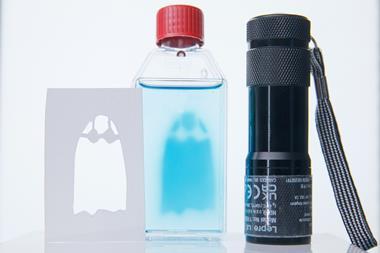
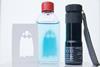
Position the LED work light on a bench shining towards the ceiling. Use the opaque card to mask part of the light. Lay the cell culture flask on its side, with half of it on the card and half directly in the light. Position a white wall or screen behind the flask to help visualise the colour. Within a few seconds, the illuminated part of the solution will decolourise while the shaded section will remain blue. Switch the light back off and watch the colour return to the shaded section.
Teaching goal
This demonstration supports lessons on electrode potentials and the thermodynamics of redox reactions (e.g. spontaneity). With a small extension you can also show how kinetics often overrides a prediction made using thermodynamics alone.
In this experiment, methylene blue has a coloured cationic form (MB+) and a colourless reduced form, leucomethylene blue (LMBH). In the low pH of the citric acid solution (approximately pH 2.5), LMBH is further protonated to LMBH32+.
The electrode potential for the reduction of Fe3+(aq) is:
Fe3+(aq) + e- ⇌ Fe2+(aq) E = +0.77 V
At pH 0, the electrode potential for the reduction of MB+ is:
MB+(aq) + 2e- + 3H+ ⇌ LMBH32+ E = +0.53 V
By combining the half equations, we get:
∆E = Ereduction – E oxidation = +0.53 V – (+0.77 V) = –0.24 V
The pH of the demonstration is around 2.5 rather than 0, meaning the MB+ reduction potential is even less favourable. The Nernst equation shows that the potential at this pH ought to be closer to +0.3 V than +0.53 V.
Either way, the ∆E is negative and the dye will not spontaneously decolourise without energy being supplied to the system. In this demonstration, the energy required to nudge the dye towards spontaneity comes from light.
Methylene blue absorbs efficiently in the red end of the spectrum thanks to the delocalised π system extending over all three rings with λmax of 664 nm.
When MB+ absorbs a photon, a short-lived, highly energetic excited state forms and its full two electron reduction potential increases to +1.43 V. Now the ∆E is large and positive – the solution bleaches. You can demonstrate the importance of light at the red end of the spectrum with the use of coloured filters. Red or yellow filters allow the correct wavelengths through and the dye will bleach, while blue filters will prevent the reaction from occurring.
Once light is removed, the backward reaction wins out and the Fe3+ oxidises the leucomethylene blue back to its coloured form again. This happens slower than in the original demonstration that uses thionine, meaning it’s easier to observe the effects.
Health, safety and disposal
- Read our standard health and safety guidance and carry out a risk assessment before running a live demonstration.
- Wear eye protection.
- CLEAPSS members should consult HC032 and RB108 when making up the methylene blue solution, SSERC members should consult the Chemsitry health and safety page, or consult your local safety authority body. The solution itself is not classified as hazardous at the concentration used in this demonstration.
- Iron(II) sulfate heptahydrate is irritating to skin and eyes.
- See CLEAPSS PS052 for safe use instructions for the LED work light or consult your local safety authority board.
- Dispose of the solution down a foul water drain with plenty of water.
Turn the page to uncover another side to the two-faced reaction …
Downloads
Shed new light on the two-faced reaction technician notes
PDF, Size 0.25 mbShed new light on the two-faced reaction technician notes
Word, Size 0.46 mb


1 Reader's comment