


Get started
Watch a demonstration of this experiment and download the technician notes from the Education in Chemistry website: rsc.li/3LtKCMF
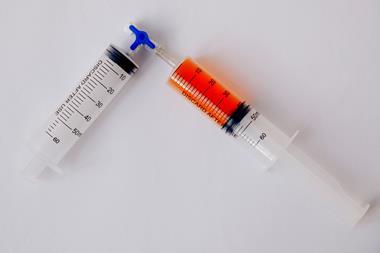
You can use the syringe of nitrogen dioxide, NO2, produced using the Avogadro’s law revisited demonstration to explore a counterintuitive example of equilibria chemistry.
You can use the syringe of nitrogen dioxide, NO2, produced using the Avogadro’s law revisited demonstration to explore a counterintuitive example of equilibria chemistry.
Demonstrate this in your 14–16 and post-16 lessons on the nitrogen oxides and equilibrium.
Kit
- 60 cm3 syringe loaded with nitrogen dioxide
- 60 cm3 syringe loaded with nitrogen monoxide
- Syringe caps
- Kettle and container for a hot water bath
- Access to freezer or salted ice bath
- Approximately 3 cm silicone tubing with a 4 mm internal diameter
- 50 cm3 stop bath of 0.4 M sodium hydroxide
Health, safety and disposal
- Read our standard health and safety guidance and carry out a risk assessment before running a live demonstration.
- Wear eye protection.
- Work in an efficiently running fume cupboard.
- Nitrogen dioxide and nitrogen monoxide are toxic, corrosive and oxidising – avoid skin contact and inhalation. CLEAPSS members should consult HC068B.
- 0.4 M sodium hydroxide is an irritant to skin and eyes. Dilute the contents of the stop bath and dispose of down a foul-water drain.
Preparation
Make a capped syringe of NO2 using the technique in Avogadro’s law revisited . You can use a syringe left over from the previous demonstration or make a fresh sample. Eject 10 cm3 (leaving 30 cm3) into a stop bath of 0.4 M sodium hydroxide, NaOH, in a fume cupboard to allow you to move the syringe’s plunger.
In front of the class and teaching goal
The syringe of NO2 actually contains a mixture of NO2 (red-brown) with dinitrogen tetroxide, N2O4 (colourless), according to the equilibrium in the equation below.
Equation 1: 2NO2(g) ⇌ N2O4(g)
The syringe of NO2 actually contains a mixture of NO2 (red-brown) with N2O4 (colourless) according to the equilibrium in equation 1.
Equation 1: 2NO2(g) ⇌ N2O4(g)
The equilibrium is exothermic as written (ΔH = -57 kJ) and lies to the right at room temperature with a Kc of 215 at 25°C.
Students should predict that depressing the plunger will cause the equilibrium to shift right, leading to a paler colour. Holding a finger over the syringe cap to secure it, depress the plunger and show that, counterintuitively, the colour darkens briefly before paling once more to a similar colour seen at the start. Show the opposite effect by retracting the plunger. This happens because the NO2, which causes the red-brown colour, is contained in a smaller volume and it takes a few seconds for the chemistry to catch up.
Make a hot water bath using the kettle (up to 80°C, above which the plastic may weaken) and an ice bath. Placing the syringe in the ice bath causes the gas to contract slightly while getting substantially paler. When left in the hot water, the colour darkens significantly even though the volume increases slightly.
More resources
- Watch Avogadro in action and demonstrate hydrogenating an alkene without the need for heating.
- Read these CPD articles on reversible reactions and equilibrium constants before using the strategies in your 14–16 lessons.
- Discover 5 ways to explain rate and equilibrium to improve your learners’ exam answers.
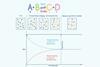
- Display the infographic poster and download the scaffolded storyboard activity for 14–16 students to describe and sequence a dynamic equilibrium.
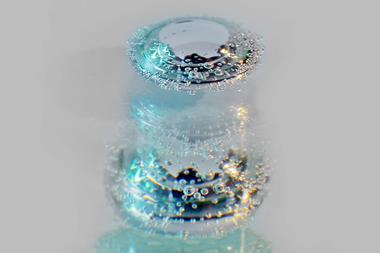
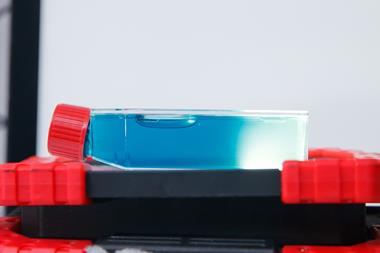
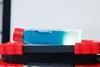
You can demonstrate a second equilibrium if you have time (equation 2). Working in a fume cupboard, connect the syringe of NO2 (and N2O4) to a syringe of NO and draw 30 cm3 of the colourless gas. Leave the 60 cm3 syringe either in the freezer or in a salted ice bath for 10 minutes. A blue liquid will form.
Equation 2: NO(g) + NO2(g) ⇌ N2O3(l)
You can demonstrate a second equilibrium if you have time (equation 2). Working in a fume cupboard, connect the syringe of NO2 (and N2O4) to a syringe of NO and draw 30 cm3 of the colourless gas. Leave the 60 cm3 syringe either in the freezer or in a salted ice bath for 10 minutes. A blue liquid will form.
Equation 2: NO(g) + NO2(g) ⇌ N2O3(l)
Either keep the NO2 syringe when finished or bubble the gaseous contents through a stop bath of 0.4 M NaOH. When I am finished with a syringe, I demonstrate the reaction of NO2 with water and the neutralisation of the resulting acid. If you add a few drops of universal indicator to the stop bath and draw up 5 cm3 into the syringe, the colour will change as the gas dissolves into and reacts with the NaOH solution, demonstrating the formation and neutralisation of nitric acid.
Declan Fleming
Downloads
Unexpected equilibrium technician notes
Handout | PDF, Size 0.21 mbUnexpected equilibrium technician notes
Editable handout | Word, Size 0.47 mb



No comments yet