


A map to maximum marks with a foolproof checklist and different worked examples
Why is finding x so difficult if we move x? This sounds like a straightforward maths question, but teaching bond energy calculations can be tricky. Typically, learners can calculate the overall energy change for a reaction from given bond energies. However, when given the overall energy change, some of the bond energies and an unknown bond energy (x), they often struggle to find x.
Bond energy calculations appear most years on exams for 16 year-olds, and usually in two regular formats. The first, a simple approach to calculate the overall energy change for a reaction ΔH. The second is usually a more complex calculation to determine an unknown bond energy when given the overall energy change ΔH.
Calculating bond energy changes
First of all, here is a quick checklist for students so they can work out which type of problem they are solving:
1. Does the question state the reaction is endothermic or exothermic?
2. Does the question state that there is more/less energy involved in breaking bonds in reactants or forming bonds in the products?
3. Does the question tell you the overall energy change for the reaction?
4. Does the table of bond energies provided have a letter x rather than a value?
If the students answer yes to questions three and four, they have a missing bond energy to calculate. I approach teaching the solution through three different scenarios where x is in a different place each time. Note that it’s important students have revised that breaking bonds is endothermic and making bonds is exothermic.
Scenario one – Calculate x where ΔH is x
I start by introducing the simple reaction of hydrogen reacting with fluorine.
Hydrogen + Fluorine → Hydrogen fluoride
H–H + F–F → 2HF
∑Reactants – ∑Products = Energy change ΔH
∑Reactants – ∑Products = x
(436 + 254) – (2 x 423) = x
690 – 846 = –156 kJ/mol
Top tip → This method generates a positive/endothermic answer or a negative/exothermic answer.
Scenario two – Calculate an unknown bond energy x
I then let students know this is an almost identical reaction, so just one change at this point. They now calculate the Cl–Cl bond energy, but I tell them that ΔH = -165 kJ/mol.
Hydrogen + Chlorine → Hydrogen chloride
H–H + Cl–Cl → 2HCl
∑Reactants – ∑Products = Energy change ΔH
(436 + x) – (2 x 428) = –165
Rearrange to make x the subject of the equation: x = -165 – 436 + (2 x 428)
x = 255 kJ/mol
Scenario three – Find the unknown bond energy x for a higher demand example
I introduce this example by asking students to study the question and identify the difference between this and the previous two scenarios.
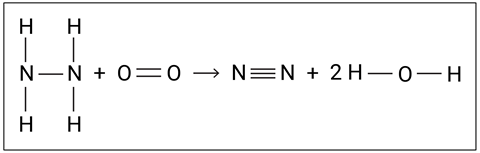
The reaction below is exothermic and releases 581 kJ/mol.
Calculate the bond energy of the O=O bond:
| Bond |
N–N |
N–H |
O=O |
N≡N |
O–H |
|---|---|---|---|---|---|
| Bond energy kJ/mol |
163 |
391 |
x |
945 |
464 |
First, get the students to draw a vertical line to separate reactants and products, then follow the steps in the table:
| Reactants | Products | |
|---|---|---|
| Bond count |
(N–N x 1) + (N–H x 4) (x x 1) |
(N≡N x 1) (O–H x 4) |
| Bond energies |
(163 x 1) + (391 x 4) + x |
(945 x 1) + (463 x 4) |
| Sum |
1727 + x |
2797 |
|
Reactants – Products = ΔH |
||
| Substitute |
1727 + x –2797 = –581 |
|
| Rearrange |
x = -581 – 1727 + 2797 |
|
| Answer |
489 kJ/mol |
|
Top tip → Cross out each bond in the diagram as you count them and circle the number of each molecule.
In scenarios one, two and three, the aim is to find x. The difference is that x changes position in the calculation.
Avoid slip-ups
According to examiner reports, the more complicated examples are problematic for students.
Common exam errors include:
- Completing the calculation incorrectly. However, those who did not complete the calculation correctly could score partial credit for working out that the energy to break bonds is 1727 + x kJ/mol and/or that the energy involved in forming bonds is 2797 kJ/mol.
- Leaving out the x for the bonds broken.
- Ignoring the overall energy change of 581 completely.
- Adding the 581 to the bonds formed instead of subtracting it or adding it to the bonds broken.
However, if your students follow the methods above, they will be on track to find x.
Ian McDaid







No comments yet