

Spark learners’ curiosity with a eye-catching demonstration, then keep the flame aglow with a memorable story
‘No way! Can you do it again? Can I video it?’
These are the phrases every science teacher loves to hear. Students are captivated, asking questions and talking about the lesson as they leave. That’s the perfect lesson.
Engagement sparks curiosity and drives achievement, but keeping students engaged can feel like an uphill battle. Wow demonstrations instantly grab attention, yet their impact can fade quickly. Storytelling helps that excitement last.
The best stories make students wonder, ‘Why did that happen? What will happen next?’
Stories place facts in context, giving students a framework for memory and understanding. They also evoke emotion, which deepens engagement and motivation. Stories and demonstrations share common ingredients – drama, suspense and surprise. So how can you combine the two to create a learning experience that is extraordinary and truly deserving of the wow title?
Stimulate curiosity
The best stories make students wonder, ‘Why did that happen? What will happen next?’ In his Fire Stopper demonstration, Declan Fleming turns a simple idea – carbon dioxide extinguishing fire – into a powerful narrative linked to the 1986 disaster when more than 1,700 people and many animals were killed by a massive release of gas from Lake Nyos in Cameroon.
The best stories make students wonder, ‘Why did that happen? What will happen next?’ In his Fire Stopper demonstration, Declan Fleming turns a simple idea – carbon dioxide extinguishing fire – into a powerful narrative linked to the 1986 disaster when more than 1,700 people and many animals were killed by a massive release of gas from Lake Nyos in Cameroon (rsc.li/4oEQkdy).
With careful questioning, students discuss, debate and uncover misconceptions, transforming a quick demo into real learning.
Create emotional connection
Chemistry’s history is full of accidental discoveries and students love to hear about how things have gone wrong. Put a human face to the story and the chemistry becomes more concrete and memorable.
In 1845 Christian Schönbein was working at his kitchen table when he accidentally spilt a mixture of nitric and sulfuric acid. He wiped them up with a cotton apron and hung it to dry on the oven door. Moments later, the apron burst into flames and disappeared without trace. This led to the development of guncotton, a material six times more explosive than gunpowder. You can demonstrate the reaction to enhance lessons on combustion and balancing equations.
Using places, ideas and objects that students know about and encounter regularly can help them relate the science to their own life, encouraging them to perceive science as relevant to them. Demonstrating this reaction doesn’t just show combustion – it tells a story of curiosity and discovery. The rapid production of large quantities of gaseous products makes guncotton a useful explosive for blasting in mines and quarries – a useful link if your students live near a local quarry.
In 1845 Christian Schönbein was working at his kitchen table when he accidentally spilt a mixture of nitric and sulfuric acid. He wiped them up with a cotton apron and hung it to dry on the oven door. Moments later, the apron burst into flames and disappeared without trace. This led to the development of guncotton, a material six times more explosive than gunpowder. You can demonstrate the reaction to enhance lessons on combustion and balancing equations (rsc.li/4r2Vulg).
Using places, ideas and objects that students know about and encounter regularly can help them relate the science to their own life, encouraging them to perceive science as relevant to them. Demonstrating this reaction doesn’t just show combustion – it tells a story of curiosity and discovery. The rapid production of large quantities of gaseous products makes guncotton a useful explosive for blasting in mines and quarries – a useful link if your students live near a local quarry.
Build suspense
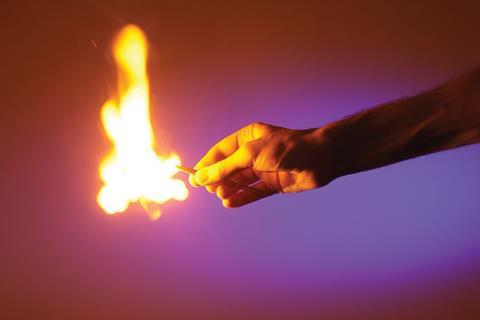
Suspense is crucial in storytelling – it keeps readers engaged and invested in the narrative. Demonstrations such as the non–burning paper where there are obvious consequences if it all goes wrong can be greatly enhanced with a simple narrative designed to build tension. Traditionally, you would burn a bank note in this demonstration to raise the stakes. Since the new polymer notes can’t burn, you could pretend to burn a piece of homework instead. This will focus your students’ attention, and they’ll be excited to see what happens next.
Suspense is crucial in storytelling – it keeps readers engaged and invested in the narrative. Demonstrations such as the non–burning paper where there are obvious consequences if it all goes wrong can be greatly enhanced with a simple narrative designed to build tension (rsc.li/49jy04U). Traditionally, you would burn a bank note in this demonstration to raise the stakes. Since the new polymer notes can’t burn, you could pretend to burn a piece of homework instead. This will focus your students’ attention, and they’ll be excited to see what happens next.
Choose your moment
Wow demonstrations require juggling multiple tasks: handling equipment, asking questions, managing behaviour, achieving learning outcomes and keeping everyone safe. Adding a story to accompany this adds further to the challenge and makes practice of both the demonstration and the story prior to delivery essential.
The question of whether teachers should purposefully aim to entertain is complex and subjective. Adding a story to every demonstration would not be appropriate but when used thoughtfully, storytelling turns fleeting wow moments into lasting understanding. It gives demonstrations context, emotion, and meaning – enhancing learning rather than distracting students from it. It can transform sparks of excitement into genuine curiosity that will help learners connect with the curriculum.
Catherine Smith
For further guidance on running effective demonstrations, visit The National Strategies – Effective demonstrations.






3 readers' comments