

Ian McDaid describes his favourite ‘must do’ experiments to engage your students
My memories of school always bring back to me that one teacher who got it right. That person was my secondary school chemistry teacher, Brian ‘Betty’ Thompson.
How did he get it right? He stimulated my thoughts, promoted an inquisitive approach to learning and adopted a practical approach to teaching.
Based on those principles, here are my favourite chemistry practical activities you can use to engage your students. Remember, always carry out a full risk assessment before attempting any of these experiments.
1. Amazing displacement
This dramatic demonstration ventures to the extremes of the reactivity series. When you add water to a mixture of silver nitrate powder and magnesium powder, rapid ion exchange causes an explosion that ignites any leftover magnesium.
If you attempt this, be aware that the mixture can spontaneously ignite. The powders must be very dry and under no circumstances should you grind them together.
2. Flaming rainbow
A simple demonstration of flame colours of various metal salts can take you all the way to discussing excited electrons. You can find a safe and exciting way to perform this demonstration for 11–18 learners.
The key question with this experiment is, ‘how does heat energy produce different colours?’ This gives students a really visual demonstration of energy levels occupied by electrons and leads to an interesting discussion of the relationship of ΔE with the wavelength of light.
As a follow up you can get pupils to carry out flame tests using metal salts on clean nichrome wires.
3. Alginate worms
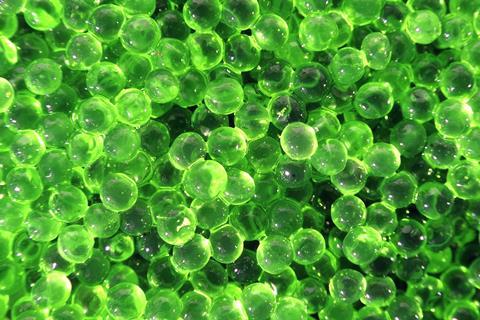
You will probably be aware of the classic ‘slime’ experiment using borax and PVA glue to illustrate the change in properties when cross-links form. An alternative using sodium alginate to make gel spheres and ‘worms’ works so much better and has much more visual impact.
So, what’s the science behind this? In the suspension, sodium ions are bonded to the alginate chains. These are displaced by calcium ions that can form bonds between two alginate chains, forming cross-links between them.
4. Rainbow fizz
Gently pouring sodium carbonate solution into a boiling tube of dilute hydrochloric acid with universal indicator is an incredibly visual way of introducing pH, indicators, neutralisation, density or diffusion to a lesson.
These experiments are adapted from Ian McDaid's book, 100 ideas for secondary teachers: outstanding science lessons (published by Bloomsbury).
Watch demos
Check out Declan Fleming's demonstrations of alginate worms and rainbow fizz in our Exhibition chemistry articles. They also include full instructions for teachers and technicians.
This article was updated on 24 September 2025.





3 readers' comments