



Crystals of a key mineral responsible for water hardness synthesised for first time
-
Download this
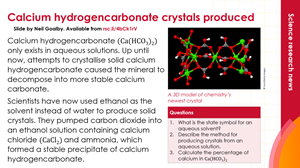
Use this story and the accompanying summary slide for a real-world context when studying formation of salts with your 14–16 learners.
Download the story as MS Word or PDF and the summary slide as MS PowerPoint or PDF.
If you are a fan of the Great British Bake Off, you likely have some sodium hydrogencarbonate, NaHCO₃, better known as bicarbonate of soda, in your kitchen. This white crystalline powder reacts with acids in cake batter to produce carbon dioxide gas, which helps cakes rise.
Despite trying for around two centuries, scientists have not been able to isolate calcium hydrogencarbonate crystals – until now
If you live in a hard water area, calcium hydrogencarbonate, Ca(HCO₃)₂, is also in your kitchen, dissolved in the water flowing from your taps. But unlike its sodium counterpart, it is only present in a solution. Despite trying for around two centuries, scientists have not been able to isolate calcium hydrogencarbonate crystals – until now. Earlier attempts failed because the salt rapidly decomposes to calcium carbonate (CaCO3) when the water it is dissolved in evaporates. In hard water areas, these calcium carbonate crystals line the inside of kettles.
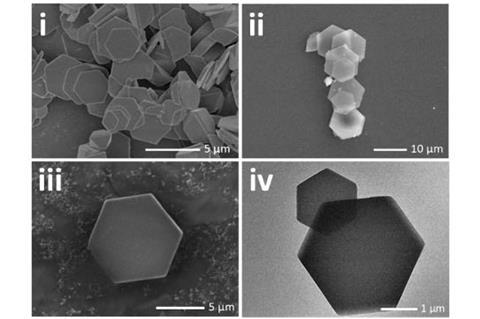
Researchers in China have now reported that they have successfully isolated crystals of calcium hydrogencarbonate. The team made the salt in ethanol rather the water used in previous attempts. They pumped carbon dioxide into an ethanol solution to make hydrogencarbonate ions, which then formed calcium hydrogencarbonate salt by forming ionic bonds with calcium ions also present in the ethanol solution. Calcium hydrogencarbonate is insoluble in ethanol, so the salt formed as a crystalline precipitate.
The research team then probed the calcium hydrogencarbonate’s structure, revealing that it has a similar crystal structure to calcium carbonate. Using the same strategy, the team then made hydrogencarbonate crystals of strontium and barium, which were also previously difficult to synthesise.
This breakthrough expands scientists’ understanding of how metal–hydrogencarbonate bonds form within ionic compounds. The researchers also suggest that materials like these could support new ways to capture carbon dioxide from the atmosphere and inform global challenges.
This article is adapted from Mason Wakley’s in Chemistry World.
Nina Notman
References
K Kong et al, J. Am. Chem. Soc., 2025, doi.org/10.1021/jacs.5c12101
Download this
Summary slide with questions and the article for context when teaching 14–16 lessons on formation of salts: rsc.li/XX
Downloads
Calcium hydrogencarbonate salt formation student sheet
Handout | PDF, Size 0.21 mbCalcium hydrogencarbonate salt formation student sheet
Editable handout | Word, Size 0.5 mbSummary slide Calcium hydrogencarbonate
Presentation | PDF, Size 0.26 mbSummary slide Calcium hydrogencarbonate
Presentation | PowerPoint, Size 0.71 mb







No comments yet