

Instilling representational competence is key to improving student knowledge of molecules
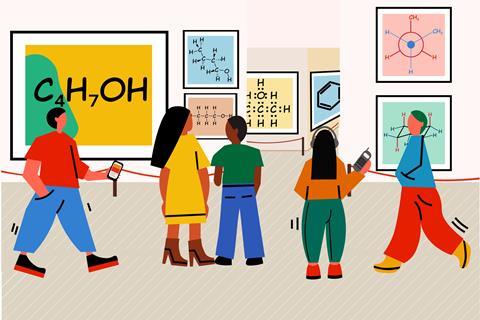
Chemistry students encounter a bewildering range of ways to represent molecules, each communicating different aspects of molecular structure. Learning to move between them is more than learning how to draw each representation. Students need to recognise what information each representation contains and connect that information across different forms.
Chemistry students encounter a bewildering range of ways to represent molecules, each communicating different aspects of molecular structure. Learning to move between them is more than learning how to draw each representation. Students need to recognise what information each representation contains and connect that information across different forms.
Representational competence
This ability, known as representational competence, is particularly important in organic chemistry, where representations increasingly incorporate implicit atoms and three-dimensional information. But how do students reason when asked to translate from one representation to another?
Researchers in the US investigated how students taking an introductory organic chemistry course translated between seven representations of molecular structure: molecular formulas, condensed structures, Lewis structures, skeletal structures, wedge-dash diagrams, chair conformations and Newman projections.
A cohort of 28 students completed 20 translation tasks while taking part in semi-structured think-aloud interviews, encouraging them to explain their reasoning as they worked.
The more successful students were better at adapting when a switch in strategies was necessary
Rather than simply recording whether an answer was right or wrong, the researchers wanted to understand how students arrived at their answers. They coded these responses to identify reasoning strategies, examined the relationship between strategy use and accuracy, and then used cluster analysis to identify broader patterns in students’ approaches. This produced 18 reasoning strategies, grouped principally into decoding, mapping and drawing, as well as four distinct student personas.
Approaches to translation
Rules are not enough
Students typically used between two and four strategies for each translation task. These included decoding strategies, such as counting atoms and checking connectivity, and mapping strategies, such as matching functional groups between representations.
Drawing was useful when students had to work with representations containing implicit atoms or three-dimensional information. Creating an intermediate representation could reduce the complexity of the problem and make otherwise implicit structural features visible. However, drawing was relatively underused, appearing in fewer than a quarter of the translation tasks.
The students’ approaches fell into four broad personas:
- Handypersons had the broadest repertoire of strategies and were generally able to select appropriate approaches for different problems
- Apprentices knew several useful strategies but struggled particularly with the more spatial representations introduced in organic chemistry
- Quick fixers relied heavily on surface-level similarities, such as assuming that features in the same position on the page represented the same structural feature
- Rule followers applied self-generated rules rigidly, struggling when those rules did not fit the representation in front of them.
The important distinction was therefore not simply whether students knew particular strategies; students could use the same strategy productively in one context but inappropriately in another. The more successful students were better at adapting when a switch in strategies was necessary.
This study suggests that students need to learn not just what each representation means in isolation, but how to reason between them and decide which strategies are appropriate to translate between representations.
Teaching tips
- Make your own reasoning visible. When you demonstrate translating between representations, talk through the checks you make.
- Ask students to explain, not just identify. A student who correctly recognises that two structures represent the same molecule may still be relying on an unproductive strategy.
- Challenge surface-level matching. The quick fixers in this study often matched features according to where they appeared on the page rather than what they represented.
- Encourage transitional drawings. When representations become more complex, ask students to draw an intermediate structure before making the translation.
- Discuss what each representation can and cannot show. Rather than treating representations as interchangeable pictures of the same molecule, ask students what information each one makes visible or hides.
- Use paired or small-group reasoning. Think-pair-share, clicker questions and guided discussion are ways of making students’ reasoning visible.
Fraser Scott
Reference
L Wright Ward, F Rotich, S Arevalo and M Popova, Chem. Educ. Res. Pract., 2026, doi.org/10.1039/d5rp00382b









No comments yet