


Use these research-based approaches for learners with different confidence levels to improve all your students’ learning

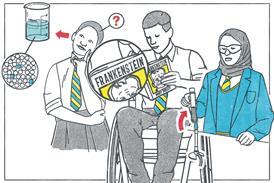
Peer feedback is a powerful tool for helping chemistry students refine their scientific arguments, evaluate evidence and develop stronger reasoning. This type of formative assessment offers students the opportunity to improve a piece of work.
Yet in practice, many teachers find that peer review activities fall short of their potential. A 2025 research study offers a compelling explanation that the effectiveness of peer feedback depends less on the comments students receive and more on how they experience the task, particularly regarding the level of confidence they have in their own work.
Student confidence impacts effectiveness
Confidence levels
The study shows that students with low confidence look for reassurance in peer comments and can feel destabilised by critique, even when it is constructive. Students with moderate confidence are more receptive. They actively search for specific suggestions that will help them improve. Highly confident students often treat peer review as a confirmation exercise. They skim for praise, discount criticism and rarely revise unless the feedback aligns with what they already believe.
These confidence-driven patterns interact with several structural barriers commonly seen in classrooms. Without explicit modelling, students often default to vague praise, ‘looks good’ or blunt criticism, ‘this is confusing’. Neither of these supports meaningful revision. Many also hold an expert bias, assuming that only the teacher can provide trustworthy feedback. When tasks have a single correct answer, there is little space for peers to offer substantive critique, making the activity feel artificial.
Getting the best results from peer feedback
Plan for the best results
Peer feedback becomes genuinely productive when teachers design for collaboration, openness and metacognitive engagement. Reframing the activity is a powerful first step. When students understand that their role is to act as thinking partners rather than judges, they become more willing to explore alternative interpretations and to revise their own ideas.
Task design is equally important. Peer review works best in tasks where multiple defensible answers exist. Students have to justify choices, interpret data or evaluate competing explanations. These open‑ended structures create the cognitive space necessary for meaningful dialogue.
Scaffolding also plays a crucial role. Sentence starters and structured routines help students move beyond surface-level comments into reasoning-focused critique. A simple pattern, such as identifying one strength, one area for improvement and one concrete next step, gives students a manageable framework for offering useful feedback.
Teaching tips
Before the activity
- Frame peer feedback as a collaborative learning process where students act as thinking partners.
- Choose open tasks that require interpretation or justification rather than a single correct answer.
- Share simple sentence starters so students know how to give specific, constructive comments.
During the activity
- Use a clear routine: one strength, one area for improvement and one concrete next step.
- Encourage students to focus on clarity, reasoning and evidence rather than surface features.
- Circulate to prompt deeper thinking, especially for students who tend to offer only praise or brief criticism.
After the activity
- Build in DIRT so students can act immediately on the feedback they receive.
- Ask students to annotate their changes or explain why they chose not to use a particular suggestion.
- Provide tailored support: exemplars and guided questions for low‑confidence students; stretch prompts for highly confident students.
Feedback only becomes learning when students have time to act on it. Building in Dedicated Improvement and Reflection Time (DIRT) immediately after the exchange encourages students to revise while the feedback is fresh. Asking them to annotate their changes or justify why they chose not to use a suggestion deepens their evaluative judgement.
Low confidence learners benefit from exemplars, verbal rehearsal and reassurance that multiple answers are possible. High confidence learners may need stretch prompts that require them to justify their decisions, especially when they choose to reject peer input.
Giving feedback is a powerful learning activity. Analysing someone else’s work helps students recognise strengths and weaknesses in their own reasoning.
More resources for effective peer feedback
- Discover our ready-made structure strips, aka sentence starters.
- Read 5 ways to use them to scaffold learning.
- Try these tips for using peer support during practical work.
- Learn how to use peer feedback to understand what your learners know.
- Discover our ready-made structure strips, aka sentence starters: rsc.li/3OwjC0Y
- Read 5 ways to use them to scaffold learning: rsc.li/4tyDFdZ
- Try these tips for using peer support during practical work: rsc.li/4516h5A
- Learn how to use peer feedback to understand what your learners know: rsc.li/4bnGmZu
Naomi Hennah
Reference
MT Urbanek, D Vinton and A Moon, Chem. Educ. Res. Pract., 2026, 27, 494–506 (doi.org/10.1039/D5RP00118H)
References
MT Urbanek, D Vinton and A Moon, Chem. Educ. Res. Pract., 2026, 27, 494–506 (doi.org/10.1039/D5RP00118H)









No comments yet