There is an emerging trend towards using pre-lecture activities to support tertiary level learning: the options investigated
The concept of pre-laboratory activities is familiar to chemists. Students complete some work before the laboratory session with a view to familiarising themselves with an experimental technique or some underlying principles of the experiment. Therefore, more than most educators, it is not a big conceptual leap for chemists to consider pre-lecture activities in their teaching, with a similar purpose of preparing the mind of the learner.
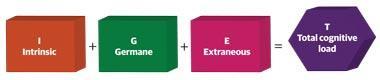
The underlying pedagogy of pre-lecture activities is grounded in cognitive load theory (see box). As learners are exposed to new information, they process what they see and hear in the working memory. The amount of information – called the cognitive load – that can be processed is limited, and depends on the learner's prior knowledge. The more a learner knows about a subject, the easier it is to assimilate the newly acquired information into the long-term memory. Cognitive load theory provides a basis for describing how much new information should be presented (intrinsic load) and how this is presented (extraneous load) so that there is capacity for learning (germane load) to take place. For learners new to a topic or discipline, reducing the amount of new information presented in any single learning situation and presenting the information clearly, leaves more capacity for learning.
Cognitive load theory
Cognitive load describes the capacity for learners to process new information in the working memory. Three types of cognitive load are identified:
- Intrinsic load is caused by the unfamiliarity and/or complexity of the material. This depends on the level of expertise of the learner – the extent of their prior knowledge.
- Extraneous load depends on the quality or nature of the instructional materials. Poor materials or those that require a large amount of working memory to process will increase the load and leave little capacity for learning.
- Germane load is the mental effort required for learning. Due to the limited capacity of the working memory, the capacity to process germane load (the extent of learning) will depend on the level of intrinsic and extraneous load.
Pre-lecture activities aim to directly address the intrinsic load component of cognitive load. By providing learners with some information prior to the class, the amount of new information presented during class time is reduced. Learners have time to process the information provided in advance, and if structured properly, they can use this information in a class setting. This opens up several questions for implementation in practice: what form the pre-lecture activities take; how much information to provide in advance; how to ensure students will look at this information; and how the pre-lecture information is used in class time.
Types of pre-lecture activities

Cognitive load describes the capacity for learners to process new information in working memory
Pre-lecture activities aim to present some specific information to students for a specific purpose. Therefore, they can take any form you like that fulfils this role. This may be as simple as requesting that students read a specific section of a textbook or webpage or may be a custom-made resource that presents information and includes questions. An important consideration to remember is that the underlying rationale is based in cognitive load. Therefore, recommendations for reading in textbooks should be specific, and have clear goals outlined. With custom-made resources, it is easy to drift into asides and contexts. In terms of cognitive load theory, these are considered 'noise' and should be avoided. The time students spend completing pre-lecture activities will depend on what category they fall into and are described in table 1. However, even those which aim to present most or all of a lecture did not extend much beyond 15 minutes.
Categorising pre-lecture activities
Two scenarios are outlined in table 1 which represent ends of a spectrum of the type of pre-lecture activities that can be incorporated into teaching. At one end, preparatory pre-lecture activities are used to provide learners with an overview of some of the core concepts of a lecture. The lecture itself remains relatively unchanged, save for occasional references to what was presented in the pre-lecture activity. The aim is to reduce some of the in-class intrinsic load by presenting students with some key concepts in advance. It is a low-risk strategy for all concerned ? students who do not complete the activity will still have the core content of what was delivered in the lecture, although they may struggle with the pace if the lecturer is assuming some basic principles have been addressed in advance. For lecturers, it requires, in principle, little change in the lecture, and therefore little work beyond preparing the pre-lecture activity. However, in practice, it has been found that when armed with some core terminology/principles on arriving at the lecture, students are more likely to ask questions based around their understanding of topics, and the nature of the lecture tends to become more discussion-based.
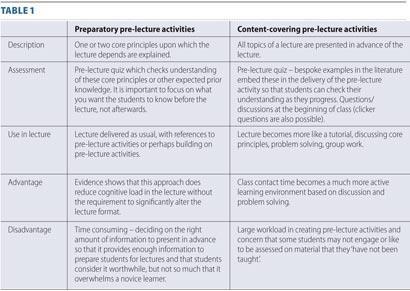
This concept of making lectures more discussion-based leads to a second category: content-covering pre-lecture activities. In this case, students cover a significant portion of lecture material in their own time in advance of the lecture. The lecture hour is devoted to discussing this content in greater detail or dealing with problems or misunderstandings. This concept is grounded in cognitive load theory, and is the basis of an emerging trend called 'flipping/inverting the classroom', whereby students do work that was traditionally done in a lecture in their own time, and work that was traditionally done as homework in class time. By requiring so much of students in advance, this approach is high-risk, in that there is a substantial demand on the learner to cover a required amount of material before class. It is also more demanding for lecturers, as the structure of the lecture is now more vague. In principle, students could request to discuss any aspect of the content they did not understand. In practice, structured in-class work can be used, along the lines of a tutorial.
These two scenarios represent extreme ends of a spectrum of possibilities for pre-lecture activities, and it is likely that most lecturers considering their use will initially opt for something in between. Whichever approach is taken, it is likely to be more effective if you can link it to some prior knowledge the students are likely to have. The lecturer should be clear about what is required of the pre-lecture activity and how it will be used in the lecture. Once this is clear, the assessment of the pre-lecture work can be established.
Assessment

The implementation of pre-lecture activities into your teaching will rely on assessment. This is most conveniently done using some form of online quiz that students complete before the lecture. The nature of the questions should reflect what is required of the pre-lecture activity; ranging from questions on understanding core concepts for activities which aimed to introduce a topic, to questions on application or analysis for activities that aimed to cover a topic in detail. As with any online quiz, it is worthwhile taking some time to consider the wrong answers, as well as the question, as this can help students tease out any misconceptions they may have. Quiz-setting software allows for variety in question types other than multiple choice – for example hot-spots or matching pairs.
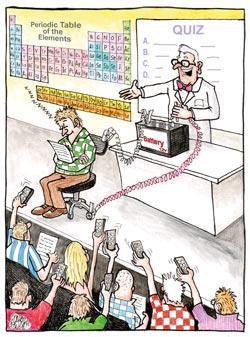
For activities that tend towards the content-covering model, some more thought needs to be given to assessment, as they involve a significant effort on behalf of the student. One approach is to complement the pre-lecture quizzes with some in-class formative assessment. This allows students to report on their conclusions from study and receive feedback from it, but it does not necessarily contribute to their formal grade. In my own practice, I have tried this approach by asking students to investigate experimental techniques prior to a lecture, and then using first peer and then whole-class (approximately 90 students) discussion in the lecture time to build up a set of notes on a particular instrument. It is more time-consuming than a traditional approach, but I feel the discussion does allow students to develop their understanding of the topic more and gets them talking about a technique, its applications and limitations. With larger class sizes, this might be more easily managed with in-class clickers.
Teaching style
The assessment aims to give students a motivation to complete the pre-lecture activity, and it would probably be foolish to think they would do so on an ongoing basis if it wasn't there. However, a consistent theme emerges from the literature on pre-lecture activities. Even for those who were wedded to a traditional lecture style found that their class time changed. Students arriving in class with some preparation for material being presented were more able to ask questions on misunderstandings. This in turn led to more in-class discussions, based on the pre-lecture activities. This attributes a real sense of value to the activities, they are seen as relevant and useful to students. Therefore it is recommended, even for pre-lecture activities in the preparatory category, that the lecturer makes reference to them and uses them wherever possible so that the pre-lecture, lecture and assessment are seen as a combined unit in the overall learning on any particular topic.
Getting started
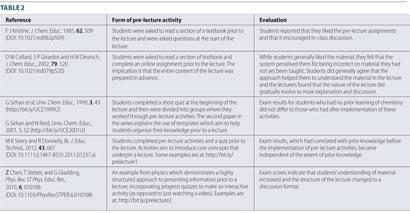
Some examples of reports of pre-lecture activities in the education literature are summarised (table 2) and provide a range of approaches people have tried. Educators wishing to test out this idea could take one or two lectures whose content is known to be difficult to students, and prepare a pre-lecture activity for the students to try. This would give a feel for how students use them and how they might adjust their teaching style to accommodate them. Having brought them into my own teaching of introductory chemistry several years ago, and seen their effect on students' preparedness for lectures, I have never looked back.
Michael Seery is a lecturer in physical chemistry at the Dublin Institute of Technology, Ireland
Acknowledgements
My thanks go to Norman Reid and his colleagues at the Centre for Science Education, University of Glasgow, whose two papers Preparing the mind of the learner and subsequent discussions informed much of my own understanding on this topic.
Downloadable Files
Download this article as it originally appeared in Education in Chemistry
PDF (334k)
PDF files require Adobe Acrobat Reader






No comments yet