



Use this poster and fact sheet to aid your students’ fluency with carrying out flame tests and analysing the results
A flame test is an analytical technique used to identify the presence of certain metal elements in a sample. The sample is heated in a flame and the colour of the flame used to identify the element present.
A common use for flame tests is to identify the metal ion present in an unknown ionic compound.
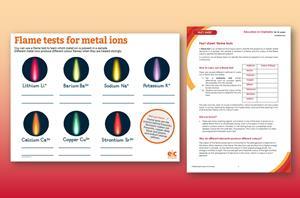
View and download more infographics
How to carry out a flame test
There are several different methods to carry out a flame test, including the recommended wooden splint method, but simply:
- Dip a nichrome wire (other alternatives such as wooden splints are possible) into the sample.
- Place the wire into the blue flame of a Bunsen burner.
- Observe and record the colour of the flame produced in a table like the one below.
The wire must be clean to avoid contamination, which would lead to an inaccurate result. It can be cleaned by dipping it into hydrochloric acid and then placing it into a blue Bunsen flame until no colour is seen.
Did you know?
There are many masking agents, but sodium is one of the best. It produces a yellow flame that is so remarkably strong, even a tiny speck of dust or sweat (which contains sodium chloride) on the testing loop can completely mask weaker colours like the pale lilac of potassium. This is why it is important to clean your equipment between each test.
Lithium Li+ (pink flame) Barium Ba2+ (green flame)
Sodium Na+ (yellow flame) Potassium K+ (lilac flame) Calcium Ca2+ (orange flame)
Copper Cu2+ (green-blue flame) Strontium Sr2+ (red flame)
Why do different elements produce different colours?
The colour of the flame produced is connected to the arrangement of electrons in the atom. When heated in the flame, the electrons are excited into a higher energy state that is unstable. As the electrons return to their original energy levels, the energy is emitted as light. The wavelength and therefore colour of the light emitted depends on the arrangement of electrons in the atom, which is unique to each element.
Not all elements produce a coloured flame. This is because either the light emitted when the electrons return to their original energy levels has a wavelength outside of the visible region (what we can see), or the atoms are extremely stable, meaning that the electrons can’t initially be excited. For these elements, alternative methods must be used to identify them.
Did you know?
- When a flame test is carried out on a solution containing an unknown metal ion, it is not the electrons in the ions in solution that are excited. Instead, during the flame test, the ions are converted usually into the neutral metal atom, and it’s the excitation of electrons in this atom that give rise to the familiar colours.
- Chemistry in the night sky: Flame tests are the exact science behind fireworks. By mixing different metal compounds into firework shells, you can create colourful displays. Strontium is used for reds, copper for deep blues and greens and sodium for intense yellows.
Downloads
Flame tests poster
Handout | PDF, Size 4.19 mbFlame tests fact sheet
Editable handout | Word, Size 0.44 mbFlame tests fact sheet
Handout | PDF, Size 0.1 mb




No comments yet