










Use scaffolded prompts to support learners to write about representing elements and compounds
-
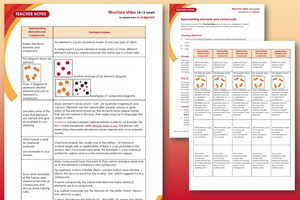
Download this
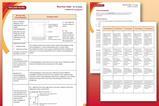
Stick these structure strips into the margin of a page to support learners to find or retrieve information and write independently about representing elements and compounds. The resource includes editable writing prompts, an extension question and example answers.
View and download more Structure strips
Learning objectives
- Construct and interpret diagrams, formulas and names of elements and compounds.
- Describe the format of chemical symbols.
- Describe the differences between elements and compounds.
Introduction
Atoms of elements are the building blocks of all substances. All the known elements are organised in the periodic table and represented by their chemical symbols. However, many of the everyday chemicals we use are compounds, not elements. While chemical symbols represent elements, combinations of different chemical symbols in a formula represent compounds. The names and diagrams of compounds are also different to the names and diagrams of elements.
How to use structure strips
Structure strips are a type of scaffolding you can use to support learners to retrieve information independently. Use them to take an overview at the start of the topic, to activate prior knowledge, or to summarise learning at the end of a teaching topic. For more ideas on how to use structure strips with your learners, visit 5 ways to use structure strips effectively.
Structure strips have sections containing prompts, sized to suggest the amount that learners must write. Ask learners to glue the strips into the margin of an exercise book and write their answers next to the sections, in full sentences or in bullet points. When learners have finished using the structure strip, they will have an A4 page set of notes and examples.
The strips are printed five to a page and will need to be trimmed to size. Find them on the second page of the student sheet.
This resource is part of our support for literacy in science teaching, designed to embed literacy into your curriculum and develop learners’ skills in reading, writing and talking about science and their understanding of scientific language.
Scaffolding
- Encourage learners to use the suggested key words and phrases in their answers. These link with our corresponding key terms support resources for Elements, compounds and mixtures at 14-16 and at 11-14.
- To further support learners, include additional prompts in the structure strip. If learners are struggling to engage with the task, supply them with sentence starters created from the example answers. Alternatively, get learners to discuss the prompts with a partner before attempting their answer.
- As learners grow in confidence, ask them to attempt the extension task first and then use the structure strip to improve or self-assess their attempt.
- Use the tips in this article to further support your learners’ understanding of the differences between elements and compounds.
Key words
Element, compound, atom, chemical symbol, chemical formula.
Metacognition
This resource supports learners to develop their metacognitive skills in three key areas.
- Planning: the strips provide scaffolding to plan the written response. Learners will decide where to gather information from (textbooks, own notes, revision websites). Ask learners: is the source of information you are using reliable?
- Monitoring: learners are prompted by the questions in the structure strip and can check their own answer against the prompts. Ask learners: have you covered all of the prompts in the space provided? Do you need to change anything to complete the task?
- Evaluation: learners can self-assess or ask a peer to check their work against the answers. Ask learners: did you achieve what you meant to achieve? What will you do differently another time?
Answers
Suggested answers for the structure strip activity are given in the downloadable teacher notes.
Answer to extension question
Learners are asked to explain why several statements about particular elements and compounds are incorrect, and suggest a correction in each case. Example answers are provided in the teacher notes.
Downloads
Representing elements and compounds structure strip student sheet
Handout | PDF, Size 0.19 mbRepresenting elements and compounds structure strip teacher notes
Handout | PDF, Size 0.23 mbRepresenting elements and compounds structure strip student sheet
Editable handout | Word, Size 0.44 mbRepresenting elements and compounds structure strip teacher notes
Editable handout | Word, Size 0.49 mb
- Prepare(2)
- Deliver(4)
 Resource
Representing elements and compounds | Developing understanding | 14–16 years
Explore a variety of visual representations from particle models to chemical formulas
 Resource
Sulfur dioxide | Johnstone’s triangle | 14–16 years
Consider sulfur dioxide in the atmosphere at three conceptual levels to embed understanding of compounds and mixtures
currently reading
 Resource
Representing elements and compounds | Structure strip | 14–16 years
Use scaffolded prompts to support learners to write about representing elements and compounds with confidence
 Exhibition chemistry
Clarifying compounds and mixtures
Declan Fleming clears up confusion in a puff of purple vapour
- Literacy(2)
 Resource
Elements, compounds and mixtures | Reading comprehension | 14–16
Practise reading comprehension skills with a science research article about a new technique for extracting lithium
 Resource
Elements, compounds and mixtures | Key terms support | 14–16
Key terms list, accessible glossary, Frayer models and unscrambling definitions provide comprehensive language support for this topic
- Assess(4)
 Quiz
QuizSymbols, formulae and balanced equations | Bridging the knowledge gap | 14–16 years
Support your students with the transition to post-16 study with this quiz on symbols, formulae and balancing equations
 Resource
Representing elements and compounds | In context | 14–16
Use the real-world contexts of the elements that are used to make mobile phones and the composition of lunar soil
 Resource
Representing elements and compounds | Knowledge check | 14–16
Assess understanding of representing elements and compounds with a higher and foundation worksheet
 Resource
Representing elements and compounds | Review my learning worksheets | 14–16 years
Identify learning gaps and misconceptions with this set of worksheets offering three levels of support
- Enrich(3)
 Games and puzzles
Ionic formulas 1 and 2 | Gridlocks puzzle | 14–16 years
Help your students consolidate their understanding of ionic formulas using these sudoku-style puzzles, with printable worksheets and answers
 Games and puzzles
Everyday chemicals | Gridlocks puzzle | 14–16 years
Explore and reinforce your students’ understanding of everyday chemicals using these sudoku-style puzzles, with printable worksheets and answers
 Games and puzzles
Compounds and formulas matching pairs game
Strengthen your learners’ confidence identifying compound names and formulas with this card game



No comments yet