












Support your learners to develop mental models and deepen their understanding of symbols and formulas
Developing understanding is a series of resources that encourages learners to connect their thinking at the macroscopic, sub-microscopic and symbolic levels.
-
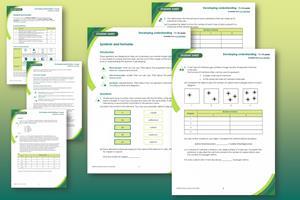
Download this
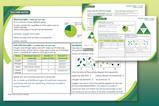
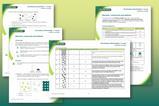
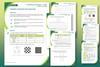
A ramped worksheet to help learners develop their mental models of symbols and formulas. With icons to indicate the conceptual level/s of each question.
View and download more Developing understanding worksheets
Learning objectives
- Recognise that chemical symbols are based on the element name in English or in Latin.
- Determine the number of each type of atom in a molecule from a chemical formula.
- Interpret the meaning of a chemical formula representing a substance made up of separate molecules.
- Interpret the meaning of a chemical formula representing a substance made up of one giant molecule.
How to use this resource
This resource aims to develop learners’ understanding of symbols and chemical formulas. The questions encourage learners to think about what is represented by the chemical formula of a substance made of individual molecules. This leads to the idea of a chemical formula as showing the ratio of different types of atom in the bulk substance. As a result, learners should develop more secure mental models to support their thinking about this topic.
- When to use? Use after initial teaching or discussion of this topic to develop ideas further. You can also use as a revision activity.
- Group size? Suitable for independent work either in class or at home. Or use the questions for group or class discussions.
- How long? 15–30 mins
Johnstone’s triangle
Johnstone’s triangle is a model of the three different conceptual levels in chemistry: macroscopic, symbolic and sub-microscopic. You can use Johnstone’s triangle to build a secure understanding of chemical ideas for your learners.
Introduce learners to Johnstone’s triangle with our C, O and Co Johnstone’s triangle worksheet which guides learners to think about the differences between carbon monoxide and cobalt at a macroscopic, sub-microscopic and symbolic level.
Further reading
Read more about how to use Johnstone’s triangle in your teaching with these articles:
- Develop deeper understanding with models
- Improve students’ understanding with Johnstone’s triangle
- Practical ideas for using Johnstone’s triangle
Norman Reid’s book The Johnstone triangle: the key to understanding chemistry provides a more in-depth overview, the first chapter is available to read online.
Johnstone’s triangle and this resource
The icons in the margin indicate which level of understanding each question is developing to help prompt learners in their thinking.
- Macroscopic: what we can see. Think about the properties that we can observe, measure and record.
- Sub-microscopic: smaller than we can see. Think about the particle or atomic level.
- Symbolic: representations. Think about how we represent chemical ideas including symbols and diagrams.
The levels are interrelated, for example, learners need visual representation of the sub-microscopic in order to develop mental models of the particle or atomic level. Our approach has been to apply icons to questions based on what the learners should be thinking about.
Questions may be marked with two or all three icons, indicating that learners will be thinking at more than one level. However, individual parts of the question may require learners to think about only one or two specific levels at a time.
Support
This worksheet is ramped so that the earlier questions are more accessible. The activity becomes more challenging in the later questions. You can give extra explanations for the more challenging questions. If completing as an in-class activity it is best to pause and check understanding at intervals, as often one question builds on the previous one.
It is useful for learners to observe macroscopic properties first hand. You could circulate examples of substances in the classroom, run a class practical of a chemical reaction or show a teacher demonstration of properties.
Additional support may be needed for any learners still lacking in confidence in the required symbolic representation, for example by sharing and explaining a diagram or a simulation that can show movement of the particles.
Answers and guidance
There are four multi-part questions in the student worksheet. The answers can be found in the teacher notes.
The first question develops learners’ understanding of the use of letters to create symbols for a range of elements whose names start with the letter (symbolic understanding).
The second question develops learners’ understanding of how a chemical formula (symbolic understanding) can show the number of atoms in each molecule of substance (sub-microscopic understanding). It also develops understanding of what information a chemical formula does not provide (the order in which atoms are connected in a molecule). Please note that whilst all the examples in this question are made up of separate molecules it may help reduce later misconceptions to ensure that learners are aware that a chemical formula does not always represent a substance made up of individual molecules. A formula can represent a single connected giant structure (see Q4). At this point in the curriculum learners will not have encountered the idea of ions and therefore ionic compounds have been avoided in this resource.
The third question develops learners’ understanding of how a chemical formula (symbolic understanding) represents the ratio of atoms in the bulk substance which consists of many molecules. Please note that knowledge of the word ratio is not required. Learners are provided with a sentence structure to express the idea (see Q3c).
The fourth and final question develops learners’ understanding of how a chemical formula (symbolic understanding) represents the ratio of atoms in silicon dioxide which has giant structure rather than being made up of individual molecules (sub-microscopic understanding). This is why it is important to extend understanding of chemical formulas from giving the number of different types of atoms in a single molecule to giving the ratio of types of atom in the bulk substance. It may help learners to show them a 3D physical model of silicon dioxide or a digital image of the structure.
Downloads
Symbols and formulas developing understanding student sheet
Handout | PDF, Size 0.25 mbSymbols and formulas developing understanding teacher notes and answers
Handout | PDF, Size 0.25 mbSymbols and formulas developing understanding student sheet
Editable handout | Word, Size 0.5 mbSymbols and formulas developing understanding teacher notes and answers
Editable handout | Word, Size 0.5 mb
- Prepare(1)
 Feature
Demystifying scientific symbolic language
Teach your students how to understand and use chemical symbols in their learning
- Deliver(7)
 Resource
Gases in the air | Johnstone’s triangle | 11–14 years
Think about the mixture of elements and compounds in air at three conceptual levels
 Resource
Elements, compounds and mixtures | Developing understanding | 11–14 years
Secure your learners’ understanding of how elements and compounds are represented in particle diagrams
 Resource
Symbols and formulas | Structure strip | 11–14 years
Use scaffolded prompts to support learners to write about symbols and formulas with confidence
 Resource
Atoms and molecules | Structure strip | 11–14 years
Use scaffolded prompts to support learners to write about atoms and molecules with confidence
 Lesson plan
What is stuff made of? Matter, atoms and elements | 11–14 years
Use this lesson plan to introduce the properties and behaviour of atoms as the smallest parts of elements
 Resource
C, O and Co | Johnstone’s triangle | 11–14 years
Develop your learners’ understanding of symbols and formulas at different conceptual levels by comparing the symbolic representations of carbon monoxide and cobalt
currently reading
 Resource
Symbols and formulas | Developing understanding | 11–14 years
Develop your learners’ understanding of what is represented by symbols and chemical formulas
- Literacy(2)
 Resource
Elements, compounds and mixtures | Key terms support | 11–14
Language support pack for elements, compounds and mixtures, with key terms list, accessible glossary, Frayer models and unscrambling definitions
 Resource
Elements, compounds and mixtures | Reading comprehension | 11–14 years
Practise reading comprehension skills with a science research article about the benefits of carbon capture from the oceans
- Assess(1)
 Resource
Atoms, molecules and compounds quiz | 11–14 years
Use this quiz to check understanding of atoms, molecules, elements and compounds
- Enrich(4)
 Games and puzzles
Formulas of compounds | Gridlocks puzzle | 11–14 years
Help your students get to grips with formulas of compounds using these sudoku-style puzzles, with printable worksheets and answers
 Games and puzzles
Elements 1, 2, 3 and 4 | Gridlocks puzzle | 11–14 years
Familiarise your students with a range of elements using these sudoku-style puzzles, with printable worksheets and answers
 Games and puzzles
Compounds and formulas matching pairs game
Strengthen your learners’ confidence identifying compound names and formulas with this card game
 Games and puzzles
Common compounds | Gridlocks puzzle | 11–14 years
Reinforce your students’ understanding of common compounds using these sudoku-style puzzles, with printable worksheets and answers



No comments yet