
David Everett describes some difficulties with the topic and shows how you could help your students
In an earlier article, I wrote about conceptual difficulties learners have with organic chemistry.1 Derek Denby recently wrote about issues arising from the new specifications in A-level examinations2 and I will expand on how this affects practical work in organic chemistry.
Too long?
Reactions involving breaking and making covalent bonds are slower than the almost instantaneous reactions associated with ionic compounds in inorganic chemistry. Some of the techniques used, such as boiling under reflux, mean that preparations cannot be completed within the timeframe of a school lesson.
Derek asked us to focus on the objectives of practical work and we can apply this to specific experiments. For example, at GCSE do we need to prepare pure samples of esters? Simple test tube preparations of esters,3 albeit mixed with other products, can demonstrate a range of aromas that will excite and engage students. An investigative approach can be used in which groups of students are provided with a range of acids and alcohols and are asked to compare their results.
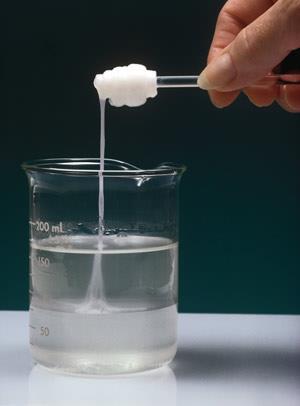
Condensation polymerisation is being reintroduced into pre-16 specifications: the preparation of a nylon thread4 gives gratifyingly fast results and demonstrates this important reaction type.
These experiments can easily be fitted into a single lesson. Some other suggestions are given in Experiments and demonstrations for pre-16 courses.
At A-level, students need to carry out extended practical activities, especially of a preparative nature. These can usually be split into distinct stages, which may be carried out over a sequence of lessons. The synthesis, purification and identification of a compound is an obvious example that lends itself to this approach.
Experiments and demonstrations for pre-16 courses
- Distillation of ‘crude oil’
- Limonene from oranges and lemons
- Fermentation
- Properties of ethanoic acid
- Cracking hydrocarbons
- Testing for unsaturation
- Polymerisation – making a nylon thread
- Making esters Investigating the burning of fuels
Too dangerous?
Many organic chemicals are highly flammable and in some cases toxic or carcinogenic. Early in my career I demonstrated the fractional distillation of crude oil using a full-scale quickfit distillation apparatus and real crude oil! It is no wonder my students were bored by the long-winded procedure, which bore little resemblance to the industrial continuous flow process. We now know that crude oil contains carcinogenic materials and its use in schools is banned.5
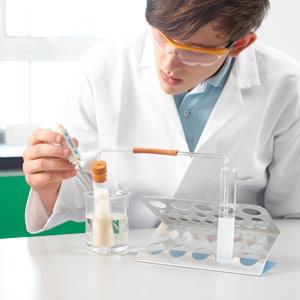
If we are teaching this topic, again we need to consider what learning outcomes we expect from practical work. It is important to emphasise the different boiling points and properties of the various fractions, albeit using mock crude oil to simulate the process. A simple miniature distillation apparatus allows the experiment to be done quickly.6 It also reduces the risk from hazards of fire and vapour levels to a degree that this demonstration can be carried out safely on an open bench – a bonus when fewer school laboratories have adequate fume cupboards.
Too prescriptive?
Examination boards have published lists of experiments for the new A-level courses with examples of how practical work can be assessed. Unfortunately, some teachers have taken these to be restricted and prescriptive lists of experiments that must be done. Nothing is further from the truth and the guidance given encourages a wide range of practical activities.
In organic chemistry, students are expected to show skills in preparation, purification and characterisation of organic compounds, but teachers should not restrict practical activities to these areas. There are opportunities to use organic reactions or materials in other contexts, especially problem-based practical activities.7
Organic materials can be used in experiments that develop other practical skills such as data analysis, enthalpy determination, rates of reaction and research skills. Burning alcohols and measuring enthalpy changes, finding the pH of acids and measuring rates of a reaction, for example, may all be contexts where students develop many practical skills that in turn lead to a better understanding of the underlying organic chemistry. Some further suggestions for practical work at post-16 level are given in Experiments and demonstrations for post-16 courses.
Experiments and demonstrations for post-16 courses
- Measuring enthalpy changes for a range of homologous compounds
- Preparation, purification and characterisation of a liquid halogenoalkane and a solid (eg aspirin or paracetamol)
- Oxidation of alcohols and aldehydes
- Investigation of amino acids (chromatography)
- Hydration of alkenes
- Investigating the iodination of propanone
- Investigating homolytic fission in free radical reactions
- Investigating rates of nucleophilic substitution
- Making and using an azo dye
Reduced-scale experiments
Many will be familiar with the term microscale, but the use of microscale apparatus has had a lukewarm response, especially where special and sometimes expensive kits of apparatus have been suggested. Bob Worley of CLEAPSS has developed a range of reduced-scale procedures, largely using pieces of ordinary apparatus that we would find in our laboratories.
One of these procedures is cracking propanol to prepare propene – this product can then be used to demonstrate hydrogenation. This and other demonstrations can be viewed on the CLEAPSS YouTube channel.8 The advantages of reduced-scale chemistry include:
- Improved safety because of the reduction in the quantity of toxic or flammable materials used
- Reduced cost – the apparatus is simple and constructed of pieces that are usually available in any laboratory
- Student engagement is improved as students are able to work on the experiments themselves rather than watch passively
- Students’ manipulative skills improve as they handle small-scale apparatus
- Reduced time needed – reduced-scale experiments can usually be completed more quickly than with conventional full-scale apparatus
The opportunities offered by organic chemistry are almost limitless. It is important to keep in mind why we carry out practical work in chemistry. Derek Denby addressed this in his article,2 where he pointed out that we want to develop our students’ practical skills through a variety of activities and not just fulfil the requirements of an examination specification. Practical work, when integrated with the theoretical background, engages students and develops their understanding of how science works.
David Everett is a retired chemistry teacher now working as an independent science education consultant
More CPD
The Royal Society of Chemistry’s Developing Expertise in Teaching courses are designed to support you throughout your teaching career. Practical work is an integral part of all face-to-face workshops.
To find out more about the CPD for Teachers courses on offer, visit edu.rsc.org/teacher-pd/courses
References
1 Education in Chemistry, July 2014, p12
2 Education in Chemistry, September 2015, p12
3 Making esters from alcohols and acids
4 Making nylon - the nylon rope trick
5 Banned chemicals and other myths. CLEAPSS, 2011
6 The fractional distillation of crude oil




No comments yet