

Bring enthalpy cycles to life with some chalk and shaving foam to develop learners’ understanding
As a Gen X child, I was captivated by Johnny Ball’s energetic, imaginative way of making complex ideas accessible – whether he was juggling to show parabolas or turning maths into magic on his Think of a number show. His playful use of props and storytelling brought abstract ideas to life, and this joyful approach has stuck with me to this day.
Now, as an A-level teacher, I try to bring that same energy to chemistry. One of my favourite ways is using chalk and snow spray, or shaving foam, to map giant enthalpy cycles. It turns theory into something students can physically explore – a blend of science and spectacle that makes thermodynamics feel tangible and real.
Why students struggle with Hess’s law
Why Hess’s cycles are a hurdle
We often teach Hess’s cycles as a sterile, number-crunching exercise which can alienate students. Despite their elegance, the cycles rely heavily on abstract representations. With little sensory context, students often struggle to make sense of them.
Research highlights many students cannot intuitively grasp that different reaction pathways can lead to the same overall energy change – a core tenet of Hess’s law. Students often misinterpret static diagrams, but when we support their learning with practical experiences they are much more likely to understand the concept of multiple reaction routes leading to the same outcome.
Often, students treat questions like a formulaic puzzle. This leads to shallow understanding; students may plug numbers into equations without appreciating the dynamic nature of energy changes. By combining tactile and role-playing strategies with diagrams (dual coding), students physically embody the processes, which reinforces the learning through both words and action.
Creating visual enthalpy cycles outdoors
Making the invisible visible
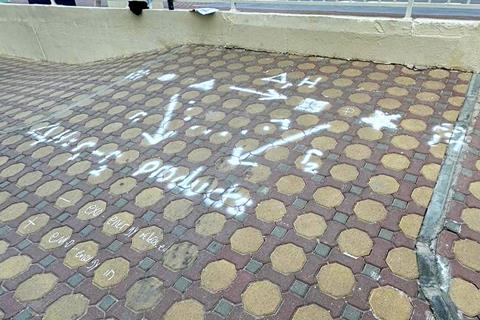
Choosing an outdoor space that students know well instantly sparks their curiosity. I then use snow spray – or more environmentally friendly shaving foam – to create a giant Hess’s cycle on the ground. I map each enthalpy change as a path or arrow and walk the routes of different reaction pathways.
This physical journey reinforces the idea that the overall energy change is independent of the path taken – a key principle.
From groundwork to group work
After my demonstration, students create their own cycles in groups, each with a single stick of chalk – this keeps them focused and makes monitoring simple.
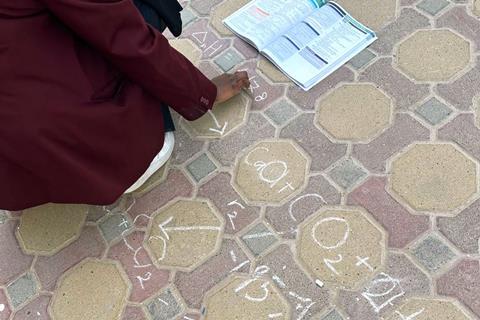
As they work, I circulate and prompt discussion to address misconceptions. I’ve found that students grasp the idea quite quickly, which is to everyone’s benefit. According to John Hattie’s book, Visible learning, peer support with collaborative tasks can enhance understanding and accelerate progress, and this has proved the case with this approach. The impact is immediate – the students engage with the lesson and retain the key processes more effectively.
Perhaps more importantly, they enjoy the process. As one student put it, ‘It finally made sense when I could see it and walk it!’
Reflections
In an age of digital screens and sterile worksheets, a bit of chalk and fresh air might be the most radical teaching tools we have. I adored Johnny Ball growing up and meeting him at university was a moment I’ll never forget. Johnny may not have taught Hess’s law, but his influence is evident every time I transform thermodynamics into something students can touch, walk and remember.
Get more ideas for teaching enthalpy cycles in this guide to the topic at post-16 and try using roleplay to teach organic mechanisms.
Faisal Khan
Find more ideas for teaching enthalphy cycles and rates of reaction at post-16 in our Teaching 16–18 chemistry collection: rsc.li/3SXcXeN








No comments yet