
Discover how a simple spring and trolley model helps post-16 learners master the underlying theory
Explaining the theory underlying infrared (IR) spectroscopy can feel superfluous in a content heavy curriculum. However, spending a bit more time considering how radiation of different wavelengths interacts with molecules can deepen students’ understanding and help them go beyond simple pattern-matching.
Bonding models
Having watched a video on IR spectroscopy with an animation of bonded atoms shown as balls on springs I wondered if I could build a real-life, physical version. By chance, our physics department had been teaching simple harmonic motion to a post-16 class. I was inspired to play with the springs, trolleys and masses they used and, with help from a colleague, built a simple model.
A few days later, I taught a year 12 group, none of whom take physics, and included an animated simulation as a reminder of the decomposition of ozone in the presence of UV. I then changed the simulation to show how IR radiation causes bonds to vibrate rather than break (fission). I asked my learners what features of the molecules they thought might impact the amplitude or frequency of the vibration. Their suggestions included the sizes of the atoms and whether there were single or double bonds.
Interpreting the findings
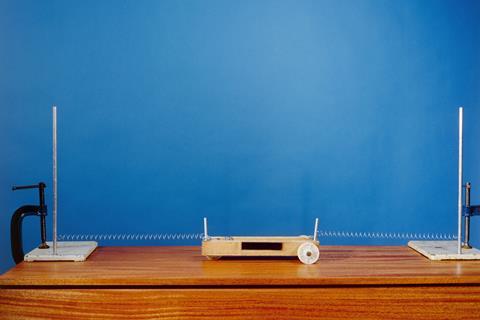
I then introduced the model. I attached a small trolley to two clamp stands using three springs on each and gave the trolley a gentle push to start vibrations. As a class we then loaded the trolley with 500 g to represent a heavier atom and added extra springs in parallel to represent double bonds and saw how these changes affected the frequency of the vibrations. I asked a student to film the activity so we could watch replays of various setups and make comparisons.
The class noted that stronger bonds or lighter atoms vibrated at higher frequencies. Then students were able to correctly predict how the absorption frequencies of a C–O bond compare to either an O–H or C=O bond.
Applying knowledge
Later in the lesson, I asked the students to explain the difference in breadth of an O–H peak on a spectrum relative to C=O. Excitingly, with minimal scaffolding, one learner made a link to hydrogen bonding. Collaboratively, the class considered how the model might be adapted to represent intermolecular forces. They tried gently holding the trolley and placing magnets nearby but were unsuccessful. However, these activities provided scope to evaluate the limitations of the model.
After the lesson I did an internet search, which suggested attaching a block using Velcro alongside the trolley to mimic transient interactions. I’ve not been able to try this yet, but I’ll be giving it a go in the future.
As a plenary we looked at other ways to identify molecules and had lots of fun with some sonification sampling software (see this research paper on encoding molecular structures as music). The students tried to match molecules to their tunes when they had heard the rhythm for a given functional group.
I’m also working on an extension task. This involves considering what differences in structure cause absorption frequencies C=O and O–H but not O=O to appear on their data sheets and thus why carbon dioxide and water are greenhouse gases, but oxygen is not.
Learning outcomes
A lasting impression
When it comes to the next set of assessments, I hope the dynamic nature of the lesson has helped the key principles stick. Encouragingly, when the trolley was set up on the school open day a few days after the lesson, my year 12 students were able to help young children use it to conduct experiments and they described the spectroscopy concepts accurately to prospective parents.
Revising the electromagnetic spectrum at this point in the course provides a nice link to why transition metal complexes are coloured and potentially for extension discussions of how x-ray crystallography works when studying arenes too.





No comments yet