


Help students overcome numeracy difficulties so they can fully access the chemistry curriculum and achieve success

‘I can’t do maths!’ This is a phrase we have all encountered in the classroom. It’s often accepted that, unlike other skills, some people are just bad with numbers. As a result, students may see numeracy ability as a fixed trait rather than a skill they can develop. This belief forms a psychological barrier that prevents students from engaging confidently with mathematical content.
For chemistry teachers, this barrier is particularly frustrating. Some students can eloquently explain chemical concepts, from trends in the periodic table to an organic mechanism, but struggle when asked to calculate a reacting mass.
Given the significant weighting of mathematical content in chemistry specifications, we must challenge this mindset. We cannot allow a fear of numbers to dictate a student’s outcomes. Instead, we must deconstruct the students’ belief that they cannot do maths, putting measures in place that help them unlock the chemistry intertwined with the numbers.
What is numeracy?
Often over-simplified as just maths, numeracy is the ability to apply appropriate mathematical skills and knowledge in familiar and, importantly, unfamiliar contexts. To teach this effectively, we need to be familiar with what best practice is, not when it comes to teaching maths, but how we teach our students to apply those skills to our subject, as the transfer of skills is rarely automatic.
Numeracy in practice
Ask a chemistry student which parts of the subject they find most challenging, and many will point to some of the calculations – whether that be calculating reacting masses, equilibrium constants or the order of a reaction. It is not always the chemistry itself that causes the difficulty; it is the combination of the chemistry with the numerical reasoning that sits beneath it.
When students have to focus on new chemistry information and marry that with their existing cross-curricular knowledge, the cognitive load can quickly escalate, making even familiar maths feel overwhelming.
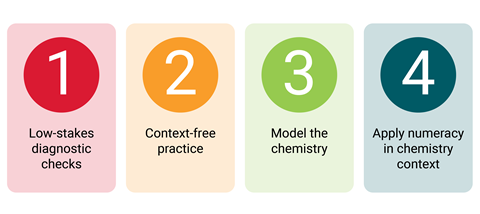
By having an awareness of how we explicitly teach numeracy, deliberately scaffolding the process, we can help students approach it with confidence rather than dread. A process of identifying and assessing the existing mathematical knowledge, using clear chemical models and then utilising those maths skills in the chemistry context creates a more stable pathway for learners.
Ask a chemistry student which parts of the subject they find most challenging, and many will point to some of the calculations – whether that be calculating reacting masses, equilibrium constants or the order of a reaction. It is not always the chemistry itself that causes the difficulty; it is the combination of the chemistry with the numerical reasoning that sits beneath it.
When students have to focus on new chemistry information and marry that with their existing cross-curricular knowledge, the cognitive load can quickly escalate, making even familiar maths feel overwhelming.
By having an awareness of how we explicitly teach numeracy, deliberately scaffolding the process, we can help students approach it with confidence rather than dread. A process of identifying and assessing the existing mathematical knowledge, using clear chemical models and then utilising those maths skills in the chemistry context creates a more stable pathway for learners.
Titration calculations provide a clear example of this approach. They draw together several areas of numerical reasoning at once, so even minor gaps in understanding can become barriers when the chemistry is introduced. Low-stakes, diagnostic checks of the numeracy that underpins titration calculations, including conversion of units, ratios, algebraic manipulation and confident use of standard form, helps teachers to identify these gaps early.
Addressing these areas of numeracy in a context-free environment is important. Modelling standard form allows students to see why it is used. This can be done by pacing out distances outside to visualise the size of some numbers or by completing calculations, both with and without using standard form.
Similarly, asking students to rearrange algebraic expressions in isolation will help them to feel more confident when they later apply the same process to chemical quantities. You may have to support them using either the balance model or the transition model, so it is sensible to talk to school’s maths department to ensure that the advice learners receive is consistent. Connect numeracy back to the chemistry by using a model to make the concept visible and therefore more relatable.
Similarly, asking students to rearrange algebraic expressions in isolation will help them to feel more confident when they later apply the same process to chemical quantities. You may have to support them using either the balance model or the transition model, so it is sensible to talk to your school’s maths department to ensure that the advice learners receive is consistent. Connect numeracy back to the chemistry by using a model to make the concept visible and therefore more relatable.
Once these building blocks are secure, rebuild the calculation within a chemical context. At this stage, it is helpful to try each step in isolation to ensure that learners are confident before moving on. Clear teacher modelling is essential, so make your reasoning explicit at every stage. A common pitfall in modelling is focusing only on the highlights or the parts we assume will be difficult, but students benefit most when they see the full flow of thought, including the seemingly straightforward steps.
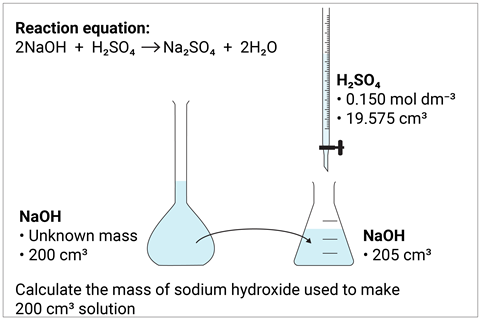
When learners reach the point of attempting a complete multi-step titration calculation, they benefit from having only the information that is mathematically relevant. Removing the distraction of a word-heavy stem avoids the additional cognitive challenge of searching for, and selecting, the relevant information. That is, of course, an important skill in itself, but there is time for that once the numeracy is secure. At this stage, give learners only what they need: the balanced equation, the values and a visual representation of the process. This allows them to focus on applying the mathematical structure they have already practised, building their confidence before the demands of full exam-style questions are introduced.
By supporting students through each stage of applying their numerical reasoning, we help them develop the confidence to use those skills in the unfamiliar context of chemistry, strengthening their conceptual understanding of chemistry along the way.
A teacher’s experience
The impact of this approach is perhaps best illustrated by a student I once taught. She was a very introverted student who had transferred from another school with high grades in both science and maths. Unfortunately, it became clear that any mathematical content in chemistry caused her difficulties.
How can you help learners master numeracy skills in chemistry?
Build your learners’ numeracy confidence and understand the difficulties they face by exploring effective strategies for key numeracy challenges in the self‑led Effective pedagogy teacher PD course.
Diagnostic questions from the previous year confirmed this. She could complete ratio questions, rearrange algebra and balance equations when they were presented on their own, but she could not apply the same skills once they appeared in a chemical context. I modelled each step and gave additional practice, but there was no improvement until I helped to illustrate the transition from maths to chemistry at every stage. The process had to be slowed down, allowing her to complete mathematical questions in a context-free setting before attempting the equivalent chemical version.
When we returned to titration calculations, I removed all unnecessary wording, as searching for relevant information among a block of text increased her anxiety. Without the distractions, she could focus only on the values and the diagram. At first, I asked her to explain her steps, but she found this uncomfortable, so we trialled dual coding instead. It helped us identify and correct errors in her thinking.
When we returned to titration calculations, I removed all unnecessary wording, as searching for relevant information among a block of text increased her anxiety. Without the distractions, she could focus only on the values and the diagram. At first, I asked her to explain her steps, but she found this uncomfortable, so we trialled dual coding instead. It helped us identify and correct errors in her thinking (rsc.li/4ukLrcN).
While the mathematical parts of the course never became her strength, the approach allowed her to apply enough numerical reasoning that it no longer became a barrier to studying chemistry.
Research evidence
Mathephobia, a term first used in 1953 and now more commonly referred to as maths anxiety, arises partly because unfamiliar mathematical situations impose additional cognitive load, making it harder for learners to process and respond effectively.
Teachers should recognise that supportive, low-threat classroom environments, where positive beliefs about maths are nurtured can significantly reduce this fear. Research also highlights that teacher modelling and the use of clear, structured worked examples further alleviate anxiety by reducing cognitive demands, helping students feel more secure when approaching mathematical tasks.
What’s next?
- Improve numeracy for all using these approaches to help your students get over any numeracy hurdles.
- Ideas and activities to support maths in chemistry.
- Discover our collection of resources to help your learners apply what they have learned in their maths lessons in the science lab.
Mathephobia, a term first used in 1953 and now more commonly referred to as maths anxiety, arises partly because unfamiliar mathematical situations impose additional cognitive load, making it harder for learners to process and respond effectively (rsc.li/4rlJzxC).
Teachers should recognise that supportive, low-threat classroom environments, where positive beliefs about maths are nurtured can significantly reduce this fear. Research also highlights that teacher modelling and the use of clear, structured worked examples further alleviate anxiety by reducing cognitive demands, helping students feel more secure when approaching mathematical tasks (rsc.li/4cGb4ys).
What’s next?
- Explore key numeracy challenges and effective strategies to build your learners’ confidence in the self‑led Effective pedagogy teacher PD course: rsc.li/4bj1crS
- Improve numeracy for all using these approaches to help your students get over any numeracy hurdles: rsc.li/4b2D8L3
- Ideas and activities from Education in Chemistry to support maths in chemistry: rsc.li/3Pt53v7
- Discover our collection of resourcesthat will help your learners apply what they have learned in their maths lessons in the science lab: rsc.li/3Nf6M6A
Matthew Parks is a secondary school science teacher, head of chemistry and a teacher developer.





No comments yet