
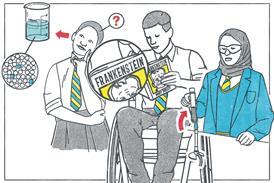


Trainee May reflects on her second placement as she steps out of her comfort zone, gets to know the school and develops her practical teaching skills

Mid-January, I’m starting my second teaching placement and it’s raining – again. It’s dark when I leave the house and dark when I come home.
A few weeks into this placement, I got together with our trainee group to share our feelings and thoughts. ‘I didn’t think it would be this hard’, ‘I want to go back to my first school’ and ‘I don’t know what I’m doing anymore’ were common refrains. And to be honest, that’s exactly how I felt too. Despite everything I thought I learned last term, I feel like I’m back at square one.
New corridors. New systems. New expectations. New children whose names I don’t yet know, and who don’t know me. It’s unsettling how quickly confidence can evaporate when the context changes.
The more I train, the more I realise how closely my learning mirrors theirs
Last term was certainly a lot of work, but ultimately it ended on a high. I’d survived what everyone had said would be the toughest term of the year. I had stood in front of classes and taught for the first time, tried to sound confident, managed behaviour I had never faced before, crafted and submitted PGCE assignments (the last essay I’d written was so long ago) and really started to get to know my classes. The second half of last term also felt more comfortable as the routines started to click. While it still felt like early days, I also began to get a real sense of achievement when taking a concept or idea learned in training, then trying it out with a class the following week.
And just as I was beginning to think that, with a following wind, I might eventually become a teacher, it was time to leave my comfort zone and jump headfirst into a new school.
Starting at a new school
It’s amazing how different schools can be. That sounds like common sense, but I don’t think I really understood what that would feel like until I started trying to work out how my new school operates. The routines, the behaviour systems, the lesson times – all different. All logical once you know them, but overwhelming when you don’t.
It’s also really hard not to compare, especially when my first teaching placement had been so enjoyable. I have to keep reminding myself that a couple of weeks into September I was pretty clueless. I now see how knowing your classes makes teaching easier — not because behaviour magically disappears, but because pupils are more likely to trust you once they feel more comfortable with you and you relax.
Building resilience as a trainee teacher
Resilience is vital. We think and talk about how we can teach this to our learners. We encourage pupils to keep going, to try again, to learn from mistakes. But the change to a second placement feels like I’m also learning how to be resilient.
As I’m new to the school and classes, I’m observing lessons for now. This is fantastic for seeing how other teachers use routines and the behaviour management system, as well as for learning a few names. However, accompanying this is the desire to pause for longer, to not start my teaching practice yet – in case I fail. There’s certainly the temptation to stay in my comfort zone and observe just a few more lessons.
Each small success builds a little more confidence, a little more capacity to make the next challenge feel possible
And then some small things happen. A colleague offers a kind word, a shared joke in the staffroom, a supportive chat with my mentor, a pupil says thank you at the end of the lesson. These moments don’t just make us feel better emotionally, they actively reduce the cognitive load we’re carrying. Suddenly we have more capacity to think, to notice, to be involved.
This has made me reflect on resilience in a new way. Resilience isn’t about pretending something isn’t hard. It’s about creating the conditions to make persistence possible. Which, of course, is what we try to do for our students in the classroom when we say we just want them to have a go. The more I train, the more I realise how closely my learning mirrors theirs.
The uncertainty and worry of getting it wrong, the temptation to stay in the safe zone, the relief when someone notices effort rather than outcome. What helps me when I’m stuck, such as the clear routines, encouragement and small successes, can be what helps our learners too.
New to teaching?
There’s plenty of help and advice across our website. Why not start with our tip-packed CPD articles organised by age range and topic, or maybe some practicals with our Exhibition chemistry articles and videos.
A recent parents’ evening added another layer of perspective for me. I had the chance to observe some of the conversations about students’ futures, as well as to hear from them where they wanted to go next and what’s important to them. This reminded me teaching isn’t just about grades, it’s about lives and choices, and how school fits into all of that. This was a fantastic way of reminding me of the bigger picture, and how as teachers we can enable and support our learners.
Developing practical chemistry teaching skills
Training to teach practical work
Over the last month or two, I also have had the chance to do some training in teaching and demonstrating chemistry practicals. These have been sessions in a school lab, talking through (and of course doing) some of the more common practicals, such as demonstrating alkali metals in water and making salts. These experiences have not only been full of amazing tips and advice on how to organise and conduct these practicals, but they have also reminded me of why I chose this subject in the first place. It has reminded me what I do know, that I can talk about the science and I can explain what is happening.
Teaching is full of ups and downs. Every ECT I spoke to warned me about placement two: ‘you might not like it at first’, ‘stick with it’, ‘give it time.’
Aren’t those the same words we say to our pupils? Have a go. Keep going. Try again.
I’m happy to say I’m beginning to settle into my new school. I feel extremely lucky to have supportive colleagues around to help and provide endless words of encouragement (I have also realised how much I need this!). Each small success builds a little more confidence, a little more capacity to make the next challenge feel possible.
‘Miss, when can you start teaching us?’ asks a pupil. Next week, actually. And I’m fairly sure we’ll both be learning.
Check back in May for the next instalment of May’s teacher training diary. Missed the first instalment? Read it now.
More resources
- Learn how to help students help themselves in this article on metacognition and resilience from experienced teacher, Niki Kaiser.
- Boost your confidence with this group of articles focused on teaching practical lessons.
- Learn how to help students help themselves in this article on metacognition and resilience from experienced teacher, Niki Kaiser: rsc.li/4rijDE1
- Boost your confidence with this group of articles focused on teaching practical lessons: rsc.li/4rjKuj4









No comments yet