

After seven years working on Education in Chemistry, editor Lisa realises anyone can feel they belong in science
Two recent events made me reflect on my chemistry identity – the way we see our connection to the science, something I’d barely considered before. After all, I’m not a chemist, so why would I?
The first event was a session run by colleagues at an RSC Education team meeting in autumn. They asked us to draw or write our chemistry identity; a timeline, if you will, from our school experiences up until the present. I was happy to give it a go, expecting mine would be short: I didn’t enjoy chemistry lessons at school (I spent the double period on Friday mornings discussing the previous evening’s episode of Moonlighting), I did get an O-level (yes, I am that old), I chose German and politics instead of science and as an adult I made one friend who was a chemist. Then I joined the RSC. That was it, my whole lack of chemistry identity in 50 or so words.
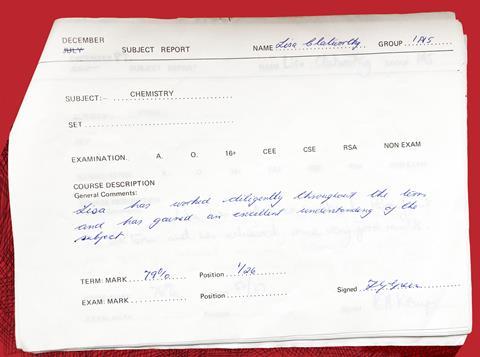
Then the second event happened. I found my secondary school reports. Yes, all of them. Two a year for five years (I did A-levels at college). One page of A5, handwritten, for each subject.
Here are some of my chemistry reports.
First year, December: Lisa has worked diligently throughout the term and has gained an excellent understanding of the subject.
First year, July: This is a very pleasing report. Lisa’s examination shows a careful and thoughtful application of scientific principles learned during the year.
Third year, December: A good result for Lisa. She is keen and interested in this subject.
Fifth year, December (and after O-level mock): Lisa has worked well this term. Her protocol was well done, and her other paper showed a good understanding of the subject.
Was I surprised to learn I’d done well at chemistry and seemingly enjoyed it? Yes! Quite honestly, I was flabbergasted.
Help learners to see their chemistry story
Why share this? Because it shows that learners who might not have much science capital can develop a chemistry identity – and you can help them do it. With a chemistry identity comes a sense of belonging, interest and motivation to participate, as well as confidence. All useful traits in the science classroom. And teachers can nurture students’ chemistry identities. Every time you show your learners how science is relevant to their lives you help them build that view of themselves.
Why share this? Because it shows that learners who might not have much science capital can develop a chemistry identity (rsc.li/4owGM3q) – and you can help them do it. With a chemistry identity comes a sense of belonging, interest and motivation to participate, as well as confidence. All useful traits in the science classroom. And teachers can nurture students’ chemistry identity. Every time you show your learners how science is relevant to their lives you help them build that view of themselves.
So next time you share a job profile with your pupils (maybe from A future in chemistry), highlight a news story (possibly with a Science research news summary slide), or display a poster showing how scientists use chromatography in industry, remember: you’re building their chemistry identities. You’re developing their interest, motivation and confidence that chemistry is for them.
So next time you share a job profile with your pupils (maybe from A future in chemistry; rsc.li/4as4Alq), highlight a news story (possibly with a Science research news summary slide – rsc.li/48ycKGu or turn to pages 4 and 5), or display a poster showing how scientists use chromatography in industry (rsc.li/48rsMBW), remember: you’re building their chemistry identity. You’re developing their interest, motivation and confidence that chemistry is for them.
Thank you to my chemistry teacher, Mr Westbrook for doing that for me. Even if I lost it for a few decades.
Want to help us help you help your learners? Email education@rsc.org with the subject, Chem ID, to get involved with your work developing support to nurture your learners’ chemistry identities.










No comments yet