

Adapt teaching through planning and in‑the‑moment adjustments to help all students access, understand and succeed in science
With student diversity increasing in recent years, being fully inclusive and meeting different learning needs can seem challenging. However, adaptive teaching can help all you meet all your learners’ needs; let’s explore how you can embed it into your science teaching.
What is adaptive teaching?
It is teaching that changes in response to students’ learning and, as with formative assessment, next steps are decided based on evidence. You create learning microclimates in which all students can thrive, building these through anticipatory adaptations based on students’ prior knowledge and responsive, in-the-moment changes.
It is teaching that changes in response to students’ learning and, as with formative assessment, next steps are decided based on evidence (rsc.li/4gBv8DU). You create learning microclimates in which all students can thrive, building these through anticipatory adaptations based on students’ prior knowledge and responsive, in-the-moment changes.
Anticipatory adaptations + responsive adaptations = adaptive teaching
We need to be observant, responsive and reflective. Examine your teaching, asking questions such as:
- What learning has happened and why did it happen?
- What evidence do I have about the learning of individual students?
- What have I done that promoted or inhibited learning?
- What could I change next time to enhance learning?
What does it look like in the classroom?
What does it look like?
Suppose you’re teaching learners how to calculate relative formula mass (RFM), a topic that previous classes have disliked. Rather than starting with the algorithm showing how to calculate RFM, start by explaining what RFM is, then move on to the calculations. To teach adaptively:
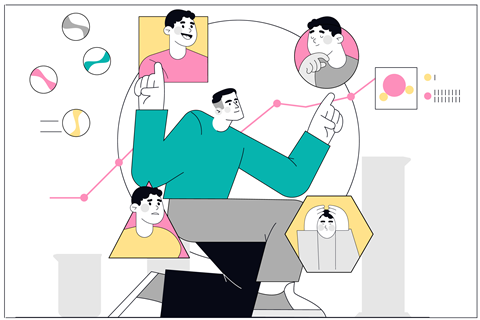
1. Reflect and research before planning
Identify possible barriers to understanding, including misconceptions, drawing on your own experience and published sources.
With RFM, students may struggle with abstract thinking. Mass and weight calculations may cause anxiety in students who dislike maths or find maths a barrier. Or they may have encountered the concept of reference points, such as a height being above sea level, but haven’t related it to chemistry. Finally, the topic may seem irrelevant.
With RFM, students may struggle with abstract thinking. Mass and weight calculations may cause anxiety in students who dislike maths or find maths a barrier (rsc.li/4f2II0X). They may also have encountered the concept of reference points, such as a height being above sea level, but haven’t related it to chemistry. Finally, the topic may seem irrelevant.
2. Consider student profiles
Curriculums assume that all upper secondary students can grasp complex, abstract concepts, but this is just not true. They may not have the expected level of cognitive maturity or may have missed lessons on foundational knowledge, and it’s essential to bear this in mind before, during and after lessons when reflecting and adapting.
3. Build in scaffolding and challenge
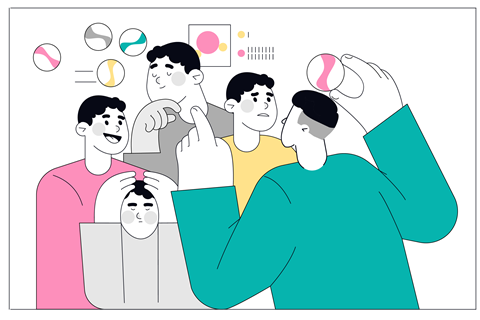
The term relative can provide invaluable scaffolding when you begin with a concrete model of the target concept. For example, place two or three small items in turn into the pan of a hanging balance and see how many marbles balance against each one. They can now be described in terms of how many marbles-worth they are and how they relate to each other. For example, item two has twice the mass of item one. The key point is that learners don’t need to know the mass of one marble to describe the relationship between them.
The questioning techniques you use are key here. Open-ended questions are more challenging and provide an opportunity for formative assessment. You might describe John Dalton’s error in calculating the relative atomic mass of oxygen: he assumed that water was made of one oxygen atom joined to one hydrogen atom. When he found that the mass of oxygen in water was eight times greater than that of hydrogen, he assigned a relative atomic mass of eight to oxygen. This led to further mistakes in the relative mass of other atoms.
The questioning techniques you use are key here (rsc.li/4w4BYpW). Open-ended questions are more challenging and provide an opportunity for formative assessment. You might describe John Dalton’s error in calculating the relative atomic mass of oxygen: he assumed that water was made of one oxygen atom joined to one hydrogen atom. When he found that the mass of oxygen in water was eight times greater than that of hydrogen, he assigned a relative atomic mass of eight to oxygen. This led to further mistakes in the relative mass of other atoms.
Ask students to consider questions at the start of the lesson and revisit them at the end, for example:
- What do modern chemists now know about the formula of water? What evidence do they have to support the idea that there are two hydrogen atoms bonded to one oxygen atom?
- John Dalton gave hydrogen a relative mass of one. Do we still think it is the smallest atom? Do we still give it a relative mass of one? Why, or why not?
- Why might early chemists have looked at the ratio of the mass of different atoms, rather than their actual mass?
The research evidence
There is strong empirical evidence for responding to observed needs and strengths rather than pre-determining them. The impact of teacher expectation on academic attainment is termed the Pygmalion effect and was first evidenced by Rosenthal and Jacobson in 1968 (PDF: bit.ly/4exObMU).
The European Agency for Special Needs and Inclusive Education undertook a study across 30 countries to identify the essential skills, knowledge and understanding, attitudes and values required by inclusive teachers. Its Profile of Inclusive Teachers report showed that being reflective and responsive were key teacher characteristics (bit.ly/4xyXtkp).
Crawford et al (2005) set out evidence of the characteristics of adaptive science teaching and its benefits, specifically the willingness to engage in unexpected occurrences and develop a more thorough knowledge of their students in their study Characterizing adaptive expertise in science teaching (PDF: bit.ly/4ezqS5l).
More recently, Brühwiler and Vogt (2020) showed that it is an effective approach but one that teachers need to receive support to develop in their report: Adaptive teaching competency: Effects on quality of instruction and learning outcomes. Journal for educational research online, 12(1), 119-142 (bit.ly/4aDk99c).
Detailed evidence of the impact of adaptive teaching in one science topic is found in Allen, Webb and Matthews’ (2016) account of teaching floating and sinking in primary school (bit.ly/4oy7Fp7).
What does the evidence say?
There is strong empirical evidence for responding to observed needs and strengths rather than pre-determining them. The impact of teacher expectation on academic attainment is termed the Pygmalion effect and was first evidenced by Rosenthal and Jacobson in 1968.
The European Agency for Special Needs and Inclusive Education undertook a study across 30 countries to identify the essential skills, knowledge and understanding, attitudes and values required by inclusive teachers. Its Profile of Inclusive Teachers report showed that being reflective and responsive were key teacher characteristics.
Crawford et al (2005) set out evidence of the characteristics of adaptive science teaching and its benefits, specifically the willingness to engage in unexpected occurrences and develop a more thorough knowledge of the students in their study Characterizing adaptive expertise in science teaching.
More recently, Brühwiler and Vogt (2020) showed that it is an effective approach but one that teachers need to receive support to develop in their report, Adaptive teaching competency: Effects on quality of instruction and learning outcomes. Journal for educational research online, 12(1), 119-142.
Detailed evidence of the impact of adaptive teaching in one science topic is found in Allen, Webb and Matthews’ (2016) account of teaching floating and sinking in primary school.
4. Monitor students’ learning and respond
Observation and informal conversation provide valuable insights upon which to base in-the-moment support and feedback. For example, you notice that an autistic student, who has frequently found chemistry concepts challenging, is thriving with RFM calculations because of the clear and consistent protocol. Meanwhile, you hear another student, who has found previous topics easy to grasp, saying, ‘I just don’t get why we are using this relative thing. Don’t they know how much an atom weighs?’.
5. Reflect and plan next steps
Frequent self-evaluation is essential for adaptive teaching. You should focus on your students’ learning rather than your prior planning and make sure it’s actionable. In the RFM example above, you could make a set of summary instructions available and ensure the reason for the concept being taught is more explicit.
What do teachers say about adaptive teaching?
What do teachers say?
Gemma Short, science lead teacher at Haringey Learning Partnership, implemented adaptive teaching techniques in her classroom and identified the following: ‘Many of the barriers faced by students were common – even if they had a different cause in each case. The adjustments and strategies benefited a wide cross-section of students, including those who didn’t have that barrier to start with.
‘I found that setting out what will be done in the lesson helps students with task initiation and attention challenges, as well as those with working memory issues. It also helps students understand what is expected and to feel safe; it’s good to know what you are aiming towards and what success looks like.’
Teaching fellow and chemistry ITE lead at Strathclyde Institute of Education John Cochrane said: ‘Scaffolding was particularly useful when teaching calculations. I began with worked examples, really emphasising each step and requirement, then slowly withdrew support, asking the students to help me with next steps.
‘For this to work, relationships are key. Only once you really know the young people can you start to adapt. Knowing your class, you know to look out for the non-verbal cues of those who are struggling. At that point, add some support back in. This method allows for more students to become comfortable with calculations and achieve better grades in the end.’
What next?
1. Explore our range of materials on adaptive teaching in the self-led online Effective pedagogy teacher PD course.
1. Explore our range of materials on adaptive teaching in the self-led online Effective pedagogy teacher PD course: rsc.li/44ejFCL.
2. Devise a format for making and responding to lesson evaluations. For example:
- Annotate lesson plans with your observations and possible responses, then highlight the adaptations in your next plan and evaluate success.
- Make a table of observations of student learning and future adaptations in response to these.
3. Reflect: how did you feel when a student told you they did not understand what had been taught? Frustrated, disappointed or interested? What changes did you make to your teaching?
Jane Essex, honorary reader (associate professor) at the University of Strathclyde in Glasgow








No comments yet