

Four steps to compound learners’ knowledge of carbon atoms at 14–16
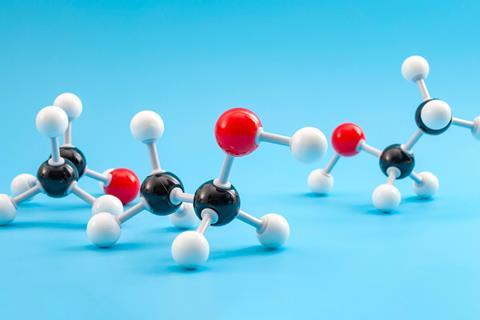
Meet the class of chemicals containing carbon atoms, known as organic compounds. They form an important part of our lives so it’s good to get on first name terms with them.
However, they can be a tricky subject for 14–16 students, as carbon is in group 4 of the periodic table and so tends to form molecules with four covalent bonds, including double and triple bonds with itself and bonds with other non-metal atoms. This gives rise to a huge variety of different carbon skeletons, both natural and synthetic. Use these four steps to lead your learners to success.
1. Strengthen understanding
Review key concepts in bonding. Most organic compounds students meet at this stage are molecules; awareness of the bonding in simple covalent molecules is key to resilient understanding.
It’s common for learners to draw the wrong number of bonds to atoms involved in the more complicated functional groups like alcohols, carboxylic acids and esters. Reassure them that they already know a lot about these molecules, despite never having met them before. Return to the key concept of electron configurations and follow this through, e.g. oxygen has six electrons in its outer shell, so must have two covalent bonds per atom which could be a double bond or two single bonds. Encourage students to check this in their diagrams.
2. Learn the language
The multiple representations of molecules in organic chemistry can present a barrier to understanding. For example, molecules A to D (figure 1) are all representations of ethanol and experts easily understand this. However, students don’t appreciate that molecules are constantly rotating and when we draw them on the page, we are only temporarily pinning them down.
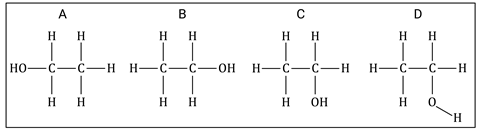
Add to this the name, ethanol, and various formulas that show the same molecule, C2H6O (the molecular formula), C2H5OH and CH3CH2OH (both types of structural formulas), and it can be confusing. Showing students lots of different resources containing representations, such as worksheets and textbooks from different publishers, really helps understanding. Modelling with Molymods helps students see that the molecules A–D are all the same too.
Competence with multiple representations is important. For example, learners would lose marks for writing an equation for combustion of ethanol using the molecular formula (first equation below) as it is ambiguous. But they would be correct to write the second and third equations below. They can only secure these details with independent practice and scrutiny when marking – occasionally overlooked when peer marking.
⮽ C2H6O + 3O2 → 2CO2 + 3H2O
☑ C2H5OH + 3O2 → 2CO2 + 3H2O
☑ CH3CH2OH + 3O2 → 2CO2 + 3H2O
Sometimes, students benefit from direct teaching of the different types of representations. This can be tedious so take care if integrating it into a learning scheme.
3. Test recall
This topic can be content heavy. If not well learned, students can lose marks on short questions, undermining grades and confidence. Help them to build retrieval practice into their school routine. Emphasise the importance of learning key facts in good time. Suggest they ask friends and family to test their recall. Encourage different ways of learning facts, such as physical and online flashcards; Q and A banks for peer (or family) learning; or look, cover, write protocols. Include low-stakes formative assessment into lessons so students engage in regular retrieval practice.
4. Demonstrate
Concerns about flammability and waste disposal mean that we seldom use organic compounds in practicals at 14–16. However, small-scale teacher-led demonstrations can illustrate key reactions well. Always remember the power of demonstrating apparently quite simple concepts. One of my favourite demonstrations is proving that candle wax is a hydrocarbon through observing the products of combustion – a good opportunity to revisit tests for gases, conservation of mass and melting and boiling points. While low risk and very relatable for students, it’s not particularly exciting so I advise a well-rehearsed, interactive explanation.
Concerns about flammability and waste disposal mean that we seldom use organic compounds in practicals at 14–16. However, small-scale teacher-led demonstrations can illustrate key reactions well. Always remember the power of demonstrating apparently quite simple concepts. One of my favourite demonstrations is proving that candle wax is a hydrocarbon through observing the products of combustion (rsc.li/4nuRX7U) – a good opportunity to revisit tests for gases, conservation of mass and melting and boiling points. While low risk and very relatable for students, it’s not particularly exciting so I advise a well-rehearsed, interactive explanation.
These tips will help you enhance the teaching of this tricky topic, strengthening its link with more secure, foundational concepts from earlier in the course as well as providing some variety.
Kristy Turner





No comments yet