






All Resource articles – Page 63
-
 Resource
Odd one out
This activity is fairly synoptic in nature and should encourage a rapid consideration of the range of concepts met in chemistry taught to ages 11–13.
-
 Resource
Universal indicators
This activity develops understanding of universal indicators and single indicators. The students build up their understanding by mixing two indicators. They also develop an awareness that the observed colour may be due to a mixture of colours.
-
 Resource
Chromatography worksheet
This activity extends the students’ understanding of chromatography. It links chromatography with particle theory and develops the tools of analogy and modelling.
-
 Resource
Atoms, elements, molecules, compounds and mixtures
This activity is designed to help students clarify the relationship between atoms, elements, molecules, compounds and mixtures. It also develops the skill of using Venn diagrams in organising their understanding.
-
 Resource
Chemistry for the gifted and talented book introduction
Chemistry for the gifted and talented is a refreshingly challenging educational book containing a wide range of differentiated activities for use in school and college.
-
 Resource
Candle burning investigation: planning an experiment
Concept cartoon and example investigation to practise developing a hypothesis, planning an investigation and evaluation skills
-
 Resource
Chemistry and Art: Venice: The Stonemason's Yard
In this picture we find an early use of a newly synthesised colour - Prusslan blue.
-
 Resource
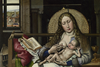
Chemistry and Art: The Virgin and Child before a Firescreen
The cleaning of this painting presented particular problems as two sections had been added, probably in the 19th century.
-
 Resource
Chemistry and Art: Winter Landscape
Scientific examination of this painting and its apparent ‘twin’ in Dortmund has given clear indications as to which one is the original.
-
 Resource
Chemistry and Art: Saint John the Baptist
This painting is a good example of the use of egg tempera paint and gilding. When it was cleaned in 1981-2, the materials used were analysed, and some of the results are discussed.
-
 Resource
Chemistry and Art: The Incredulity of Saint Thomas
Possible poor workmanship on the original panel, combined with an immersion in the Grand Canal in Venice, led to more than 100 years of conservation problems with this painting.
-
 Resource
Chemistry and Art: Portrait of Alexander Mornauer
Additions and alterations to this picture may have been a deliberate attempt to make it look like the work of a famous artist and thereby increase its value.
-
 Resource
Chemistry and Art: Boating on the Seine
This artist had access to a wide range of new colours made by chemists in the 19th century.
-
 Resource
Chemistry and Art: Bacchus and Ariadne
It was not uncommon for canvas paintings to be rolled up for ease of transport. However, this painting seems to have been rolled the wrong way - with the paint on the inside. This led to problems of flaking. Its restoration gave opportunities to study Titian’s methods and materials.
-
 Resource
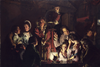
Chemistry and Art: An Experiment on a Bird
This large and dramatic painting shows an early scientific experiment in progress, and is included here more for the science in the painting than the science of making or conserving the painting.
-
 Resource
Chemistry and Art: An Allegorical Figure
X-ray photographs of this panel painting showed that there had been substantial changes to the composition made at an early stage. Were these by Tura, or was he painting over a picture made by someone else?
-
 Resource
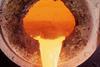
Carbon - the element with several identities
The student worksheet includes information about Sir Harry Kroto, one of the team who discovered the third allotrope of carbon, buckminsterfullerene.
-
 Resource
What happens when things burn?
This resource presents chemists as real people and not stereotypical ‘mad scientists’ whose lives are completely dominated by science.
-
 Resource
The plastic that came out of thin air
The story of Roy Plunkett and the discovery of Teflon® (polytetrafluoroethene) can be used to show that many things in science were discovered accidentally.
-
 Resource
The atom detectives
This resource presents chemists as real people and not stereotypical ‘mad scientists’ whose lives are completely dominated by science.