
Get students reading and talking with short science texts to enrich their chemistry knowledge and improve literacy

Many of us have experienced blank stares when we present our students with a textbook or past paper. Our learners are constantly bombarded with complex tier two and specialised scientific vocabulary, all of which they need to decode to fully engage with the science content. Take this example of a question from a past chemistry paper: ‘Devise a plan for the student to compare the masses of hexane and octane required to raise the temperature of water by 30°C, describing how any variables in the experiment can be controlled to make a fair comparison.’
Students need to possess the understanding of the tier two words, devise and comparison. Without this knowledge, they are unable to get any further. If we want our students to master the vocabulary of science, we must teach them to read like scientists. In my school, we do this using rich and connected texts.
These are short texts that link scientific concepts together in an engaging, story-driven format. The texts allow students to retrieve and build on core knowledge and practise using scientific vocabulary. They also link topics from the classroom to the real world.
After Ben Rogers, my trust’s head of curriculum, successfully implemented rich and connected texts across our primary schools, we extended to our secondary school. We currently use them mainly with 11–14 students, though you can tailor them for any level of learner.
How to produce rich and connected texts for your science lessons
Writing rich and connected texts
I know that implementing new approaches can increase already heavy workloads, but there is a way to lighten the load. I find it useful to ask an AI generator for the base of the texts, which you can then edit. Each paragraph should focus on a specific subtopic, sequentially building upon one another to tell a complete scientific story.
Using AI to generate content? Always follow your school’s AI policy. Remember to verify the content with a reputable source, and apply basic safe and ethical use principles. You can learn more about using AI safely and effectively in the chemistry classroom on our self-led PD course.
I know that implementing new approaches can increase already heavy workloads, but there is a way to lighten the load. I find it useful to ask an AI generator for the base of the texts, which you can then edit.
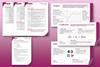
Each paragraph should focus on a specific subtopic, sequentially building upon one another to tell a complete scientific story. You can download four examples of rich and connected texts from the EiC website: rsc.li/4xArRdc
Reading the texts together
How to use rich and connected texts in your science lessons
We use the texts in lessons in a structured, collaborative speaking and listening activity that takes about 20 minutes. To start, I put students into groups of four and assign them each a numbered role. I go through each role beforehand and demonstrate examples using an I do, we do, you do approach. Students rotate their roles, so everyone gets a turn at each.
| Student role | Task |
|---|---|
| 1. Reader/leader | Reads the title of the first text, then asks student two what they already know about the topic. Once student two has spoken, other students can contribute. Once student two (and anyone else) has finished, they read the text aloud. |
| 2. Knowledge retriever | Says: ‘I already know … ’ then lists everything they know about the topic based on the title of the text. Other students can contribute. |
| 3. Paraphraser | Says: ‘In other words…’ and paraphrases the text. |
| 4. Inquirer | Says: ‘I wonder … ’ and asks a question based on the text. |
The best time to use these texts is at the end of a topic, as students need prior knowledge before diving into the discussion. Once a unit is completed, I use the texts to consolidate learners’ knowledge. While they complete the activity, I circulate the room and listen to the discussions to gauge the depth of their understanding. I coordinate how I circulate based on who is allocated each role: for example, I focus on my lower attainers when they are the knowledge retriever and my higher attainers when they are the inquirer.
When multiple groups talk at once, the classroom can get loud. To counteract this, I establish strict group volume expectations with the class before we get started. Using a noise level monitor, like the Bouncy Balls website also works well. Having assigned roles where each student has a specific task helps to prevent particular students dominating the discussion and ensures everyone’s voice is heard. I pay attention to this as I circulate and remind learners of roles if needed.
When multiple groups talk at once, the classroom can get loud. To counteract this, I establish strict group volume expectations with the class before we get started. Using a noise level monitor, like the Bouncy Balls website also works well (bit.ly/4wnpv0g). Having assigned roles where each student has a specific task helps to prevent particular students dominating the discussion and ensures everyone’s voice is heard. I pay attention to this as I circulate and remind learners of roles if needed.
Rich and connected texts are a flexible, high impact, low prep way to check students’ understanding, boost literacy and help all students learn to use scientific language comfortably and accurately. Why not give it a try in your classroom?
Want more reading?
- Download four examples of rich and connected texts, aimed at 11–14 year-old learners, to get started using this approach in your classroom.
- Find ready-made reading comprehension tasks for 11–14 and 14–16 levels and more ways to help learners access scientific vocabulary with our key terms support packs.
- Discover more tips for helping students break down tricky scientific terms.and how to create constructive group conversations in the classroom using talk triplets.
- Read more about why and to embed literacy into science lessons and how to teach reading in science.
Rebecca Reynolds
Downloads
Example rich and connected texts
Handout | PDF, Size 96.74 kbExample rich and connected texts
Editable handout | Word, Size 0.44 mb



No comments yet