












Explore the mathematical language and terminology most useful for learners of chemistry
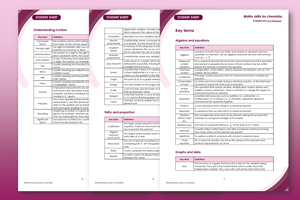
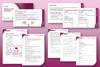
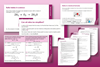
These key terms support resources support our maths skills for chemistry series. They include key mathematical language plus selected chemistry terms. The key terms resource is a list of carefully selected vocabulary, with definitions. You can also find the key terms and their definitions in the accessible glossary resource which contains images, pronunciation guides and other information.
-
-
Accessible glossary
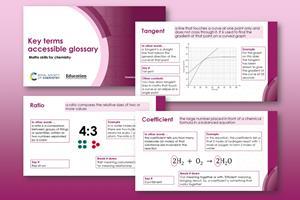
Expand on the key terms list with images, examples, learner-friendly definitions and more
-
-
Explore the full maths skills series Maths skills for chemistry
How to use the key terms list
The key terms are grouped by subtopic and in alphabetical order. Note that the definition of one term may be better understood by referring to another term that is further down the list.
Ideas for adaptation
- Include the words in a spelling task.
- Ask learners to research some of the words independently.
- Delete the definitions and ask learners to fill them in as each term is introduced.
- Integrate speaking and listening skills into this activity. Model pronunciation: say the key terms and definitions aloud and ask learners to repeat as a class. Voice a correct and an incorrect use of the key term in a sentence and invite learners to guess which is which.
How to use the accessible glossary
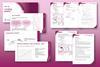
Each slide is broken down into segments. The following segments are used to expand the terms.
- In other words: a more learner-friendly definition.
- Sign it: links to the Scottish Sensory Centre BSL chemistry glossary, hosted by the University of Edinburgh. This includes a BSL translation of many of the key terms. Encountering the same information through different formats can be beneficial for all learners. Learn more about How sign language can help all learners.
- Say it: guides learners on how to pronounce each key term based on the Cambridge Dictionary English Pronunciation guide.
- Break it down: breaks key terms down into composite word parts to reveal more about each term’s meaning.
- Similar words: lists words that have the same or very similar meanings to the key term, where it could be appropriate for learners to use the words interchangeably (for example, the infinitive of the same verb).
- Example: an example of the word/the word in a context that learners are likely to be more familiar with.
- Don’t confuse with: relevant common misconceptions for learners to be aware of.
- Other contexts: other contexts in which learners might come across the word, for example in physics or biology.
Ideas for adaptation
This is a versatile resource. Here are some ideas for how to use it.
- Print as a booklet and give to colleagues who focus on EAL or SEN. Use with learners to work on vocabulary ahead of their chemistry lessons.
- Insert selected slides into other presentations, to highlight that you’re introducing a new term to learners.
- Use for revision after a lesson which featured the key term.
- Print out a version with only the image and the ‘in other words’ definition and use this as the basis for an activity you create yourself.
- Task learners to break down the key term definitions further, using labelled diagrams.
- Create revision flashcards by printing several slides on one sheet of paper.
Edit the slides to modify the content to best suit your learners, e.g. delete the contents of segments and ask learners to populate them. This encourages learners to draw on their science capital and can facilitate learners sharing prior knowledge among peers before the content is covered in class.
The key terms are presented in alphabetical order, within subtopics. You can rearrange the slide deck in a way that best suits how you are using the glossary.
For learners who need more support
Use animation to scaffold the slide deck for learners who need more literacy support, so that each segment is introduced in turn.
Consider using the translate function in PowerPoint. Go to the review tab, select translate, input the desired language and highlight the relevant text from the text boxes on the slides.
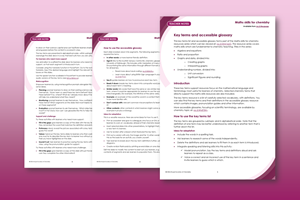
More ideas for how to use the accessible glossary as part of your teaching are included in the teacher notes.
Downloads
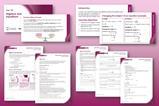
Key terms maths skills for chemistry student sheet
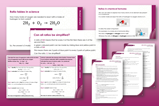
Handout | PDF, Size 0.16 mbAccessible glossary maths skills for chemistry
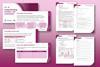
Presentation | PDF, Size 1.6 mbKey terms and accessible glossary maths skills for chemistry teacher notes
Handout | PDF, Size 0.14 mbKey terms maths skills for chemistry student sheet
Editable handout | Word, Size 4.11 mbAccessible glossary maths skills for chemistry
Presentation | PowerPoint, Size 21.89 mbKey terms and accessible glossary maths skills for chemistry teacher notes
Editable handout | Word, Size 69.29 kb



No comments yet