

Enhance your teaching of energetics with these everyday examples and practical tips
David Paterson updated this article on 15 October 2026.
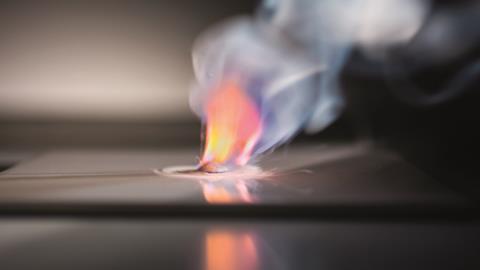
Burning fuels is a great way of introducing energy changes. Candles on birthday cakes, fireworks, Formula One racing cars and even the family barbecue provide excellent contexts to engage students and to link experiments with their everyday lives.
Progression of ideas and skills
Energetics is a central concept that flows through all the sciences. In chemistry, students are introduced to the link between chemical change and energy change in late primary education while looking at properties and change of materials. In early secondary, we equip them with a vocabulary to describe these changes, before they carry out increasingly sophisticated investigations throughout their later secondary education.
| Secondary range | Types of learning areas |
|---|---|
| Pre (approx 7–11) |
|
| Early (approx 11–14) |
|
| Mid (approx 14–16) |
|
| Late (approx 16–19) |
|
Developing practical skills and progression
At 11–14 students should have the opportunity to carry out, and see demonstrated, a range of experiments so they share a common experience with teachers. Refer to these experiments while developing appropriate vocabulary and theoretical frameworks to describe what is happening. Experiments should include both exothermic and endothermic changes.
Which sense to trust?
Endothermic changes can feel counterintuitive to some students. For example, the reaction between citric acid and sodium hydrogen carbonate solution produces bubbles, which students commonly associate with boiling, and then with exothermic change. As the reaction is endothermic, they can feel the effects of this as the test tube gets colder. This dissonance between their chemical ideas and their observations is helpful in identifying misconceptions and building more sophisticated understanding. A similar microscale reaction can also be carried out to extend their observational work.
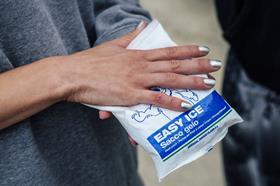
One of the reasons for uncertainty about endothermic reactions may be that students don’t come across them much in their everyday lives. Use instant cold packs for sports injuries to help here. Take one of these packs apart to show that they contain crystals of ammonium nitrate and a sachet of water.
You can extend this discussion to other uses of ammonium nitrate dissolution using this activity about cooling homes. Alternatively, use this activity on supercooling sodium thiosulfate to make the link between changes of state and energy changes.
The reaction between hydrochloric acid and sodium hydroxide solution (exothermic) is a good one to start with. Other suitable simple experiments include the reactions between citric acid and sodium hydrogen carbonate solution (endothermic), magnesium powder and copper(II) sulfate solution (exothermic), sulfuric acid and magnesium ribbon (exothermic), and dissolving ammonium nitrate in water (endothermic).
The reaction between hydrochloric acid and sodium hydroxide solution (exothermic) is a good one to start with (rsc.li/2B8w39V). Other suitable simple experiments include the dissolving ammonium nitrate in water (endothermic) (rsc.li/2IP0c2g), and the reactions between citric acid and sodium hydrogen carbonate solution (endothermic), magnesium powder and copper(II) sulfate solution (exothermic) and sulfuric acid and magnesium ribbon (exothermic) (rsc.li/2B8w39V).
Reusable hand warmers are a great example of using exothermic reactions. One common type makes use of the exothermic crystallisation of a supersaturated solution of sodium ethanoate. The pack is recharged by heating it in a pan of boiling water, which dissolves the crystals back into a small volume of water.
Students can carefully use their hands to get a direct feel for the energy changes without the complication of using a thermometer. Alternatively, they can carry out experiments using drops of solution on a thermometer strip.
Students can carefully use their hands to get a direct feel for the energy changes without the complication of using a thermometer. Alternatively, they can carry out experiments using drops of solution on a thermometer strip (rsc.li/2IP0c2g).
Some energy change demonstrations are very dramatic. The highly exothermic screaming jelly baby experiment and the highly endothermic reaction between barium hydroxide and ammonium chloride need to be practised before use in class, but are great ways of making energy changes memorable for learners.
Some energy change demonstrations are very dramatic. The highly exothermic howling jelly baby experiment (rsc.li/2MC4FXe) and the highly endothermic reaction between barium hydroxide and ammonium chloride (rsc.li/35BlWJ0) need to be practised before use in class, but are great ways of making energy changes memorable for learners.
At 14+, students will commonly carry out investigations involving repeated measurements of temperatures and calculations of temperature changes. This is a good opportunity to discuss the relative advantages and disadvantages of analogue equipment (thermometers) and digital equipment (data loggers). While the skill of temperature measurement is relatively straight forward, the experiments become more demanding. For example, carrying out calorimetry investigations into the combustion of alcohols involves multiple steps and repeats, and more complex data tables and analysis.
Practical problems and suggested solutions
Measuring energy changes in solution
Relatively accurate values for energy changes in reactions involving solutions can be obtained using simple apparatus such as disposable paper coffee cups. Polystyrene cups used to be commonly used, but these are now increasingly difficult to obtain. The cups can be easily knocked over, so place them in a glass beaker, and use a cardboard lid with a hole for the thermometer to cut down heat loss from the surface of the liquid.
Use simple experiments, such as adding acid to alkali, reactive metal to acid or dissolving a salt in water to allow students to devise their own procedure. This will allow them to learn not only what steps to take but think through why they carry them out in a particular sequence. If your students need further support, ask them questions such as what amounts of reactants to use and why stirring is helpful.
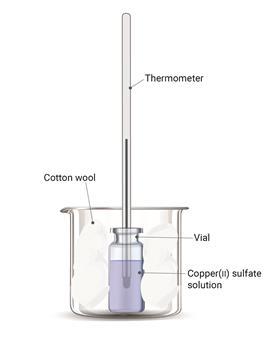
Energy changes of reactions in solution can also be measured with a reduced scale technique using a glass vial surrounded by cotton wool as an insulating material. Use targeted questions to bring out the advantages of this method in terms of reduced amount of materials to use and dispose of.
Measuring energy changes when fuels are burned
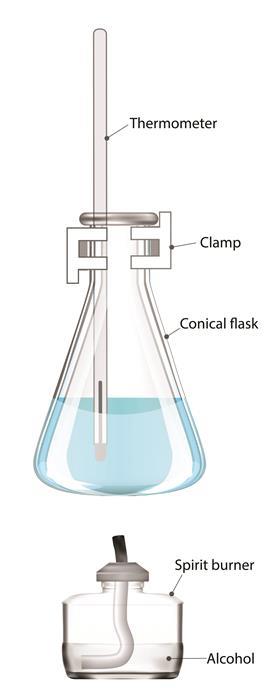
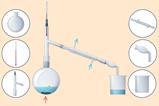
A popular experiment uses different alcohols in spirit burners to heat up water in a glass beaker, conical flask or metal calorimeter.
It is better to use a different spirit burner for each alcohol rather than using the same burner for different alcohols as this avoids the need for burners to be emptied and refilled. Ensure the students allow the burners to cool down before handling them to take mass measurements. Spirit burners should not be refilled in the laboratory due to the presence of naked flames.
This type of experiment provides an opportunity to ask students rich questions that will really probe their understanding (see table 2).
| Question number | Question | Answer |
|---|---|---|
| 1 | What is the black deposit that forms on the underside of the calorimeter and how might it affect the accuracy of the experiment? | The deposit is soot, which suggests incomplete combustion of the fuel has taken place. This will reduce the value of the energy change. |
| 2 | Why is it a good idea to minimise the time between extinguishing the flame and weighing the spirit burner? | To minimise the loss of fuel through evaporation. Burner lids are useful as they minimise this evaporative loss while giving us time to allow the burner to cool. |
| 3 | Why is it better to compare the mass of different fuels that must be burned to produce the same temperature rise rather than simply burning different fuels for the same time? | So that we are comparing the same amount of heat transferred to the water each time. |
| 4 | What assumption do we make when comparing the energy changes associated with burning different alcohols? | That the proportion of the energy from burning the fuel that is used to heat up the water in the calorimeter is the same each time. |
| 5 | What steps could we take to reduce the heat losses? | Shield the flame using Bunsen burner mats and use a copper calorimeter with a lid instead of a glass flask. |
You could choose to use a flipped learning technique in which students try out a fuel burning simulation before carrying out their own experiment.
You could choose to use a flipped learning technique in which students try out a fuel burning simulation (rsc.li/2oEDdQJ) before carrying out their own experiment.
Interpreting information from energy change experiments
At 14–16 students should be encouraged to use their graphical and arithmetic skills to make sense of their measurements.
Although insulation can reduce heat losses to the surrounding air in an exothermic reaction, it does not eliminate these losses. The maximum temperature recorded will be slightly lower than it would be without the heat loss. A common way to get round this problem is to take temperature measurements of the solution at regular intervals from just before the reactants are mixed until after the temperature begins to fall. Next, plot a graph of temperature against time, and then extrapolate the line of best fit to estimate what the maximum temperature would have been if there had been no energy loss to the air.
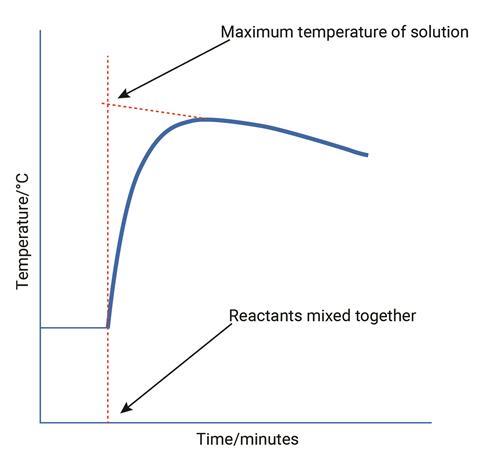
A similar technique can be used to find the end point in an acid–base titration.
A similar technique can be used to find the end point in an acid–base titration (rsc.li/2Bcda5W).
When burning different alcohols, students should compare the mass of fuel needed to produce the same temperature change. They can also calculate a value for the energy transferred by using the equation:
Energy (J) = mass of water heated (g) x temperature change (°C) x 4.2 (J g-1 °C -1; specific heat capacity of water)
Convert this value into energy per gram or energy per mole to lead to an interesting discussion about which value is most useful.
Derek Denby, a retired chemistry teacher, wrote this article in 2019. Teacher David paterson updated it in 2026







2 readers' comments