


Discover effective strategies for teaching this topic to your 11–16 learners
David Paterson updated this article 10 September 2026
Using modern applications and contexts is a great way to hook your students and capture their interest. Look at the photos below and think about what the images have in common.

Chromatography is the link: Chromatography Today a great place to find interesting stories about chromatography and its applications to share with your students.
Chromatography is the link: Chromatography Today a great place to find interesting stories about chromatography and its applications to share with your students (bit.ly/3SWf4Dq).
As with other separation techniques, learners will meet chromatography multiple times through their primary and secondary education. How can we ensure there is a clear progression in the knowledge students develop? How can we maintain their interest and help them develop practical skills? How can we make chromatography in the classroom more engaging?
Progression in ideas and skills
The chemistry behind chromatography involves drawing on concepts studied throughout students’ science education.
| Secondary range | Types of learning area |
|---|---|
| Pre (approx 7–11) |
States of matter Physical change Formation of solutions Separation of mixtures |
| Early (approx 11–14) |
Particulate model of matter Concept of and identification of pure substances Elements, compounds and mixtures, including dissolving Separation techniques |
| Mid (approx 14–16) |
Distinguishing pure and impure substances Stationary and mobile phases, and distribution of substances between phases Intermolecular forces Interpreting chromatograms, including calculating RF values |
| Late (approx 16–19) |
Modern analytical techniques, including chromatography Paper/ thin-layer/ gas-liquid chromatography |
The ideas of substance and purity underpin much of the discussion of separation techniques. It is worth revising some of the basic concepts with students before discussing chromatography. Good starting points include:
- elements, compounds and mixtures: rsc.li/4iPYbEU
- mass and dissolving: rsc.li/4xhenCK
- what happens when something dissolves? rsc.li/4A778Qr
As you delve into the chromatography, more detailed resources can provide depth and breadth for the interested student. For example, Jim Clark’s excellent Chemguide website provides pages on paper and thin-layer chromatography. The Chromatography chapter from Modern chemical techniques also provides extensive detail, useful for your own professional learning.
As you delve into the chromatography, more detailed resources can provide depth and breadth for the interested student. For example, Jim Clark’s excellent Chemguide website provides pages on paper and thin-layer chromatography (bit.ly/4A04MTj). The Chromatography chapter from Modern chemical techniques also provides extensive detail, useful for your own professional learning (rsc.li/4iUrHcy).

Developing practical skills
There is a danger students will simply repeat the same chromatography experiment throughout their education. Popular activities with primary-aged children include separating the mixtures found in felt-tip pens and sweets. Between 11–14, students will often separate the mixtures in inks and food colourings. Chromatography of inks and dyes are commonly required in exam specifications.
One of the challenges teachers face is how to develop students’ practical skills and maintain their interest if they are repeating experiments. There are several possible tactics: using different contexts; setting investigative or problem-solving activities; and taking a synoptic approach.
Another challenge with practical work is for students to understand what they are doing and why they are doing it. Getting this correct during lessons will help students answer practical-based exam questions. One useful tactic is to provide plenty of opportunities for students to do more than just follow a given procedure.
Synoptic approach
Chromatography provides a great opportunity for students to research and carry out a practical method, compare observations and measurements with other groups and make links across the sciences – particularly biology and chemistry.

As preparation work, ask your students to research the pigments found in different leaves. Here are some possible questions to get your students started:
- What is the green pigment in leaves?
- Where have you come across it before?
- Where have you extracted chlorophyll before?
- How did you extract the chlorophyll?
- What techniques did you use?
Then ask them to plan a practical method for analysing a variety of different leaves (e.g. spinach, flowering plant leaves, non-flowering plant leaves etc). You can then give them a standard method for carrying out the practical and have them analyse the similarities and differences between the methods.
Thin-layer chromatography is often used in these standard methods (see image right). Although not commonly used in 11–16 lessons, it is worth, at minimum, discussing with and demonstrating to students. This will allow you to tackle some of the common practical problems encountered with chromatography.
Practical problems and suggested solutions
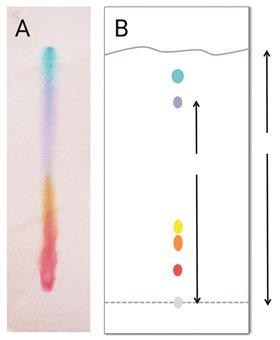
Chromatography is often seen as a quick and easy activity. However, the chromatograms students see in their textbooks and on exam papers often look nothing at all like the chromatograms from their own experiments (see comparison right).
So, faced with these results, how do we convince learners they have carried out a similar process? By asking them:
- Where is the centre of the spot?
- What value should you use to calculate the RF value?
- How can you compare RF values with such big error bars?
So, faced with these results, how do we convince students they have carried out a similar process? By asking them to find the centre spot is, what value they use to calculate the RF value and how they can compare the RF values with such big error bars.
For the purple spot in figure B (the textbook diagram), the RF is 0.8. For the same spot in figure A (typical student results), what is the distance moved by the spot? Where would you draw the line? There will be a very large error in any value calculated.
Discover our resource packages
These two comprehensive packages covering chromatography offer all the support you need to teach:
Improving the results
Paper chromatography doesn’t give very good separation in classroom experiments. You would need a long piece of paper and lengthy elution time to get good separation. However, there are several things you can do to make improvements.
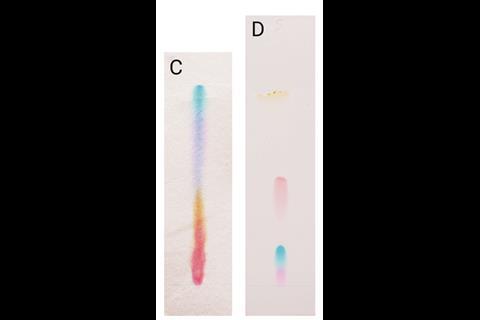
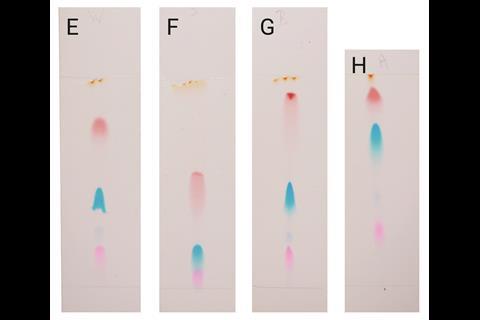
Changing the stationary phase by using thin-layer chromatography (TLC) can lead to better separation. In the gallery, on C and D, TLC gives clear bands with more easily measurable RF values. The solvent in both cases was a dilute solution of sodium chloride and the same black ink is used in both. Note the difference in the order in which the component dyes move up the stationary phase.
Be explicit with your students that the principles and underlying chemistry of TLC are the same as paper chromatography. The only real difference is the stationary phase, which may be silica on a polyester backing or aluminium oxide coated plates. The mobile phase remains the same but the way the two phases interact with the sample components is different.
Changing the phases is the basis of a good investigation. The activity could be a problem-solving exercise or competition, where students have to work out how to get good separation and then go on to produce the best chromatogram.
Hopefully your students will be able to accept that the chromatograms seen in D and then E–G in the gallery are a little closer to what they might meet in the exam.
Chromatography equipment
Although TLC plates are expensive, a classroom set of small plates can be cut from one standard plate. (Tip: If using right-handed scissors, try cutting with the backing side of the sheet uppermost. This seems to minimise flaking of the fragile coating. Alternatively, use a scalpel, ruler and cutting board.)
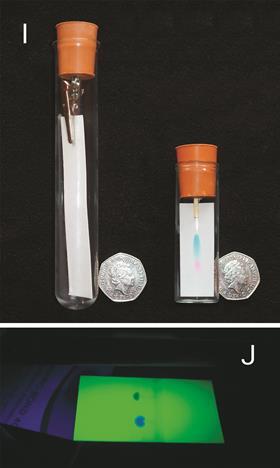
An expensive chromatography tank is not necessary to get good chromatograms. There are many methods that give good results. A one-holed boiling tube bung and crocodile clip (I and J) is useful for large classes and when volatile solvents (e.g. ethanol or propanone) are needed. You only need small quantities of solvents and can keep fumes to a minimum.
A small vial and thin layer plate (A and B right) can also give good separation over a very short distance. Several sources describe this small-scale approach, including these activities on plant pigments.
A small vial and thin layer plate can also give good separation over a very short distance. While CLEAPSS and SSERC members can source a small-scale method from these sites (bit.ly/4gUksib; bit.ly/4A7cATn), you might also want to try these activities on plant pigments from SAPS (bit.ly/4hj3NpU).
You can get TLC plates with a fluorescing agent in the coating. These are useful for locating colourless components. Many colourless compounds absorb UV light and appear as darker spots.
More resources
- Explore a range of different types of black pens in this crime scene investigationfor 11–14 learners.
- Investigate the dyes used in brightly colour sweets.
- Separate pigments in a leaf using paper chromatography.
- Take chromatography out of the school lab and into the real-world with this video showing the separation of paint binders.
- Investigate the separation of inks using paper chromatography with this video and classroom-ready resources for 14–16 learners.
- Discover our resource packages covering chromatography with all the support you need to teach separating mixtures for 11–14 years and mixtures and separation for 14–16 years: rsc.li/485YXHc and rsc.li/4hVpRr8 respectively
- Explore a range of different types of black pens in this crime scene investigation for 11–14 learners: rsc.li/4gXfyCj
- Investigate the dyes used in brightly colour sweets: rsc.li/4gEjnLs
- Separate pigments in a leaf using paper chromatography: rsc.li/4hV3HWo
- Take chromatography out of the school lab and into the real-world with this video showing the separation of paint binders: bit.ly/4xlgCWo
- Investigate the separation of inks using paper chromatography with this video and classroom-ready resources for 14–16 learners: rsc.li/4yceKj0


Teaching practical science

Boost your confidence and your learners’ outcomes with these articles focused on practical lessons







No comments yet