







This microscale experiment allows learners to get hands-on with cracking
Small and microscale chemistry practicals provide plenty of variety and opportunity for learners to refine their observation skills.
In this activity, learners crack liquid paraffin to illustrate the conversion of long-chain saturated hydrocarbons into shorter-chain unsaturated hydrocarbons.
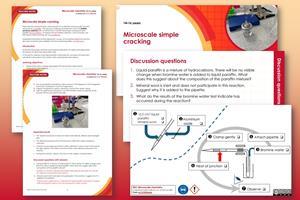
Download this
All the information you need to prepare, set up and run this experiment with your learners:
- Teacher and technician notes as pdf and MS Word
- Integrated instructions and support as pdf and MS PowerPoint
Learning objectives
- Observe the colour change associated with the bromine water test for unsaturated hydrocarbons.
- Explain the purpose of cracking, as used in the petrochemical industry.
Equipment (per group)
- Integrated instruction sheet
- Sealed glass Pasteur pipette (see note below for instructions on how to prepare)
- Miniature spirit burner (WARNING: Highly flammable liquid) - instructions on how to prepare
- Small test tube
- Delivery tube connected to a short (~5 cm3) length of flexible tubing
- Retort stand, boss and clamp
- Mineral wool
- Liquid paraffin, 0.5 cm3
- Aluminium oxide powder or granules
- Bromine water (0.002 mol dm-3), 1 cm3 (WARNING: Irritant)
- Optional: potassium manganate(VII) solution (0.002 mol dm-3) as a substitute for bromine water
Safety equipment
- Eye protection: safety glasses to EN ISO16321 C
Safety
- Read our standard health and safety guidelines and carry out a risk assessment before running any live practical.
- The main hazards are ethanol, the glass tubing and bromine water. Due to the nature of the hazards, eye protection should be worn at all times during this experiment, including set up and dismantling.
- Students should be warned about the dangers of the ethanol in the spirit burners. They should keep the burner upright and should not take off the lid. Ethanol produces highly flammable vapour and can catch fire very easily. To minimise any risk, ensure that the burners are filled prior to the lesson. Students need to light their burners, and the easiest way to do this is with matches - take a flame to the burner, not the burner to a flame. It is advisable to have a box of matches per bench, to know how many boxes you have and to count them out at the start and in at the end of the session. As an alternative, have a lit Bunsen or two in the laboratory and have students use splints to light their burners. However, they can be tricky to light this way.
- Refer to SSERC/CLEAPSS Hazcards and recipe sheets or contact your local safety advisory body. Hazard classification may vary depending on supplier.
Preparation
To prepare the glass Pasteur pipette for this practical:
- Hold the tip of a clean, dry Pasteur pipette in the outer blue cone of a Bunsen burner, rotating the pipette continuously to ensure it is heated evenly.
- As the glass softens and glows orange/red the tip will melt and close shut.
- Remove from the flame and leave the pipette on a heat-proof surface to cool slowly.
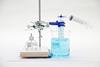
CLEAPSS have developed a guide to producing small-scale spirit burners using miniature jars as shown in the image of the experimental set up.
More information about preparation is given in the teacher and technician notes.
Disposal
- Dispose of the Pasteur pipette directly into the glass waste.
- Flush solutions down a foul water drain.
Method
- Add approximately 0.5 cm3 of liquid paraffin to a sealed Pasteur pipette, followed by mineral wool so that all the liquid is absorbed.
- Place the aluminium oxide in the pipette above the mineral wool.
- Add 0.5–1 cm3 of bromine water (or potassium manganate(VII) solution) to the test tube.
- Set up the pipette and delivery tube as shown in the diagram on the integrated instructions worksheet or see the image below.
- Support the pipette by gently clamping it around the rubber tubing.
- Light the spirit burner and place it so that the flame heats the pipette at the junction of the wool and the powder.
Expected results
- The reaction produces a mixture of small chain alkanes, alkenes and hydrogen gas.
- The alkenes produced will turn the bromine water from yellow−orange to colourless.
- A liquid may be observed (which is often yellowish in colour) near to the end of the glass pipette. This is likely to be the shorter-chain alkane produced in this reaction.
- During the reaction, carbon may form on the catalyst, turning it black.
Discussion questions with answers
1. Liquid paraffin is a mixture of hydrocarbons. There will be no visible change when bromine water is added to liquid paraffin. What does this suggest about the composition of the paraffin mixture?
Paraffin is a mixture of alkanes/saturated hydrocarbons and does not contain any alkenes/unsaturated hydrocarbons.
2. Mineral wool is inert and does not participate in this reaction. Suggest why it is added to the pipette.
Mineral wool is highly porous. It absorbs the liquid paraffin and keeps it in place, while allowing the vapours that are produced to easily escape.
3. What do the results of the bromine water test indicate has occurred during the reaction?
The longer hydrocarbon chains in the paraffin mixture have been ‘cracked’ to produce a mixture of shorter-chain alkenes and alkanes. Br2 (bromine) molecules react with the carbon−carbon double bond in unsaturated hydrocarbons such as alkenes, decolourising the orange bromine water.
4. Suggest the benefits of using an aluminium oxide based catalyst, such as a zeolite, in industry.
Because the catalyst lowers the activation energy of the reaction, a lower temperature can be used. This means that less energy is required for heating, conserving energy resources. Catalysts increase the rate of a chemical reaction, meaning more product can be produced per unit time.
5. Cracking reactions produce a mixture of alkanes and alkenes of different chain lengths. Suggest how this mixture could be separated.
Fractional distillation can be used to separate the mixture of hydrocarbons based on their different boiling points.
Equations
If the paraffin is assumed to have six carbon atoms in the hydrocarbon chains (it is actually more than this), then an equation is given below.
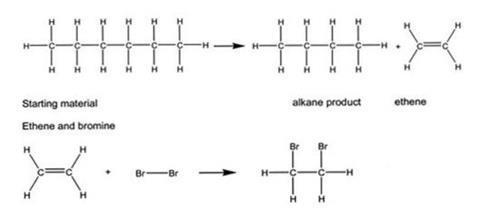
The paraffin does not react with the bromine because it is an alkane. Alkanes do not react with bromine because they do not have a carbon-to-carbon double bond. The double bond can open up and allow other atoms to bond to the carbons.
Downloads
Microscale simple cracking teacher and technician notes
Handout | PDF, Size 0.47 mbMicroscale simple cracking integrated instructions and support
Handout | PDF, Size 0.8 mbMicroscale simple cracking teacher and technician notes
Editable handout | Word, Size 0.78 mbMicroscale simple cracking integrated instructions and support
Presentation | PowerPoint, Size 1.77 mb
Additional information
These teacher and technician notes are part of a collection of microscale chemistry resources. This resource combines an experiment from the Nuffield practical collection with a method from CLEAPSS Microscale cracking of liquid paraffin.
- Prepare(1)
 Ideas
Tie sustainable industry into your chemistry topics
Complement your teaching of reaction kinetics, catalysts and equilibrium with UN sustainable development goal 9
- Deliver(3)
 Resource
Cracking alkanes | Johnstone’s triangle | 14–16 years
Secure learners understanding of the process of cracking paraffin at macroscopic, sub-microscopic and symbolic levels
currently reading
 Class experiment
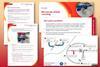
Microscale simple cracking
Use this microscale experiment to illustrate hydrocarbon cracking. Includes integrated instructions, discussion questions and full technician notes
- Literacy(2)
 Resource
Crude oil | Reading comprehension | 14–16
Practise reading comprehension skills with a science research article about turning waste into fuel
 Resource
Crude oil | Key terms support | 14–16
Language support pack for the introductory organic chemistry topic crude oil, including fractional distillation, properties of hydrocarbons, cracking and addition polymers
- Assess(2)
 Resource
Cracking | Review my learning worksheets | 14–16 years
Identify learning gaps and misconceptions with this set of worksheets offering three levels of support
 Resource
Cracking hydrocarbons – organic chemistry worksheets | 14–16
Student worksheets at foundation and higher level. Apply knowledge in context and assess learning with questions that explore cracking hydrocarbons, including an experiment with liquid paraffin.
No comments yet