










Support your learners to deepen their understanding of interpreting chemical equations
Developing understanding is a series of resources that encourage learners to connect their thinking at the macroscopic, sub-microscopic and symbolic levels.
-
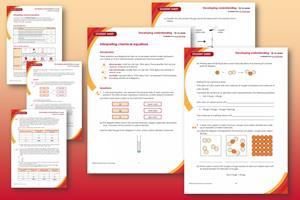
Download this
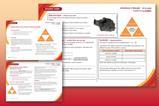
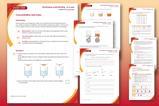
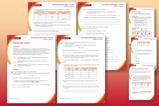
A ramped worksheet to help learners develop their mental models of what is represented by a balanced chemical equation. With icons to indicate the conceptual level/s of each question.
View and download more Developing understanding worksheets
Learning objectives
- Link the formula and state symbol of reactants and products to observations of a chemical reaction.
- Describe what a balanced chemical equation represents in terms of individual atoms and molecules.
- Describe what a balanced chemical equation represents in terms of a large number of atoms and molecules.
- Recognise that a chemical equation can be used to work out the mass of product that could be produced from the given mass of reactant.
How to use this resource
This resource aims to develop learners’ understanding of how balanced chemical equations provide information such as the state of reactants and products, and the ratio in which atoms and molecules react or are formed. The questions also encourage learners to think how a balanced chemical equation can be used to determine the mass of substances that react and those that are formed. As a result, learners should develop more secure mental models to support their thinking about this topic.
- When to use? Use after initial teaching or discussion of this topic to develop ideas further. You can also use as a revision activity.
- Group size? Suitable for independent work either in class or at home. Or use the questions for group or class discussions.
- How long? 15–30 mins
Johnstone’s triangle
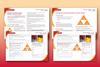
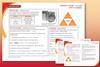
Johnstone’s triangle is a model of the three different conceptual levels in chemistry: macroscopic, sub-microscopic and symbolic. You can use Johnstone’s triangle to build a secure understanding of chemical ideas for your learners.
Introduce learners to Johnstone’s triangle with our Balancing chemical equations using hydrogen and oxygen Johnstone’s triangle worksheet which guides learners to consider what is happening at a sub-microscopic level and how to represent the reaction symbolically when a balloon of hydrogen explodes after being lit by a burning splint.
Further reading
Read more about how to use Johnstone’s triangle in your teaching with these articles:
- Develop deeper understanding with models
- Improve students’ understanding with Johnstone’s triangle
- Practical ideas for using Johnstone’s triangle
Norman Reid’s book The Johnstone triangle: the key to understanding chemistry provides a more in-depth overview, the first chapter is available to read online.
Support
This worksheet is ramped so that the earlier questions are more accessible. The activity becomes more challenging in the later questions. You can give extra explanations for the more challenging questions. If completing as an in-class activity it is best to pause and check understanding at intervals, as often one question builds on the previous one.
It is useful for learners to observe macroscopic properties first-hand. You could run a class practical of relevant chemical reactions or carry out a teacher demonstration. It is important that learners can observe the detail of the reactions so a visualiser or camera may be useful. Ensure to look up the full instructions and health and safety guidance before running a practical or demonstration.
Give learners physical models to use and manipulate, such as a Molymod kit or counters.
Additional support may be needed for any learners still lacking in confidence in the required symbolic representation, for example by sharing and explaining a diagram or a simulation that can show movement of the particles.
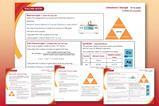
Answers and guidance
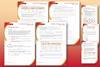
There are five multi-part questions in the student worksheet. Answers are found in the teacher guidance.
Question one develops learners’ understanding of state symbols (symbolic understanding) and how the product of a chemical reaction that is in the gas state may or may not be observed (macroscopic understanding).
Question two develops learners’ understanding of what a chemical equation (symbolic understanding) shows in terms of how many individual atoms or molecules react with or are produced from one atom or molecule of reactant (sub-microscopic understanding). This question deliberately focuses on individual atoms and molecules (an approach often used when balancing equations) before the consideration of ratio of a large number of atoms and molecules in the next question. Please note that examples where reactants or products are ionic compounds are explored in the developing understanding resource Interpreting chemical equations: ionic compounds.
Question three develops learners’ understanding of how a balanced chemical equation (symbolic understanding) shows the ratio of atoms and molecules reacting and being produced (sub-microscopic understanding). The question does not explicitly refer to the term ratio (although this could be used if students are familiar with the concept). Instead, a sentence structure is used to convey the concept e.g. each atom of carbon reacts with one molecule of oxygen.
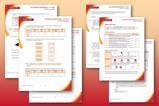
Question four develops further learners’ understanding of how a balanced chemical equation (symbolic understanding) shows the ratio in which atoms and molecules react and are produced. The concept of ratio is modelled through the use of a table showing the ratio of actual numbers, from very small to 1 billion. This aims to pave the way for the concept of reacting ratios in terms of moles.
Question five develops learners’ understanding of how a balanced chemical equation (symbolic understanding) shows the ratio of the number of moles of reacting and produced atoms and molecules (sub-microscopic). Learners are then supported to connect this to the mass of substance reacting or being produced (macroscopic). Please note that if learners are not required to learn about moles, this question could be omitted.
Downloads
Interpreting chemical equations student sheet
Handout | PDF, Size 0.37 mbInterpreting chemical equations teacher notes and answers
Handout | PDF, Size 0.28 mbInterpreting chemical equations student sheet
Editable handout | Word, Size 0.6 mbInterpreting chemical equations teacher notes and answers
Editable handout | Word, Size 0.48 mb





No comments yet