







All Physical chemistry articles – Page 7
-
 Demonstration
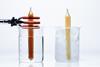
The effect of pressure and temperature on equilibrium | Le Chatelier’s principle
Try this demonstration to explore the effects of pressure and temperature on an equilibrium mixture with your students. Includes kit list and safety instructions.
-
 Demonstration
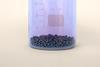
The effect of concentration and temperature on an equilibrium | Le Chatelier’s principle
Try this demonstration to illustrate how changing chlorine concentration or temperature shifts the position of an equilibrium. Includes kit list and safety instructions.
-
 Class experiment
Rechargeable cells: the lead–acid accumulator
Use this practical to demonstrate the chemistry behind rechargeable batteries, using a lead–acid accumulator cell. Includes kit list and safety instructions.
-
 Resource
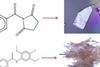
Journal articles made easy: Predict crystallinity
This article looks at predicting and controlling the crystallinity of molecular materials. It will help you understand the research the journal article is based on, and how to read and understand journal articles. The research article was originally published in our CrystEngComm journal. Will it crystallise?Predicting crystallinity of molecular materialsClick ...
-
 News
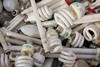
NewsImproving rare earth separation
Photochemistry selectively removes europium from red lamp phosphor
-
 The Mole
Chemistry is like... a concert
Tom Husband ponders the similarities between the sugar molecules in his cup of tea and organising a concert
-
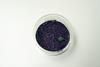 Class experiment
The migration of ions during electrolysis of potassium manganate(VII)
Try this class practical to investigate the migration of ions during electrolysis as evidence for the ionic model. Includes kit list and safety instructions.
-
 Resource
Problem based practical activities
Discover how chemistry can relate to real world problems, so students can put their science knowledge into context.
-
 Resource
Nanotechnology
The Inspirational chemistry chapter ‘Nanotechnology’. This chapter suggests games, activities, practicals and demonstrations for teaching various topics, including ways that nanotechnology can improve our everyday lives.
-
 Demonstration
The density of carbon dioxide
Illustrate the higher density of carbon dioxide relative to air by pouring it over a lighted candle in this demonstration. Includes kit list and safety instructions.
-
 Demonstration
Quantitative electrolysis of aqueous copper(II) sulfate
Use this demonstration to find the value of the Faraday constant from electrolysis of copper(II) sulfate solution. Includes kit list and safety instructions.
-
 Soundbite
Dual personality of light caught on camera
Is it a wave or is it a particle? We might know the answer, (Spoiler alert: it’s both!) but it is reassuring nonetheless to see the pictures that prove it, says Nina Notman
-
 The Mole
Chemistry is like... a game of football
Whatever the predictions, you won’t know for sure until the final whistle, says Tom Husband
-
 Resource
What happens when things burn?
This resource presents chemists as real people and not stereotypical ‘mad scientists’ whose lives are completely dominated by science.
-
 Class experiment
Rate of reaction of potassium manganate(VII) and oxalic acid
Investigate the effect of surface area or concentration on rate of reaction using oxalic acid in rhubarb and potassium manganate(VII). Includes kit list and safety instructions.
-
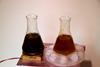 Demonstration
Iodine clock reaction demonstration method
Use this iodine clock reaction demonstration to introduce your students to rates of reaction and kinetics. Includes kit list and safety instructions.
-
 Demonstration
A spontaneous exothermic reaction
Illustrate the reaction between glycerol and potassium manganate(VII) to produce flames and steam in this demonstration. Includes kit list and safety instructions.
-
 Class experiment
Exothermic or endothermic? Classifying reactions
Decide whether various reactions are exothermic or endothermic by measuring temperature change in this practical. Includes kit list and safety instructions.
-
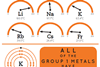 Resource
Elements infographics
A collection of visually stimulating and informative infographics about the elements, which would make a valuable addition to any science classroom.
-
 Resource
ReAct podcasts
Experienced teachers talk about some of the trickiest topics in 16+ chemistry courses and how to overcome them.