









Support learners to write about relative mass with confidence
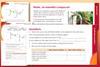
Structure strips can be used to promote independent writing. In this resource learners write about relative mass using key words, explaining how to calculate relative atomic and relative formula masses.
-
Download this
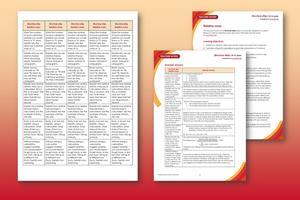
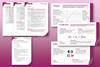
Stick these structure strips into the margin of a page to support learners to find or retrieve information and write independently about relative mass. The resource includes editable writing prompts, an extension question and example answers.
View and download more Structure strips
Learning objectives
- Explain why relative, rather than actual, masses are more commonly used in chemistry.
- Combine writing with calculations to give fuller explanations of chemical concepts.
- Describe how the relative masses of individual atoms, relative atomic mass, relative formula mass and percentage composition are linked.
Introduction
This resource asks learners to demonstrate their thought process, rather than simply to use methods they have memorised for carrying out calculations. In chemistry we compare the masses of subatomic particles, atoms, elements and compounds using relative masses, rather than stating the actual mass of the species in grams. The relative mass of any particle is its mass relative (compared) to 1/12 of the mass of a single Carbon-12 (12C) atom. Relative masses are important because we count atoms using their masses as they are far too small to see.
How to use structure strips
Structure strips are a type of scaffolding you can use to support learners to retrieve information independently. Use them to take an overview at the start of the topic, to activate prior knowledge, or to summarise learning at the end of a teaching topic. For more ideas on how to use structure strips with your learners, see 5 ways to use structure strips effectively.
Structure strips have sections containing prompts, sized to suggest the amount that learners must write. Learners glue the strips into the margin of an exercise book and write their answers next to the sections, in full sentences. When learners have finished using the structure strip, they should have an A4 page set of notes and examples.
The strips are printed five to a page and will need to be trimmed to size. Find them on the second page of the student sheet.
Scaffolding
- Encourage learners to use the suggested key words and phrases in their answers.
- To further support learners, include additional prompts in the structure strip. If learners are struggling to engage with the task, supply them with sentence starters created from the model answers.
- As learners grow in confidence, ask them to attempt the extension question first and then use the structure strip to improve or self-assess their answer.
Key words
Proton, neutron, electron, standard form, isotope, relative atomic mass, weighted average, relative formula mass, percentage.
Metacognition
This resource supports learners to develop their metacognitive skills in three key areas.
- Planning: the strips provide scaffolding to plan the written response. Learners will decide where to gather information from (textbooks, own notes, revision websites). Ask learners: is the source of information you are using reliable?
- Monitoring: learners are prompted by the questions in the structure strip and can check their own answer against the prompts. Ask learners: have you covered all of the prompts in the space provided? Do you need to change anything to complete the task?
- Evaluation: learners can self-assess or ask a peer to check their work against the answers. Ask learners: did you achieve what you meant to achieve? What might you do differently another time?
Extended answer question
Instruct learners to answer the question after they have attempted the structure strip. The structure strip activates the required knowledge, which learners can then apply to the question.
Consider re-framing the context of this question to one that your learners are more familiar with, to empower them to unlock their existing science capital. Read more about science capital.
Answers
Suggested answers for the structure strip activity are given in the downloadable teacher notes.
Answers to extended answer question
The relative formula mass of bromine is 80 + 80 = 160.
Bromine exists as two isotopes. Bromine atoms with a relative mass of 79 contain 35 protons and 44 neutrons in their nuclei, whereas bromine atoms with a relative mass of 81 still contain 35 protons but have 46 neutrons.
The relative atomic mass of an element is calculated as a weighted average based on the naturally occurring percentages of its isotopes. The fact that bromine’s relative atomic mass falls right in the middle of the relative masses of its two isotopes suggests that equal amounts of these exist in nature.
The relative formula mass for bromine is different to its relative atomic mass because bromine atoms are never found on their own. Instead, in the element, the atoms always pair up to make molecules, so the masses of the two atoms are added to give the relative formula mass.
Want more literacy resources?
Further literacy resources are available as part of our support for literacy in science teaching, designed to embed literacy into your curriculum and develop learners’ skills in reading, writing and talking about science and their understanding of scientific language.
Downloads
Relative mass 14-16 structure strip student sheet
Handout | PDF, Size 0.19 mbRelative mass 14-16 structure strip teacher notes
Handout | PDF, Size 0.23 mbRelative mass 14-16 structure strip student sheet
Editable handout | Word, Size 0.43 mbRelative mass 14-16 structure strip teacher notes
Editable handout | Word, Size 0.44 mb
- Prepare(1)
 Course
Quantitative chemistry | Self-led course
Build confidence in your quantitative chemistry knowledge and discover effective topic-specific teaching strategies
- Deliver(2)
 Resource
Relative atomic mass of boron | Johnstone’s triangle worksheets | 14–16 years
Use Johnstone’s triangle to help learners think about relative atomic mass and the abundance of different isotopes
currently reading
 Resource
Relative mass | Structure strip | 14–16 years
Support learners to demonstrate their understanding of relative mass, using scaffolded writing prompts
- Literacy(1)
 Resource
Quantitative chemistry | Key terms support | 14–16
Language support pack for quantitative chemistry, with key terms list, accessible glossary, Frayer models and unscrambling definitions
- Assess(3)
 Resource
Relative mass and foods containing starch | In context | 14–16
Practise relative mass calculations using the context of sugars in food and our bodies
 Resource
Relative mass | Knowledge check | 14–16
Assess knowledge and understanding of relative mass with a higher and foundation worksheet
 Resource
Quantitative chemistry | Review my learning | 14–16 years
A set of differentiated worksheets with answers to identify learning gaps and misconceptions on the topic of quantitative chemistry
- Enrich(2)
 Class experiment
Determining the relative atomic mass of magnesium
Use this practical to determine the relative atomic mass of magnesium using its reaction with hydrochloric acid
 Demonstration
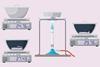
The composition and formula of water
Determine the formula of water through the reaction of copper(II) oxide with hydrogen and develop learners’ mole calculation skills with this demonstration and follow-up questions
No comments yet