











Polyesters are formed by the reaction of diol and dicarboxylic acid monomers
During the process, water molecules are eliminated and therefore the process is called condensation polymerisation.
-
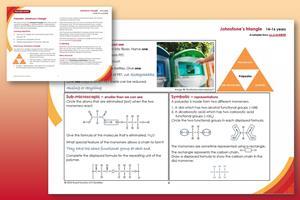
Download this
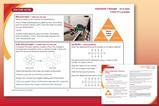
Use this student worksheet to help learners think about polyester.
View and download more Johnstone's triangle worksheets
Learning objectives
- Suggest ways to mitigate the environmental impact of the polyester PET.
- Describe how a polyester is formed.
- Interpret representations of monomer molecules.
How to use Johnstone’s triangle
Use Johnstone’s triangle to develop learners’ thinking about scientific concepts at three different conceptual levels:
- Macroscopic – what we can see. Think about the properties you can observe, measure and record.
- Sub-microscopic – smaller than we can see. Think about the particle or atomic level.
- Symbolic – representations. Think about how we represent chemical ideas including symbols and diagrams.
For learners to gain a deeper awareness of a topic, they need to understand it at all three levels.
When introducing a topic, don’t introduce all three levels of thinking at once. This will overload working memory. Instead complete the triangle over a series of lessons, beginning with the macroscopic level and then introducing other levels, in turn, once secure.
The levels are interrelated. For example, learners need visual representation of the sub-microscopic in order to develop mental models of the particle or atomic level.
Further reading
Read more about how to use Johnstone’s triangle in your teaching with these articles:
- Develop deeper understanding with models
- Improve students’ understanding with Johnstone’s triangle
- Practical ideas for using Johnstone’s triangle.
Norman Reid’s book The Johnstone triangle: the key to understanding chemistry provides a more in-depth overview, the first chapter is available to read online.
Scaffolding
Share the structure of the triangle with learners prior to use. Tell them why you are using it and how it will help them to develop their understanding. Use an ‘I try, we try, you try’ approach when introducing Johnstone’s triangle for the first time.
More resources
To further develop learner’s thinking in all areas of Johnstone’s triangle, try our Developing understanding worksheets. These include icons in the margin reterring to the conceptual level of thinking needed to answer the question.
Downloads
Polyester Johnstone's triangle student sheet
Handout | PDF, Size 0.25 mbPolyester Johnstone's triangle teacher notes
Handout | PDF, Size 0.29 mbPolyester Johnstone's triangle student sheet
Editable handout | Word, Size 0.6 mbPolyester Johnstone's triangle teacher notes
Editable handout | Word, Size 0.64 mb
- Deliver(1)
currently reading
 Resource
Polyester | Johnstone’s triangle | 14–16 years
Use Johnstone’s triangle to think about condensation polymerisation at three conceptual levels





No comments yet