










Help your learners deepen their understanding of the properties of compounds compared with their constituent elements
Developing understanding is a series of resources that encourages learners to connect their thinking at the macroscopic, sub-microscopic and symbolic levels.
-
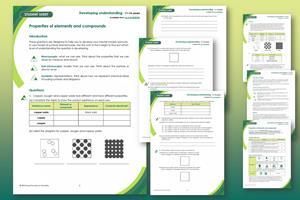
Download this
A ramped worksheet to help learners develop their mental models of the properties of elements and compounds. With icons to indicate the conceptual level/s of each question.
View and download more Developing understanding worksheets
Learning objectives
- Recognise that a compound is made up of a combination of atoms of different elements.
- Recognise when elements combine to form a compound no small pieces of the elements remain (and so an iron compound is not magnetic).
- Recognise that the colour of a compound is not a mixture of the colours of the elements with the types of atoms that make up the compound.
- Explain why a compound formed from two elements has different properties to the original elements which reacted.
How to use this resource
This resource aims to develop learners’ understanding of the combination of elements to form compounds. The questions encourage learners to think more deeply about why a compound does not have the same properties as its constituent elements. As a result, learners should develop more secure mental models to support their thinking about this topic.
- When to use? Use after initial teaching or discussion of this topic to develop ideas further. You can also use as a revision activity.
- Group size? Suitable for independent work either in class or at home. Or use the questions for group or class discussions.
- How long? 15–30 mins
Johnstone’s triangle
Johnstone’s triangle is a model of the three different conceptual levels in chemistry: macroscopic, symbolic and sub-microscopic. You can use Johnstone’s triangle to build a secure understanding of chemical ideas for your learners.
Introduce learners to Johnstone’s triangle with our Bioethanol Johnstone’s triangle worksheet which guides learners to think about the how the properties of the compound ethanol are different to those of the elements carbon, oxygen and hydrogen.
Further reading
Read more about how to use Johnstone’s triangle in your teaching with these articles:
- Develop deeper understanding with models
- Improve students’ understanding with Johnstone’s triangle
- Practical ideas for using Johnstone’s triangle
Norman Reid’s book The Johnstone triangle: the key to understanding chemistry provides a more in-depth overview, the first chapter is available to read online.
Johnstone’s triangle and this resource
The icons in the margin indicate which level of understanding each question is developing to help prompt learners in their thinking.
- Macroscopic: what we can see. Think about the properties that we can observe, measure and record.
- Sub-microscopic: smaller than we can see. Think about the particle or atomic level.
- Symbolic: representations. Think about how we represent chemical ideas including symbols and diagrams.
The levels are interrelated, for example, learners need visual representation of the sub-microscopic in order to develop mental models of the particle or atomic level. Our approach has been to apply icons to questions based on what the learners should be thinking about.
Questions may be marked with two or all three icons, indicating that learners will be thinking at more than one level. However, individual parts of the question may require learners to think about only one or two specific levels at a time.
Support
This worksheet is ramped so that the earlier questions are more accessible. The activity becomes more challenging in the later questions. You can give extra explanations for the more challenging questions. If completing this worksheet as an in-class activity, it is best to pause and check understanding at intervals, as often one question builds on the previous one.
It is useful for learners to observe macroscopic properties first-hand. You could use a teacher demonstration to show a change in properties. You can find a full method and resources for demonstrating the reaction between iron and sulfur in our Nuffield practical collection.
Answers and guidance
There are five multi-part questions in the student worksheet. The answers can be found in the teacher notes.
The first question develops learners’ understanding of the difference between elements and compounds in terms of their properties (macroscopic understanding) and their underlying structure of atoms or molecules (sub-microscopic understanding). Please note that the term ‘atoms’ is also used for copper oxide as learners are unlikely to have been introduced to the concept of ions at this stage. If this resource is being used as revision for older learners, then the term ions should be used.
The second question develops learners’ understanding of the combining of elements to form a compound with different properties (macroscopic understanding). It also helps to clarify understanding about atoms to make sure learners are aware that an atom is not a ’small piece of’ an element (sub-microscopic understanding).
The third question develops learners’ understanding of the independence of the colour of a compound from the colour of the elements made from its constituent atoms (macroscopic understanding). It is important that learners understand that an atom of an element does not have the colour of that element (sub-microscopic understanding). It is not possible to predict the colour of compound C because a substance does not get its colour from being made of individually coloured atoms from element A and B. This misconception may be inadvertently reinforced by the use of coloured particle diagrams.
The fourth and final question develops learners’ understanding of the connection between real-life observation of the reaction of two elements to form a compound (macroscopic understanding), the symbolic representation of this using element symbols and chemical formulae (symbolic understanding) and how the arrangement of atoms and molecules changes (sub-microscopic understanding).
If learners are not yet confident in understanding chemical formulas, the element symbols and formula could be deleted from the question before sharing.
Please note that full guidance on demonstrating the reaction between sodium and chlorine can be found in our Exhibition Chemistry video series. The pieces of sodium chloride formed are so small that they form a white smoke.
Downloads
Properties of elements and compounds developing understanding student sheet
Handout | PDF, Size 0.23 mbProperties of elements and compounds developing understanding teacher notes and answers
Handout | PDF, Size 0.32 mbProperties of elements and compounds developing understanding student sheet
Editable handout | Word, Size 0.55 mbProperties of elements and compounds developing understanding teacher notes and answers
Editable handout | Word, Size 0.73 mb
- Prepare(1)
- Deliver(4)
currently reading
 Resource
Properties of elements and compounds | Developing understanding | 11–14 years
Encourage learners to think more deeply about why a compound does not have the same properties as its constituent elements
 Resource
Bioethanol | Johnstone’s triangle | 11–14 years
Connect understanding about the macroscopic properties of elements and compounds at a sub-microscopic and symbolic level
 Resource
Properties of elements and compounds | Structure strip | 11–14 years
Develop writing skills and recall with these scaffolded prompts about the physical properties of elements and compounds
 Class experiment
Iron and sulfur reaction
Illustrate elements, mixtures and compounds with this demonstration and class practical exploring the exothermic reaction of iron and sulfur
- Literacy(2)
 Resource
Elements, compounds and mixtures | Key terms support | 11–14
Language support pack for elements, compounds and mixtures, with key terms list, accessible glossary, Frayer models and unscrambling definitions
 Resource
Elements, compounds and mixtures | Reading comprehension | 11–14 years
Practise reading comprehension skills with a science research article about the benefits of carbon capture from the oceans
- Enrich(3)
 Resource
The reaction between zinc powder and sulfur
A spectacular practical demonstration to show the differences between elements, mixtures and compounds
 Games and puzzles
Compounds ending in -ate | Gridlocks puzzle | 11–14 years
Reinforce your students’ understanding of compounds ending in -ate using these sudoku-style puzzles, with printable worksheets and answers
 Games and puzzles
Naming binary compounds | Gridlocks puzzle | 11–14 years
Reinforce your students’ understanding of naming binary compounds using these sudoku-style puzzles, with printable worksheets and answers




No comments yet