








This activity enables learners to check and practise calculations in chemistry
Use this resource to consolidate and to check on learning. As different types of calculation are included, you can revisit it over time.
-
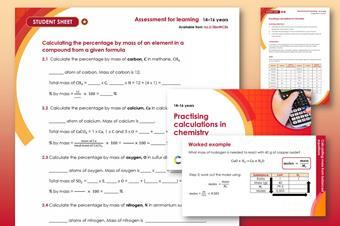
Download this
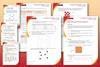
Everything you need to teach this lesson: slides, student worksheets at two levels (scaffolded and unscaffolded) and teacher guidance, including worked answers.
View and download more Lesson plans
Learning objectives
- Calculate the relative formula mass of a compound given its formula and appropriate relative atomic masses.
- Calculate the percentage by mass of an element from a given formula.
- Calculate masses of reactants and products from balanced equations using the mole equation.
Teaching sequence
Introduction
Introduce learners to quantitative chemistry with this lesson plan, focusing on the use of mathematics to understand and predict chemical reactions. While learners may already be familiar with identifying reactants and products, this topic dvelops their ability to determine how much of each substance is involved in a reaction.
Learners will calculate the relative formula mass (Mr) of compounds using relative atomic masses from the periodic table, and detmine the percentage by mass of an element with a compound in order to understand chemical composition. They will then apply this knowledge using balanced equations and the mole equation to calculate the masses of reactants and prducts in chemical reactions.
By developing these skills, learners will build their confidence in apply mathematical techniques in chemistry and gain a clearer understanding of how quantitative methods make chemistry precise, reliable and relevant to real-world applications.
Activies
The teaching sequence is the same for each learning objective:
- Give a brief introduction to the topic.
- Provide the workshed example. You can give this to learners in full afterwards, so they have an example, or ask them to copy this down as you are modelling it.
- Get learners to complete the two checkpoint questions in pairs on mini whiteboards.
- After each question, ask for a show of boards before going through the questions with cold-call questioning to the whole class.
- Ask learners to work through the final four calculations independently.
Commentary
Use a checkpoint quiz to remove some of the pressure of moving straight onto independent work, to allow you to determine who needs more support during the independent task, and to determine whether to use the scaffolded or unscaffolded sheet with your learners.
Equipment
For each learner:
- Calculator
- Data table from student sheet (or periodic table)
- Mini whiteboard for checkpoint quizzes
Scaffolding
- Two versions of the worksheet are available: scaffolded (one star) and unscaffolded (two stars). The different sheets are indicated by the number of stars in the header.
- The scaffolded worksheet provides support to learners through backwards fading for calculating relative formula mass and percentage by mass calculations. This is where examples are partially completed and the amount of completion is lowered through each example.
- For calculations of masses of reactants and products from balanced equations using the moles equation, step by step instructions are given.
Answers
Answers can be found in the teacher notes, with full working shown in the lesson slides for self-assessment.
Downloads
Practising calculations in chemistry AfL lesson slides
Presentation | PDF, Size 1.11 mbPractising calculations in chemistry AfL student sheet
Handout | PDF, Size 0.2 mbPractising calculations in chemistry AfL scaffolded student sheet
Handout | PDF, Size 0.25 mbPractising calculations in chemistry AfL teacher notes and answers
Handout | PDF, Size 0.45 mbPractising calculations in chemistry AfL lesson slides
Presentation | PowerPoint, Size 2.88 mbPractising calculations in chemistry AfL student sheet
Editable handout | Word, Size 0.44 mbPractising calculations in chemistry AfL scaffolded student sheet
Editable handout | Word, Size 0.45 mbPractising calculations in chemistry AfL teacher notes and answers
Editable handout | Word, Size 0.56 mb
Additional information
This lesson plan was originally part of the Assessment for Learning website, published in 2008. The resource was updated in 2026, with the addition of lesson slides and scaffolding by Emma Bickerstaffe.
Assessment for Learning is an effective way of actively involving students in their learning. Each session plan comes with suggestions about how to organise activities and worksheets that may be used with students.
- Prepare(7)
 Ideas
IdeasMake worked examples count in quantitative chemistry
Four teacher-tested approaches to encourage self-explanation and build learners’ confidence, engagement and understanding
 Opinion
Why I hate formula triangles
Read why one teacher asks if it’s time to change the formula when teaching calculation questions
 News
NewsBoost maths skills to improve chemistry learning
Use these evidence-based tips to help your learners get ahead with chemical calculations
 CPD article
How to teach quantitative chemistry at post-16
Use these tips to help your students successfully calculate reacting masses and limiting agents


 Course
Quantitative chemistry | Self-led course
Build confidence in your quantitative chemistry knowledge and discover effective topic-specific teaching strategies
- Deliver(1)
currently reading
 Lesson plan
Practising calculations in chemistry | 14–16 years
Help your learners check or revise key calculations in chemistry using this lesson plan with scaffolded activities and worked examples
- Literacy(1)
 Resource
Quantitative chemistry | Key terms support | 14–16
Language support pack for quantitative chemistry, with key terms list, accessible glossary, Frayer models and unscrambling definitions
- Assess(4)
 Quiz
QuizCalculations based on equations | Bridging the knowledge gap | 14–16 years
Support your students with the transition to post-16 study with this quiz on calculations based on equations
 Quiz
QuizCalculations based on formulas | Bridging the knowledge gap | 14–16 years
Support your students with the transition to post-16 study with this quiz on calculations based on formulas
 Resource
Quantitative chemistry | Review my learning | 14–16 years
A set of differentiated worksheets with answers to identify learning gaps and misconceptions on the topic of quantitative chemistry
 Resource
Basic mathematical competencies starters | 14–18
Use these Starters for ten to gauge your student’s grasp of basic mathematical competencies including rearranging equations, significant figures and unit conversions.
- Enrich(3)
 Games and puzzles
Multiples of units | Gridlocks puzzle | 14–16 years
Reinforce your students’ understanding of multiples of units using these sudoku-style puzzles, with printable worksheets and answers
 Games and puzzles
Units of volume | Gridlocks puzzle | 14–16 years
Reinforce your students’ understanding of units of volume using these sudoku-style puzzles, with printable worksheets and answers
 Resource
Quantitative chemistry starters | 16–18
Put your students’ quantitative chemistry skills to the test with Starter for ten activities around topics such as the mole, the ideal gas equation, percentage yield and atom economy.
No comments yet