



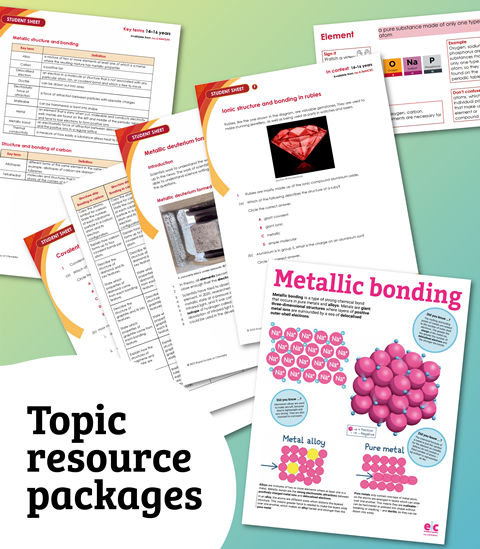








Use scaffolded prompts to support learners to write about reactants and products
Structure strips can be used to promote independent writing. Learners write about chemical reactions using key terms, identify the difference between chemical and physical changes and explain types of chemical reactions.
-
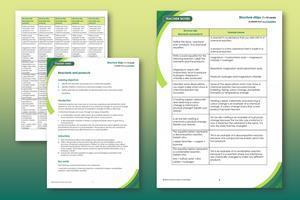
Download this
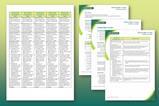
Stick these structure strips into the margin of a page to support learners to find or retrieve information and write independently about reactants and products. The resource includes editable writing prompts, an extension question and example answers.
View and download more Structure strips
Learning objectives
- Identify the reactants and products in a chemical equation.
- Identify whether a chemical or physical change is occurring.
- Define reactions as combination or decomposition from word and symbol equations.
Introduction
Chemical reactions are when one or more new substances are formed from other substances. This can also be referred to as a chemical change. In a physical change no new substances are formed, for example a change of state or dissolving.
A chemical change can occur through two types of reaction.
- A combination reaction (also known as a synthesis reaction) is where two or more reactants chemically change into one or more products
- A decomposition reaction is where a compound breaks down to give two or more products.
In chemical reactions, the reactants are the chemicals that react together and are found before the arrow in a word equation. The products are the new substances produced and are found after the arrow in a word equation.
This resource is part of our support for literacy in science teaching, designed to embed literacy into your curriculum and develop learners’ skills in reading, writing and talking about science and their understanding of scientific language.
How to use structure strips
Structure strips are a type of scaffolding you can use to support learners to retrieve information independently. Use them to take an overview at the start of the topic, to activate prior knowledge, or to summarise learning at the end of a teaching topic. For more ideas on how to use structure strips with your learners, visit 5 ways to use structure strips effectively.
Structure strips have sections containing prompts, sized to suggest the amount that learners must write. Learners glue the strips into the margin of an exercise book and write their answers next to the sections, in full sentences. When learners have finished using the structure strip, they should have an A4 page set of notes and examples.
The strips are printed five to a page and will need to be trimmed to size. Find them on the second page of the student sheet.
Scaffolding
- Encourage learners to use the suggested key words and phrases in their answers.
- To further support learners, include additional prompts in the structure strip. If learners are struggling to engage with the task, supply them with sentence starters created from the model answers.
- As learners grow in confidence, ask them to attempt the extension question first and then use the structure strip to improve or self-assess their answer.
Key words
Reactants, products, chemical reaction, chemical change, combination reaction, decomposition reaction.
Metacognition
This resource supports learners to develop their metacognitive skills in three key areas.
- Planning: the strips provide scaffolding to plan the written response. Learners will decide where to gather information from (textbooks, own notes, revision websites). Ask learners: is the source of information you are using reliable?
- Monitoring: learners are prompted by the questions in the structure strip and can check their own answer against the prompts. Ask learners: have you covered all of the prompts in the space provided? Do you need to change anything to complete the task?
- Evaluation: learners can self-assess or ask a peer to check their work against the answers. Ask learners: did you achieve what you meant to achieve? What might you do differently another time?
Answers
Suggested answers for the structure strip activity are given in the downloadable teacher notes.
Answers to extension question
Due to the nature of this task, answers will vary. Some of the key points learners can include in their summary are:
- the acid contains hydrogen, sulfur and oxygen
- magnesium contains only magnesium atoms
- magnesium atoms react with the sulfuric acid
- hydrogen gas is produced
- hydrogen contains only hydrogen atoms
- magnesium sulfate is formed
- magnesium sulfate contains magnesium, sulfur and oxygen
- bubbles or fizzing are observed
- a chemical change has occurred.
Learners can use these bullet points to self-assess or improve their answer. You can also supply them to less confident learners who need additional guidance.
Downloads
Reactants and products 11-14 structure strip student sheet
Handout | PDF, Size 0.2 mbReactants and products 11-14 structure strip teacher notes
Handout | PDF, Size 0.17 mbReactants and products 11-14 structure strip student sheet
Editable handout | Word, Size 0.44 mbReactants and products 11-14 structure strip teacher notes
Editable handout | Word, Size 0.44 mb
- Prepare(1)
 Course
Quantitative chemistry | Self-led course
Build confidence in your quantitative chemistry knowledge and discover effective topic-specific teaching strategies
- Deliver(5)
 Resource
Reactant and product substances | Developing understanding | 11–14
Use these worksheets to secure and deepen your learners’ understanding of reactants and products in chemical changes
 Resource
Iron and sulfur reaction | Johnstone’s triangle | 11–14 years
Develop understanding of reactants and products at different conceptual levels using an iron and sulfur reaction as an example
currently reading
 Resource
Reactants and products | Structure strip | 11–14 years
Use scaffolded prompts to support learners to write about reactants and products
 Class experiment
Heating chocolate and egg
Introduce learners to physical and chemical changes and the safe use of Bunsen burners with this simple practical experiment
 Class experiment
Heating copper in air
Explore the reaction of copper with oxygen to produce copper oxide by heating a copper envelope in this practical
- Literacy(1)
 Resource
Introducing chemical change | Key terms support | 11–14
Language support pack for Introducing chemical change, with key terms list, accessible glossary, Frayer models and unscrambling definitions
- Enrich(2)
 Resource
Popping good chemistry
Investigate simple chemical reactions, irreversible changes and gases around us with this exciting experiment
 Job profile
Associate principal scientist, food
Robert builds computer models to predict how different food chemicals will enhance the taste and texture of chocolate, biscuits and other snacks


No comments yet