








Investigate the science behind batteries in the context of tackling the climate crisis, with two coin battery experiments
To address our growing climate crisis, we need to move away from fossil fuels and embrace electrification. A crucial part of this journey is bigger and better batteries.
These investigations from our global battery experiment give you the opportunity to explore the science behind batteries – and why they are such an important part of our bright energy future.
Choose from two investigations, to find the one that best suits you. They have different levels of complexity, and require different equipment, but both offer the opportunity to make a coin battery. In the process, your learners will understand more about batteries and how they work, as well as getting the chance to practise scientific enquiry skills.
You can find all of the resources you need to run a class investigation below. This global experiment is now closed and data cannot be posted to the website.
Introduction
Investigation one: build a battery
Make your own coin battery and use it to light an LED. How many cells does it take?
Key information
- Target age range: 9–14 years
- Uses only everyday materials
- Can be done anywhere
Learning objectives
- Understand that batteries are made up of layers of different materials.
- Understand that batteries store energy.
Enquiry skills
- Accurately follow instructions and carry out a practical investigation.
- Make careful observations throughout and, where relevant, take and record accurate measurements.
- Ask questions based on observations and results.
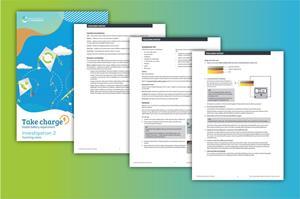
Investigation two: compare coin batteries made from different materials
Explore battery materials further. Which battery performs best?
Key information
- Target age range: 11–14 years
- Simple to set up and do, involves using a voltmeter and testing different electrolytes
- Should be done in a science laboratory
Learning objectives
- Understand that batteries are made up of cells, comprised of layers of different materials.
- Understand that changing the different layers of a cell can affect its performance.
Enquiry skills
This investigation covers many different scientific enquiry skills. You may want to choose just one or two to focus on.
Scientific attitudes
- Pay attention to objectivity as well as accuracy, precision, repeatability and reproducibility.
Experimental skills and investigations
- Make and record measurements using a range of methods.
- Evaluate the reliability of the methods and suggest possible improvements.
Analysis and evaluation
- Present observations and data using appropriate methods including graphs.
- Interpret observations and data to draw conclusions.
- Identify further questions arising from results.
Link to literacy
Use the battery power worksheet (pdf) to find out more about battery research and development from the past to the present day.
More resources
- Try another of our past global experiments, including:
- Mission Space, exploring materials and their properties with a fantastic space setting
- Water and hydrogels, investigating the water absorption of nappies to help build practical science skills
- You can find more resources, practicals and activities for primary learners at Steps into Science.
Downloads
Investigation 1: Teaching notes
Experiment | PDF, Size 2.38 mbInvestigation 1: Learner slides
Presentation | PDF, Size 0.76 mbInvestigation 1: Learner slides
Presentation | PowerPoint, Size 0.69 mbInvestigation 2: Teaching notes
Experiment | PDF, Size 2.49 mbInvestigation 2: Learner slides
Presentation | PDF, Size 0.76 mbInvestigation 2: Learner slides
Presentation | PowerPoint, Size 0.72 mbBattery power worksheet
Handout | PDF, Size 0.87 mbBattery power worksheet
Editable handout | Word, Size 0.76 mb





No comments yet