







All Johnstone's model articles – Page 3
-
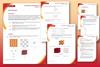 Resource
Ionic bonding | Developing understanding | 14–16 years
Develop learners’ understanding of ionic lattices through comparing 2D and 3D representations
-
 Resource
Bondio metelig | Datblygu dealltwriaeth | 14–16 oed
Datblygu dealltwriaeth is-ficrosgopig dysgwyr drwy ddehongli amrywiaeth o fodelau a ddefnyddir i gynrychioli adeiledd metelig ac ïonau metel
-
 Resource
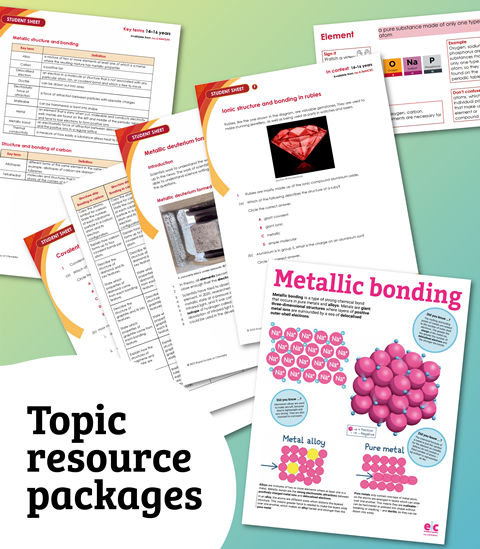
Metallic bonding | Developing understanding | 14–16 years
Develop learners’ sub-microscopic understanding by interpreting a range of models used to represent metallic structure and metal ions
-
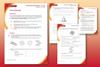 Resource
Carbon allotropes | Developing understanding | 14–16 years
Encourage learners to think about how different structures of carbon are represented and what this means at the sub-microscopic level
-
 Feature
Improve students’ understanding with Johnstone’s triangle
Make abstract ideas concrete by linking macroscopic, submicroscopic and symbolic representations
-
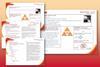 Resource
Bondio ïonig mewn halen bwrdd | Taflen waith triongl Johnstone | 14–16 oed
Defnyddiwch y taflenni gwaith hyn i ddatblygu dealltwriaeth y dysgwyr o adeiledd a bondio ïonig, gan gynnwys symbolau a diagramau a sut mae priodweddau macrosgopig yn gysylltiedig â bondio
-
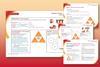 Resource
Metallic bonding in copper | Johnstone’s triangle worksheets | 14–16 years
Use these worksheets to develop learners’ understanding of metallic bonding, including symbols and diagrams and how macroscopic properties relate to the type of bonding
-
 Resource
Bondio metelig mewn copr | Taflen waith triongl Johnstone | 14–16 oed
Defnyddiwch y taflenni gwaith hyn i ddatblygu dealltwriaeth y dysgwyr o fondio metelig, gan gynnwys symbolau a diagramau a sut mae priodweddau macrosgopig yn berthnasol i’r math o fondio
-
 Resource
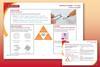
Different allotropes of carbon | Johnstone’s triangle worksheets | 14–16 years
Use these worksheets to get learners thinking about carbon allotropes at different levels, from sub-microscopic structures to macroscopic properties
-
 Resource
Gwahanol alotropau carbon | Taflenni gwaith triongl Johnstone | 14–16 oed
Defnyddiwch y taflenni gwaith hyn i gael dysgwyr i feddwl am alotropau carbon ar wahanol lefelau, o adeileddau is-ficrosgopig i briodweddau macrosgopig
-
 Resource
Bondio cofalent mewn dŵr | Taflen waith triongl Johnstone | 14–16 oed
Defnyddiwch y taflenni gwaith hyn i ddatblygu dealltwriaeth y dysgwyr o fondio cofalent, gan gynnwys modelau symbolaidd a sut mae priodweddau macrosgopig yn berthnasol i’r math o fondio
-
 Resource
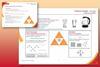
Covalent bonding in water | Johnstone’s triangle worksheets | 14–16 years
Use these worksheets to develop learners’ understanding of covalent bonding, including symbolic models and how macroscopic properties relate to the type of bonding
-
 Resource
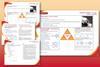
Ionic bonding in table salt | Johnstone’s triangle worksheets | 14–16 years
Use these worksheets to develop learners’ understanding of ionic structures and bonding, including symbols and diagrams and how macroscopic properties are related to bonding
-

-
 News
NewsSupport students to make sense of models
How your subject knowledge and teaching knowledge combine to transform students’ understanding
-
 Ideas
IdeasEscape the classroom: and try microscale chemistry
Escape room puzzles based on simple microscale reactions for students
-
 News
NewsUsing student-generated animations to assess conceptions
Harness the power of PowerPoint when teaching molecular motion to identify misconceptions and help students better understand the sub-microscopic world
-
 News
NewsResearchers find metacognition aids sub-microscopic understanding
Get research-based tips for improving your students’ submicroscopic understanding of particle models
-
 Ideas
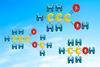
Ideas4 ways to boost students’ understanding of organic chemistry
Alcohols, carboxylic acids and esters don’t have to be difficult – try these practical tips in your classroom
-

- Previous Page
- Page1
- Page2
- Page3
- Page4
- Next Page