









Try this class practical or demonstration to simulate the industrial fractional distillation of crude oil in the laboratory
-
Download this
Download the scaffolded and unscaffolded student worksheets and teacher guidance (including answers) as MS Word and pdf, and the presentation slides as MS PowerPoint and pdf.
Discover more resources from the Nuffield practical collection
Crude oil is a mixture of chemical compounds, mostly hydrocarbons, which are molecules consisting of carbon and hydrogen only. It is an incredibly useful resource. The molecules within the mixture have different physical and chemical properties which can then be used in a wide variety of ways.To separate the mixture into its separate parts (or fractions), a process known as fractional distillation must be used.
In this experiment, learners will use a crude oil substitute to model the fractional distillation process. After collecting four fractions at different temperatures, they will test each one for viscosity, colour, smell and flammability.
Scaffolding
Two versions of the worksheet are included: a scaffolded (✪) and an unscaffolded (✪✪) version. Questions in the scaffolded worksheet provide more prompts about the correct use of keywords and how to structure answers, whereas the unscaffolded worksheet provides less guidance.
Integrated practical instructions are included in the PowerPoint for the practical activity.
Technician notes
Read our standard health and safety guidance and carry out a risk assessment before running any live practical.
Equipment
- Safety glasses
- Bunsen burner
- Heat resistant mat
- Side-arm hard glass test tube
- Bent delivery tube and rubber connection tubing
- Small sample tubes, at least 20 mm x 5 mm (or small test tubes), x 4
- Thermometer, 0–360°C, with cork to fit side-arm test tube
- Teat pipette
- Beaker, 100 cm3
- Hard glass (borosilicate) watch glass
- Mineral or ceramic fibre
- Wooden splints
Chemicals (per group)
- Crude oil substitute (HIGHLY FLAMMABLE and HARMFUL), about 2 cm3
Preparing crude oil substitute
To prepare the crude oil substitute, mix together the following chemicals and a squeeze of black oil paint, then pour the solution into a labelled bottle.
Chemicals for crude oil substitute, 100cm3
- Liquid (medicinal) paraffin, 55 cm3
- Paraffin oil (kerosene), 20 cm3
- White spirit, 11 cm3
- Petroleum ether 100–120°C, 4 cm3
- Petroleum ether 80–100°C, 4 cm3
- Petroleum ether 60–80°C, 6 cm3
For more information see CLEAPSS Recipe Book RB032.
Safety and hazards
- Wear safety glasses throughout.
- Crude oil substitute (HIGHLY FLAMMABLE and HARMFUL). Refer to CLEAPSS Hazcards HC045a and HC045b, plus CLEAPSS Recipe Book RB032. Real crude oil contains more than 0.1% benzene, which is carcinogenic, which makes it unsuitable for use in schools.
- When preparing the crude oil substitute, avoid skin contact and ensure there are no naked flames or ignition sources.
- Side-arm boiling tubes produce more consistent results than boiling tubes fitted with bungs with two holes, one for a thermometer and one for a delivery tube.
- It is important to try the experiment beforehand. It may be necessary to add an additional low boiling point fraction to the ‘crude oil’ mixture – eg cyclohexane – to obtain something below 70°C.
- This is quite a messy experiment. If it is done regularly, it is probably best to keep sets of apparatus – apart from the thermometer and watch glasses – dedicated to the experiment. This is because it is difficult to get clean, and it still works if oil residues are present.
Method
- Place about a 2 cm3 depth of ceramic fibre in the bottom of the side-arm test tube. Add about 2 cm3 of crude oil alternative to this, using the teat pipette.
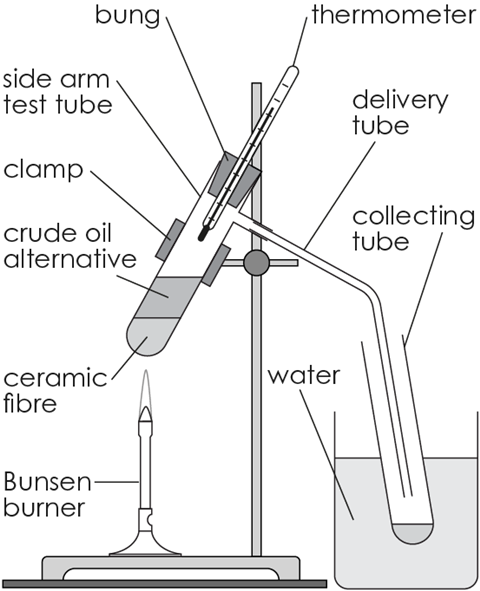
- Set up the apparatus as shown in the diagram. For the first fraction only, make sure that you place a beaker of cold water around the collecting tube. The bulb of the thermometer should be level with, or just below the side-arm. Heat the bottom of the side-arm test tube gently, with the lowest Bunsen flame. Watch the thermometer.
- When the temperature reaches 100°C, replace the collection tube with another empty one. The beaker of water is no longer necessary.
- Collect three further fractions at the following temperatures:
- Room temperature to 100°C
- 100–150°C
- 150–200°C
- 200–250°C
- A black residue remains in the side-arm test tube. Test the four fractions for viscosity (how easily do they pour?), colour, smell and flammability, and record what you observe in your results table.
- To test the smell, gently waft the smell towards you with your hand.
- To test for flammability, pour the fraction onto a hard glass watch glass and light the fraction with a burning splint.
- Keep one set of fractions and combine them to show that they form a mixture very like the original sample.
Teaching notes
During the practical activity, learners will need support in order to set up the equipment safely. It is important to guide learners throughout the practical and to promote positive group work, as there are often several things to consider at any one time. It may be useful to demonstrate the practical to learners before they carry it out themselves. You could also consider making this a slow practical – one in which you and the learners go through the steps together. During the demonstration and whilst learners are working, ask them questions about their observations and use their answers to develop their understanding of why these occur.
Your questions could include any or all of the following discussion points:
- What visible changes can you see in the test tube as we heat the crude oil substitute, and where do you notice the gas turning back into a liquid?
- Do you think the first fraction you collect will be thin and runny or thick and viscous? How easily do you think it will catch fire?
- What is happening to the energy and movement of the hydrocarbon molecules as we heat the mixture?
- Right now, where in the equipment are the molecules existing as a gas, and where are they condensing?
- When these hydrocarbons boil, are we breaking covalent bonds or intermolecular forces?
- Why do shorter chain hydrocarbon molecules boil at lower temperatures than longer chain ones?
Answers
Answers to the questions in both the student sheets and on the lesson slides can be found in the teacher notes.
Downloads
Fractional distillation of crude oil scaffolded student sheet
Handout | PDF, Size 0.23 mbFractional distillation of crude oil unscaffolded student sheet
Handout | PDF, Size 0.21 mbFractional distillation of crude oil teacher notes
Handout | PDF, Size 0.24 mbFractional distillation of crude oil slides
Presentation | PDF, Size 1.03 mbFractional distillation of crude oil scaffolded student sheet
Editable handout | Word, Size 0.5 mbFractional distillation of crude oil unscaffolded student sheet
Editable handout | Word, Size 0.49 mbFractional distillation of crude oil teacher notes
Editable handout | Word, Size 0.5 mbFractional distillation of crude oil slides
Presentation | PowerPoint, Size 19.06 mb
Additional information
This is a resource from the Practical Chemistry project, developed by the Nuffield Foundation and the Royal Society of Chemistry.
Practical Chemistry activities accompany Practical Physics and Practical Biology.
The experiment is also part of the Royal Society of Chemistry’s Continuing Professional Development course: Chemistry for non-specialists.
The supporting resources were updated in 2026 by Harry Lord.
© Nuffield Foundation and the Royal Society of Chemistry
- Prepare(1)
 Ideas
How to use models to boost understanding
Help students make sense of the chemistry they can’t see with memorable representations, including polymers and fractional distillation
- Deliver(3)
currently reading
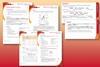 Class experiment
The fractional distillation of crude oil
Try this class practical or demonstration to simulate the industrial fractional distillation of crude oil. Includes kit list and safety instructions.
 Resource
Fractional distillation | Developing understanding | 14–16 years
Secure your learners’ understanding of fractional distillation
 Poster
Everything you need to teach fractional distillation
With this poster and classroom activity, your 14–16 students will soon be experts
- Literacy(2)
 Resource
Crude oil | Reading comprehension | 14–16
Practise reading comprehension skills with a science research article about turning waste into fuel
 Resource
Hydrocarbons and crude oil | Key terms support | 14–16
Language support pack for introductory organic chemistry topics, including fractional distillation, properties of hydrocarbons, cracking and addition polymers
- Assess(2)
 Resource
Fractional distillation and hydrocarbons | Review my learning worksheets | 14–16 years
Identify learning gaps and misconceptions with this set of worksheets offering three levels of support
 Resource
Crude oil – organic chemistry worksheets | 14–16
Student worksheets at foundation and higher level. Apply knowledge in context and assess learning with questions exploring the topic of crude oil, including fractional distillation, fuels and other products.
- Enrich(3)
 News
New membranes could slash fractional distillation emissions
Discover how membrane technology could cut the energy and emissions associated with crude oil refining
 News
Reversing our reliance on fractional distillation of crude oil
Scientists use semi-permeable polymer membrane and reverse osmosis to separate mixtures of hydrocarbons and save energy
 Job profile
Laboratory scientist apprentice
Kasia makes lubricants to improve the performance of metal-cutting tools while also studying towards a degree in chemical science


No comments yet